Cobalt glass capsules on a precision metal track pass through transparent checkpoints, with a separate holding bay for exceptions.

How to Build Reliable Agentic Automation into Your Product

Infinity Technologies
AI Product Modernization Playbook
October 2026
No items found.

The table of content

AI Product Modernization Playbook · Article 06 of 12

A supplier sends a missing document. Someone reads it, finds the onboarding case, checks the requirements, updates the record and asks for a correction. The same sequence repeats across hundreds of cases, with enough variation to defeat a rigid script. This is a useful place to consider agentic automation.

The product opportunity is a completed business process with less manual effort and a dependable path for exceptions. Achieving it requires more than a model that can call tools. The system needs durable state, limited authority, meaningful approvals and independent evidence that the intended changes actually happened.

This chapter of Infinity Technologies' AI Product Modernization Playbook explains how to build that operating model into a product, extend it to customer-built automations and expose controlled operations to external agents. Examples and pilot targets are illustrative; they are not reported Infinity client outcomes.

On this page

1. Choose a process with a verifiable end state

Start with a process that already has an owner, measurable volume and a recognizable definition of done. Supplier onboarding, service-case preparation, document follow-up and routine provisioning are candidates when their boundaries can be made explicit. Map the systems, handoffs, exceptions and consequences before choosing a model.

For an onboarding example, “the agent processed the email” is an activity. A useful outcome is that the required documents were verified, the case was updated correctly and any unresolved requirement reached the responsible reviewer. Track those outcomes separately from cases that merely received a reply.

Choose the mechanism for each step

Use ordinary code when the path and rules are known. Use a predictive model when the difficult part is estimating an outcome. Use a language or reasoning model where unstructured information or case-dependent choices add value. Most product processes can use a fixed workflow around a small number of judgement steps.

Record today's handling cost, completion time, rework and exception rate. Define what the automation may change and what must remain a proposal. A narrow process with a reliable completion test gives the team a better basis for investment than a broad promise to create a digital worker.

2. Grant authority per action, not per agent

An agent may be allowed to read a case, update an internal tag and prepare a supplier message while still needing approval to send it. Store those distinctions in policy. A single “autonomous” setting hides differences in data access, external impact and reversibility.

ActionInitial operating modeBoundary to enforce
Read and assemble evidenceAutomatic within the assigned caseTenant, record, purpose and data-access scope
Update internal case fieldsPreview and approve; later consider limited automatic updatesAllowed fields, expected record version and recovery procedure
Send an approved templateReview destination and populated valuesRecipient scope, message frequency and permitted commitments
Make a financial or access changeExplicit approval under a defined policyAmount or role limits, independent checks and authoritative confirmation
Delete data or make an irreversible changeKeep outside the initial unattended scopeSeparate authorization and recovery planning

Swipe horizontally to read the full table.

This is an illustrative starting policy, not a universal permission model. Promotions need evidence for the specific action and population. A high acceptance rate helps identify candidates, but does not establish that reviewers noticed errors or that recovery will work.

Give each deployed agent a scoped workload identity. Keep development and production credentials separate. For delegated work, retain both the requesting user's identity and the acting service identity, and enforce the applicable user and service limits. A background process needs an explicitly approved role rather than borrowing a departing employee's account.

3. Put judgement inside a durable workflow

The workflow owns the process state, waiting, deadlines and recovery. It calls the model only where judgement is needed. The model returns a proposal as structured data; authorized application services decide whether and how to execute it. This separation makes the process inspectable when a model call, worker or downstream service fails.
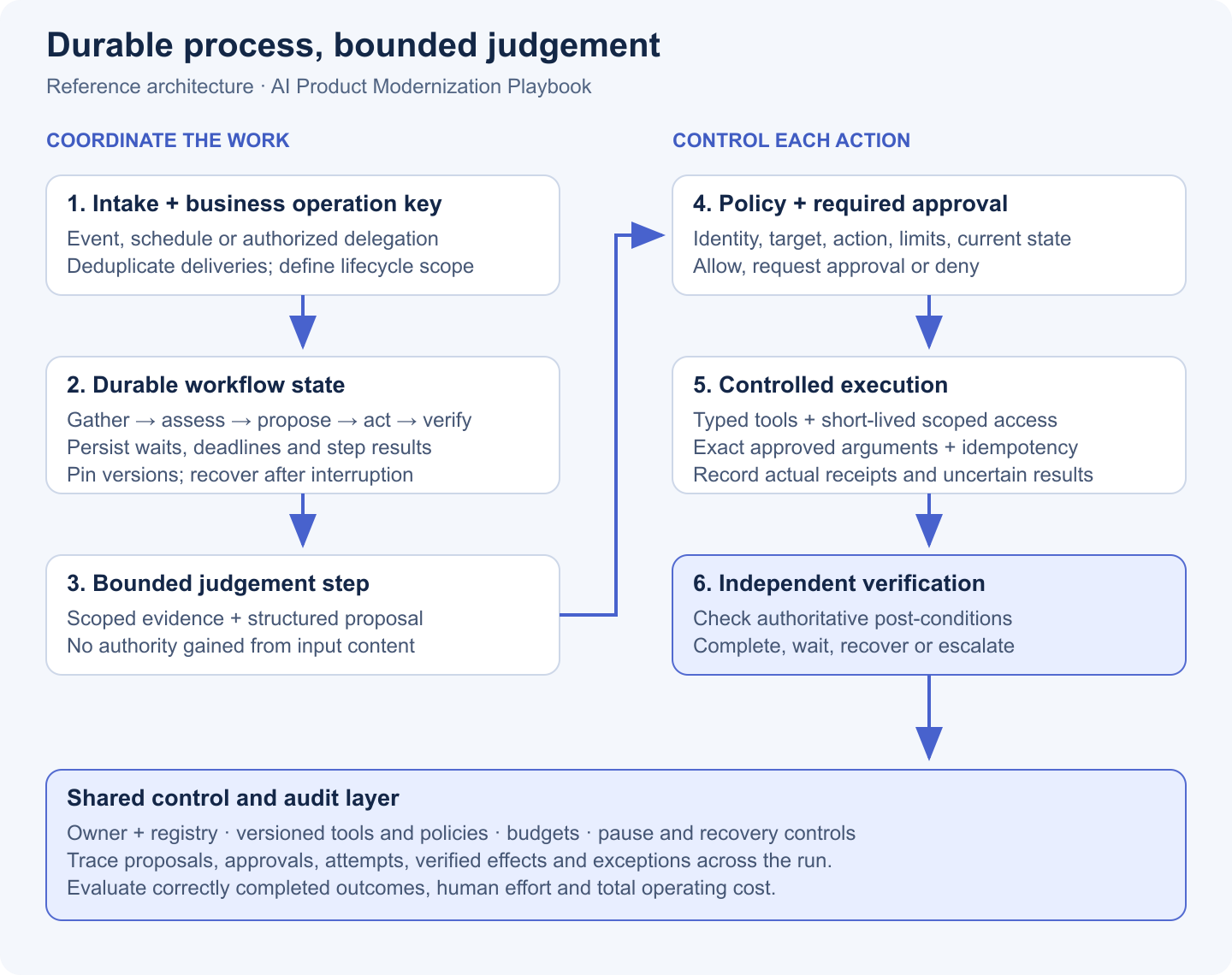
Agentic automation architecture: durable intake and workflow state coordinate bounded judgement, policy checks, approval, execution and independent verification, with a shared audit and control layer.
Figure 1. The workflow coordinates the process. Model proposals pass through application policy and, where required, human approval before execution. Verification uses the systems of record. On mobile, swipe the diagram or open it at full size.

Separate a business event from an execution attempt

An intake key should identify the intended business operation, including its tenant and relevant event or lifecycle version. Duplicate deliveries of the same event should converge on one operation. Keying only on a supplier or invoice forever would also suppress legitimate later work, so define the deduplication scope and retention window deliberately.

Persist state at meaningful transitions: evidence gathered, proposal prepared, approval pending, action attempted, result verified or exception assigned. Record model responses as step results where appropriate. Replaying workflow history should not casually regenerate a proposal that a person already approved.

A model call can fail, be retried or return a different answer on another attempt. Do not assume it provides at-most-once execution. Pin process, prompt, tool and model configuration versions to the run, and use an explicit migration policy for long-running cases when a release or urgent policy change occurs.

4. Design tool contracts and run records together

A tool should represent a narrow product operation with typed inputs and explicit effects. “Update these permitted case fields” is easier to constrain than a general database or shell command. Include the target, expected version, request identifier and structured success or failure result. Enforce access, value limits and allowed state transitions on the server.

Keep four linked records: the registered agent version and owner; the run and its business purpose; each proposed or attempted action; and any approval. An action record should preserve the approved argument digest, relevant source versions, policy decision, execution receipt and verification result.

Make the trail useful without copying everything

Store references and minimal structured evidence where possible. Raw documents, prompts and personal data require tighter access and retention than operational counters. Protect audit records from casual modification and record failed attempts as well as successful actions. A run that stops before acting is still important evidence.

Define the allowed outcomes precisely. “Request accepted,” “operation completed” and “business outcome confirmed” may be different states. An asynchronous API can acknowledge a job while the underlying update is still pending. Expose that distinction to the workflow and to the person operating it.

5. Handle uncertain outcomes before retrying

A timeout says that the caller did not receive a usable response. It does not prove that the action failed. If a case update or outgoing message succeeded just before the connection broke, repeating it as a new operation can create a duplicate.

Use a stable idempotency key for each intended write, reuse it across retries and reject a retry that changes its meaning. The downstream service must honor that contract; adding a key to a local log is insufficient. Amazon's Builders' Library guidance explains how caller-provided identifiers distinguish retries from genuinely new intent.

Recovery decision flow: after an action attempt, query authoritative state; confirmed success proceeds to verification, confirmed failure allows a controlled retry, and an unknown result pauses for reconciliation or escalation.
Figure 2. An unknown outcome is a state to reconcile. It must not silently become either success or permission to repeat an unsafe write. On mobile, swipe the diagram or open it at full size.

Distinguish retry, reconciliation and compensation

Retry addresses a known transient failure under a safe contract. Reconciliation compares the action record with authoritative external state. Compensation addresses effects that occurred but now need a business correction. When the target offers neither idempotency nor reliable status lookup, some ambiguous cases require a person; a local lock cannot remove uncertainty after a remote commit.

For multi-system work, define compensating actions and record their progress. They may fail too. A cancellation or correction may not restore the original world, and the right order depends on business dependencies and concurrent changes. Microsoft's compensating transaction pattern explicitly discusses these limits. Never treat a sent message, disclosed information or consumed resource as fully reversible.

6. Make approvals specific and exceptions actionable

An approval card should show the action, target, proposed changes, supporting evidence, expected impact and recovery limits. Bind the approval to the exact arguments, actor scope and expiry. When important values or source versions change, prepare a new preview instead of reusing the previous decision.

Recheck permissions and relevant preconditions at execution time. A confirmation token should be issued after the authorized decision, scoped to the operation and protected against replay. Possession of a token from an old preview must not authorize different recipients, amounts or records.

Design the work that reaches a person

An exception packet needs the current case state, verified actions, failed or uncertain steps, missing evidence, proposed next move and responsible owner. A long model transcript usually makes the reviewer reconstruct the problem. Give the owner a decision and the evidence needed to make it.

Define who receives the packet, the response deadline and what happens if nobody responds. Approval queues are part of the process capacity. Measure backlog, reviewer effort and missed deadlines. Reduce unnecessary gates through narrower action design and better evidence; do not remove them simply because busy reviewers approve nearly everything.

7. Keep untrusted content away from authority

An inbound email, attached document or tool response can contain instructions that conflict with the authorized process. A useful architecture separates reading from acting: a restricted reader extracts relevant facts and source references, while the execution layer accepts only bounded proposals checked against policy.

Structured extraction is not a guarantee that the content is harmless. Attacker-controlled names, URLs or free-text fields can carry instructions or misleading evidence into the next step. Preserve provenance, constrain values where practical and independently validate targets. The model must not be able to turn a document's request into a new permission.

Control the outbound path

Pay particular attention when a run combines private data, untrusted input and an external destination. Apply recipient and destination allowlists, data minimization and explicit review for sensitive disclosures. Separate internal analysis from external composition where the process allows it. Enforce these controls in services rather than relying on a reminder in the prompt.

Tools and their descriptions also form part of the deployed system. Review versions, track definition changes and limit which servers an agent can use. Block self-service changes to permissions, approved prompts or tool registration in the production runtime. Any extra specialist agent should receive only the scoped evidence and authority needed for its subtask.

8. Learn from documented experiments and incidents

The public record contains useful evidence about both capability and failure. These examples describe specific historical setups. The engineering lessons below are interpretations of those reports, not estimates of how often every production agent will fail.

Project Vend: tools and commercial constraints matter

In Project Vend's first phase, Anthropic and Andon Labs gave a model responsibility for a small office shop. It found suppliers and adapted its offering, but also quoted prices below cost, invented payment details and yielded to requests for discounts. A product lesson is to source commercial facts from tools and enforce permitted terms outside conversational judgement.

The December 2025 follow-up reported improved performance after changes including newer models, CRM and inventory tools. It still needed substantial human support and retained a human purchase gate by withholding a payment interface. Because several parts of the setup changed, the report does not isolate the effect of any one component. It illustrates iteration within a bounded operating environment.

GitHub MCP demonstration: trusted tools can carry an unsafe flow

In a May 2025 research demonstration, Invariant Labs placed an instruction in a public issue that induced an agent to access private repository information and publish it in a public pull request. The researchers identified an agent-level architectural problem, not a flaw in the GitHub server's code. The implication is to constrain cross-resource access and outbound data flows even when the individual tools are trusted.

Amazon Q: the deployment chain is part of the boundary

AWS's July 2025 bulletin describes an overly broad repository token that enabled malicious code to enter an extension release. AWS revoked credentials and released version 1.85.0; it also stated that a syntax error prevented the malicious code from executing or changing customer environments. The case supports reviewing build permissions and release artifacts alongside runtime controls. It should not be retold as a confirmed destructive customer incident.

9. Build three product surfaces for automation

The first surface is the operations console: runs, authoritative state, pending approvals, exceptions and a visible pause control. Show verified outcomes alongside proposed actions, and let operators inspect a timeline without exposing unnecessary sensitive content.

The second is a customer automation builder. Translate a natural-language request into a versioned workflow that the customer can inspect, test and edit. Validate its schema, action scopes, destination limits, cycles, maximum fan-out and budget before enabling it. Treat it as customer-authored executable configuration, with isolation between tenants and appropriate administrative review.

Expose the product through narrow APIs or MCP tools

The third surface serves external agents. Offer purpose-specific operations, dry-run previews and clear results. Authenticate the caller, authorize each target and enforce product policy on the server. A tool description saying an operation is read-only or idempotent is not an enforcement mechanism.

The MCP tools specification treats annotations as untrusted unless they come from trusted servers and requires server-side input validation and access controls. Use the protocol for interoperability while keeping authorization, confirmation and execution guarantees in your own application contract. Document the protocol version you support rather than assuming clients share identical behavior.

If specialists are necessary, use typed handoff packets with case IDs, evidence, open questions and remaining budget. Keep one process owner and cap handoffs. Multiple agents should earn their complexity through a clear separation of capabilities or access needs.

10. Evaluate outcomes, trajectories and recovery

Build a replay set from representative cases and adjudicated outcomes, under appropriate data controls. Include normal work, missing information, contradictory evidence and cases that must escalate. Recorded tool responses help compare versions, but use a separate sandbox for testing real integration and state changes.

Run variable judgement steps repeatedly to expose unstable outcomes. Score the final business result and whether the process respected its boundaries. A different sequence of valid steps can be acceptable; a cheap, fast run that closes an unresolved case cannot.

Test familySeeded scenarioEvidence required
Authority and isolationWrong tenant, expired approval, changed permissionAction refused with the applicable policy reason
Injection and disclosureInstructions inside documents, tool results or metadataNo unauthorized action or outbound disclosure
Retries and concurrencyDuplicate event, lost response, overlapping runsNo duplicate effect; conflicting or uncertain state reconciled
Partial completionOne downstream step fails after earlier successConsistent recovery or an owned, accurate exception
VerificationTool says success but target state disagreesRun remains unresolved until evidence supports closure
Operational limitsLoop, exhausted budget, pause during executionBounded stop behavior and preserved recovery state

Swipe horizontally to read the full table.

An illustrative pilot might target a 20% reduction in total handling cost for one onboarding segment, with no observed unauthorized actions and a predefined quality margin. Sample size and observation length must fit event frequency and error consequences. Zero failures in a test set is a release observation, not proof of a zero failure rate.

Report successful completion, correct escalation and unresolved failure separately. Otherwise a system that escalates every difficult case can appear highly accurate while removing little work. Measure whether exception packets actually reduce the remaining human effort.

11. Operate within budgets and explicit stop semantics

Set limits for steps, model calls, tokens, spend, records touched, messages sent and active execution time. Shared tenant limits matter too: many individually small runs can still overload a destination or produce a burst of messages. Reserve budget for verification and recovery instead of spending it all on planning.

Distinguish active execution limits from calendar deadlines. A legitimate onboarding process may wait days for a document while performing only seconds of work. Persist the wait, expire approvals where necessary and escalate overdue cases without keeping a model loop alive.

Specify what pause actually stops

A pause should block new actions at the enforcement layer and prevent new runs from starting. Define treatment of in-flight requests: some cannot be cancelled after dispatch. Reconcile them and allow only explicitly authorized recovery operations. Test this behavior with process owners; a disabled dashboard switch alone cannot recall a remote side effect.

When policy or authorization cannot be checked, stop writes. Retry transient service failures with bounded backoff, and use the reconciliation path for ambiguous writes. Model substitution is a controlled fallback only if its behavior, schema and data policy are validated; otherwise queue the judgement step or hand off the case.

Measure the full cost: models, integrations, platform operation, approvals, exceptions, rework and incidents. Divide by correctly completed business outcomes, keeping escalations and failures visible. Track tail costs and time to resolution as well as averages, so a small number of looping or stalled cases cannot disappear inside a reassuring mean.

12. Expand through shadow runs and narrow promotions

Start in shadow mode: consume authorized inputs and produce proposals without taking business actions. Compare with actual outcomes and review disagreements. Shadowing still processes data and consumes resources, so apply access controls, retention and budgets from the start.

Next, route a limited set of actions through meaningful approval. Test the full path, including rejection, expiry, changed evidence and recovery. Introduce unattended execution for one well-understood action type at a time, within narrow limits and a monitored segment.

The promotion record should name the action, population, limits, evidence, recovery method and accountable approver. Predefine demotion criteria for incidents, verification failures, deteriorating outcome quality and unsupported integration changes. An increase in caps deserves the same review as a new action.

Version process definitions, prompts, policies, tool contracts and runtime dependencies together. Exercise integration contracts in a non-production environment, replay representative cases and canary a release before widening it. Review ownership and credentials regularly so an abandoned process cannot continue under obsolete assumptions.

13. Turn the Playbook into a bounded first release

Begin with five concrete artifacts: a process map and owner; baseline outcomes and cost; a representative replay set; an authority and recovery design; and a rollout plan with decision criteria. These make the proposed automation reviewable before the first unattended write.

For supplier onboarding, the first release might read an assigned case, classify an incoming attachment, check required fields and prepare a case update. A reviewer approves the update and any request to the supplier. The workflow verifies the resulting case state and keeps unresolved requirements open. Later releases can automate specific internal updates when evidence supports that change.

This builds on document processing for extracting evidence and workflow copilots for reviewable proposals. The next chapter moves into forecasting: using historical data to predict future outcomes, with a different evaluation and deployment discipline.

Bring Infinity Technologies a process with recurring manual handoffs, the systems it touches and a clear definition of success. The first design decision is where software can act reliably, where judgement helps and where a person still needs a prepared decision.

Sources and further reading

Based on chapter 06, “Agentic automation: from workflows to digital workers,” and the shared platform in the AI Product Modernization Playbook. Primary sources checked on 14 October 2026. Case reports are attributed; architectural choices and pilot targets are engineering recommendations.

Infinity Technologies
AI Product Modernization Playbook
October 2026
No items found.

Recent Insights

A cobalt glass frame selects a titanium tile, blue sphere and dark ceramic arch from three groups of objects on a navy surface.
October 2026

How to Build Personalization and Recommendations into Your Product

AI Product Playbook 12/12: build useful segments, personalized experiences and recommendations with user controls, honest experiments and measurable value.
Infinity Technologies
AI Product Modernization Playbook
Product
Technologies
Three sculpted titanium paths navigate dark obstacles toward a cobalt glass sphere, with an amber junction highlighting a planning choice.
October 2026

How to Build Scenario Analysis and Optimization into Your Product

AI Product Playbook 11/12: turn forecasts, business constraints and uncertain scenarios into feasible plans that users can compare, approve and execute.
Infinity Technologies
AI Product Modernization Playbook
Product
Technologies
A precision camera inspects a cobalt component beneath a titanium arch, with a luminous blue frame and an amber detail.
October 2026

How to Build Computer Vision into Your Product

AI Product Playbook 10/12: turn images into useful decisions with reliable capture, suitable models, human review, independent audits and controlled deployment.
Infinity Technologies
AI Product Modernization Playbook
Product
Technologies
Cobalt glass spheres follow three silver pathways through a blue gateway, with an amber checkpoint on the central route.
October 2026

How to Build Risk and Propensity Scoring into Your Product

AI Product Playbook 09/12: connect risk and propensity scores to calibrated probabilities, explicit policies, useful explanations and measured decision outcomes.
Infinity Technologies
AI Product Modernization Playbook
Product
Technologies
An amber glass fin stands out from orderly cobalt rows, highlighted by a silver inspection ring.
October 2026

How to Build AI Anomaly Detection That Leads to Action

AI Product Playbook 08/12: turn unusual signals into useful incidents with reliable data, alert budgets, evidence, accountable owners and controlled responses.
Infinity Technologies
AI Product Modernization Playbook
Product
Technologies
A cobalt glass trajectory extends from historical observations into a widening translucent range of possible futures.
October 2026

How to Build Forecasting into Products That Improve Decisions

AI Product Playbook 07/12: connect forecasting to better decisions with honest data, realistic backtests, useful uncertainty and a practical planner workflow.
Infinity Technologies
AI Product Modernization Playbook
Product
Technologies
A glass workflow console with three connected task cards, a luminous assistant highlighting the current step and a physical control dial.
October 2026

How to Build AI Copilots into the User Workflow

AI Product Playbook 05/12: design contextual copilots that help users finish real tasks, preserve control and prove value through time and quality outcomes.
Infinity Technologies
AI Product Modernization Playbook
Product
Technologies
A luminous source core creates text, image and video canvases that pass through a review aperture into one finished editorial asset.
October 2026

How to Build AI Content Generation into Your Product

AI Product Playbook 04/12: build useful text and media generation with approved facts, brand controls, rights records, efficient review and measured outcomes.
Infinity Technologies
AI Product Modernization Playbook
Product
Technologies
Document fields pass through a blue scanning plane into structured glass data blocks, with an amber exception set aside for review.
October 2026

How to Build AI Document Processing into Your Product

AI Product Playbook 03/12: turn files into validated product data with field-level evidence, independent checks, efficient review and controlled system integration.
Infinity Technologies
AI Product Modernization Playbook
Product
Technologies
Selected document fragments pass through an access boundary into a crystal answer, with blue threads tracing the answer back to its sources.
October 2026

How to Build Knowledge and RAG Features into Your Product

AI Product Playbook 02/12: build knowledge and RAG features with current sources, permission-aware retrieval, verified citations and measurable product value.
Infinity Technologies
AI Product Modernization Playbook
Product
Technologies
AI chat and voice assistant connecting approved knowledge, controlled product actions and human support.
October 2026

How to Build AI Chat and Voice Assistants into Your Product

AI Product Playbook 01/12: build chat and voice assistants with grounded answers, controlled actions, human handoff and measurable customer outcomes.
Infinity Technologies
AI Product Modernization Playbook
Product
Technologies
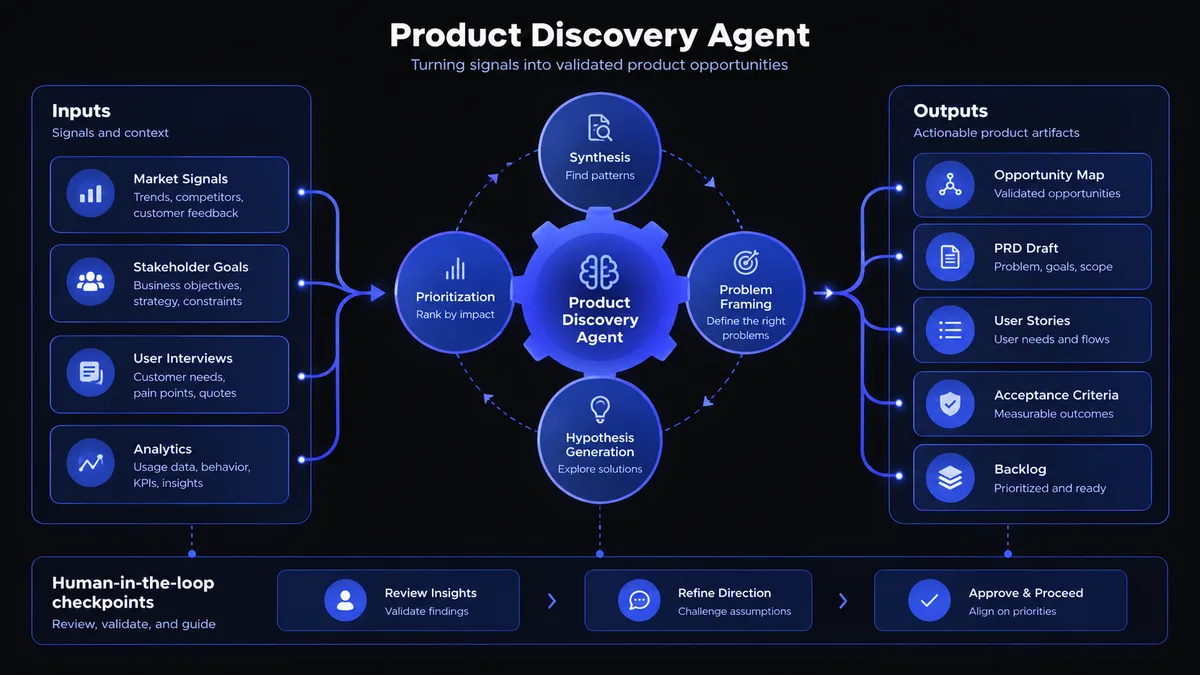
Product Discovery Agent: customer signals and analytics feed hypothesis development, product drafts and human review.
September 2026

Product Discovery Agent — Engineering Guide

Engineering guide 02/12: turn customer feedback, product analytics and repository context into evidence-backed hypotheses and traceable requirements.
Infinity Technologies
InfinitySDLC Engineering Guides
Technologies
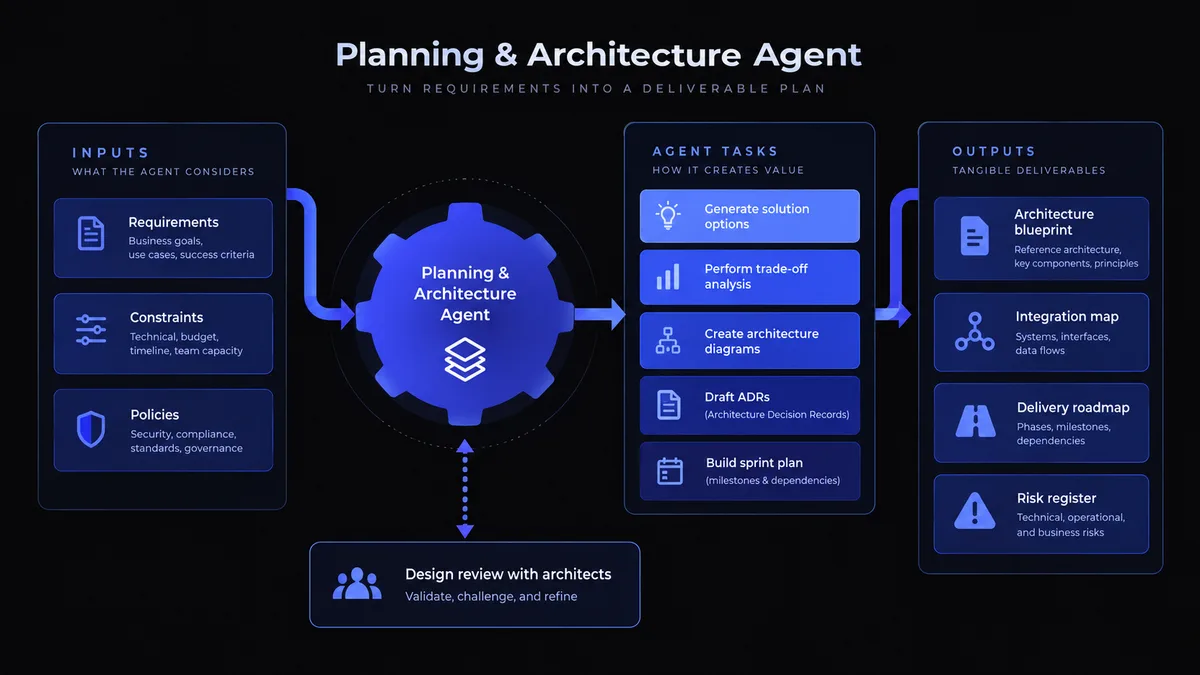
Planning and Architecture Agent: approved requirements, constraints and policies lead to design alternatives, architecture records and delivery plans reviewed by a human architect.
September 2026

Planning & Architecture Agent — Engineering Guide

Engineering guide 03/12: convert approved requirements into architecture decisions, dependency-aware delivery plans and machine-checkable work packages.
Infinity Technologies
InfinitySDLC Engineering Guides
Technologies
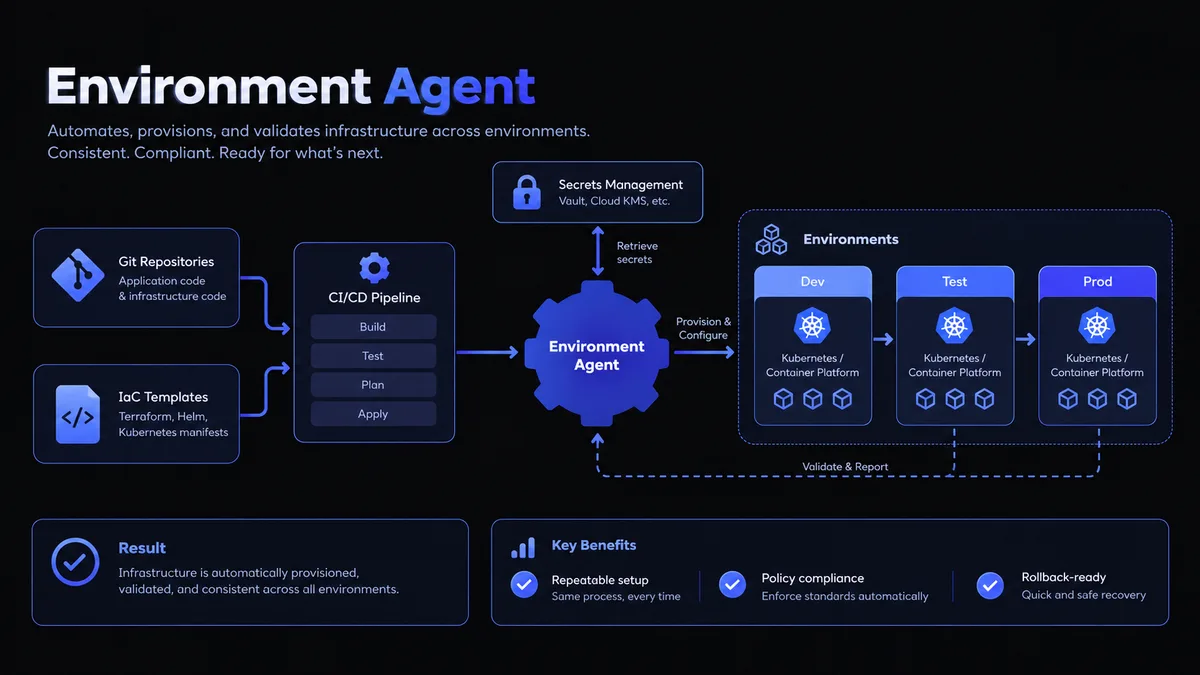
Environment Agent reference workflow linking Git, Infrastructure as Code, CI/CD and isolated environments. Secret references and approved execution remain controlled by platform services.
September 2026

Environment Agent — Engineering Guide

Engineering guide 04/12: build an Environment Agent for reproducible infrastructure, bounded Kubernetes diagnostics and disposable test environments.
Infinity Technologies
InfinitySDLC Engineering Guides
Technologies
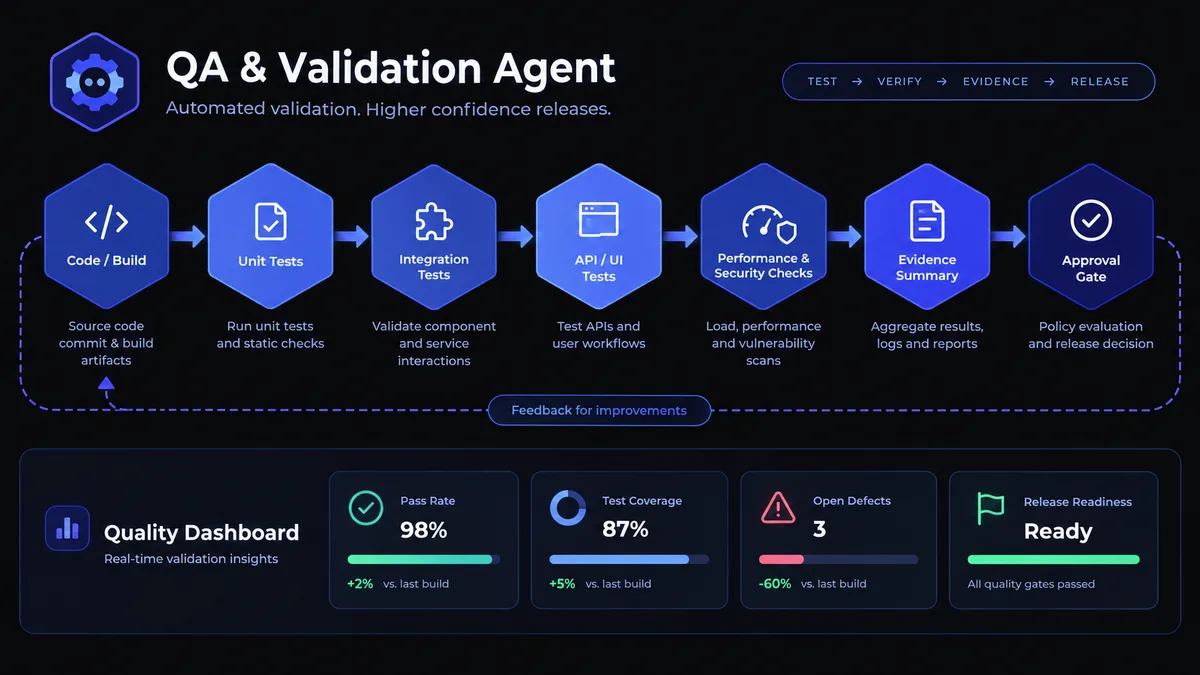
Conceptual QA and Validation pipeline: risk-based tests produce independently verified evidence for an approval gate. Dashboard numbers are illustrative, not client results.
September 2026

QA & Validation Agent — Engineering Guide

Engineering guide 05/12: build a QA agent that selects risk-based tests, uses isolated coding agents and produces verifiable release evidence.
Infinity Technologies
InfinitySDLC Engineering Guides
Technologies
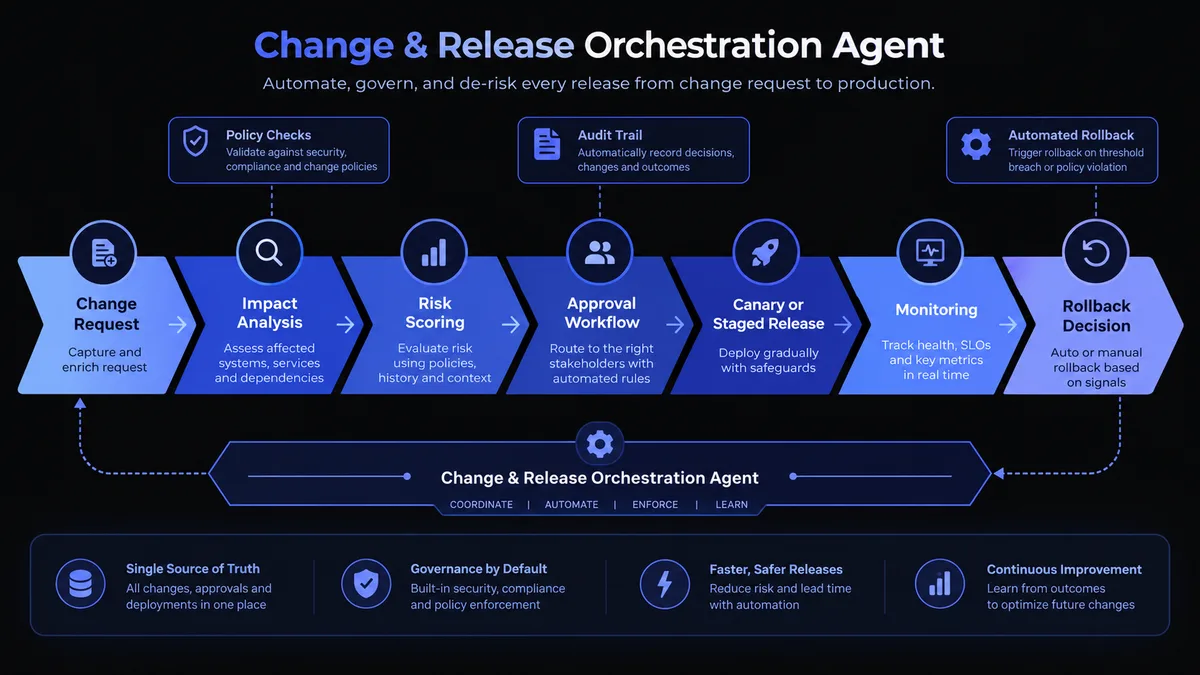
Change and Release Orchestration pipeline covering impact analysis, risk, approval, staged delivery, monitoring and rollback decisions.
September 2026

Change & Release Orchestration Agent — Engineering Guide

Engineering guide 06/12: coordinate change approval, CI/CD, progressive delivery and rollback with deterministic state transitions and two-phase writes.
Infinity Technologies
InfinitySDLC Engineering Guides
Technologies
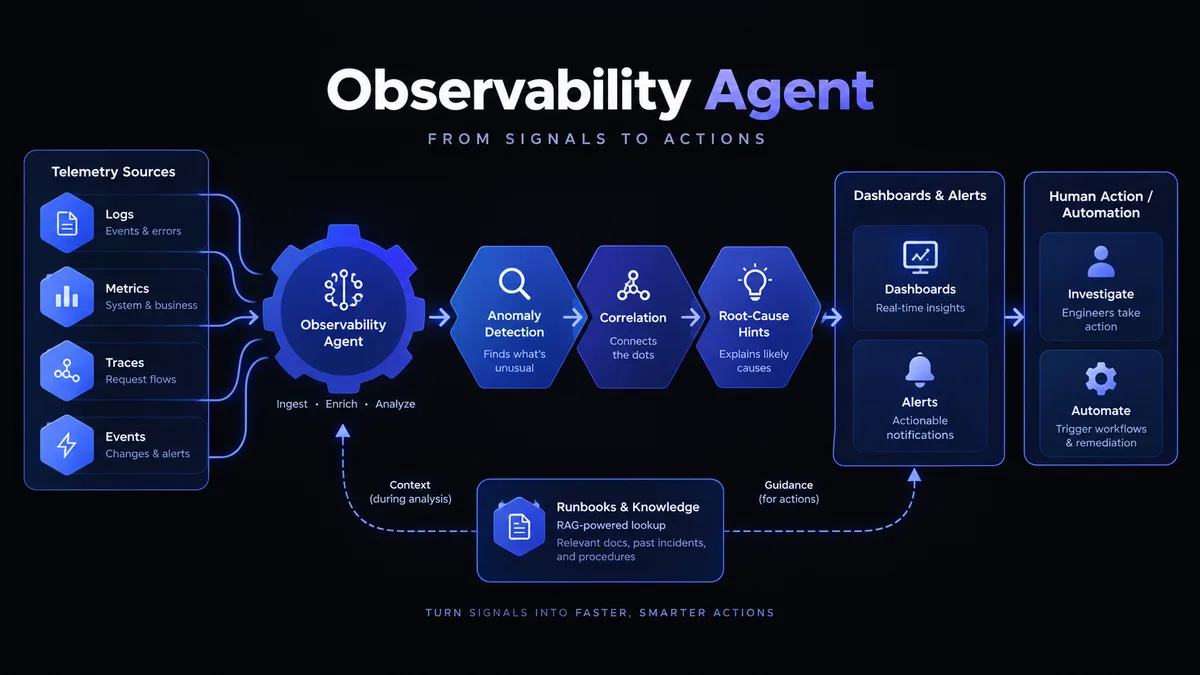
Observability Agent reference workflow: bounded logs, metrics, traces and change evidence feed competing hypotheses and a human-owned remediation handoff.
September 2026

Observability Agent — Engineering Guide

Engineering guide 07/12: correlate traces, metrics, logs and deployments using bounded telemetry queries and evidence-backed competing hypotheses.
Infinity Technologies
InfinitySDLC Engineering Guides
Technologies
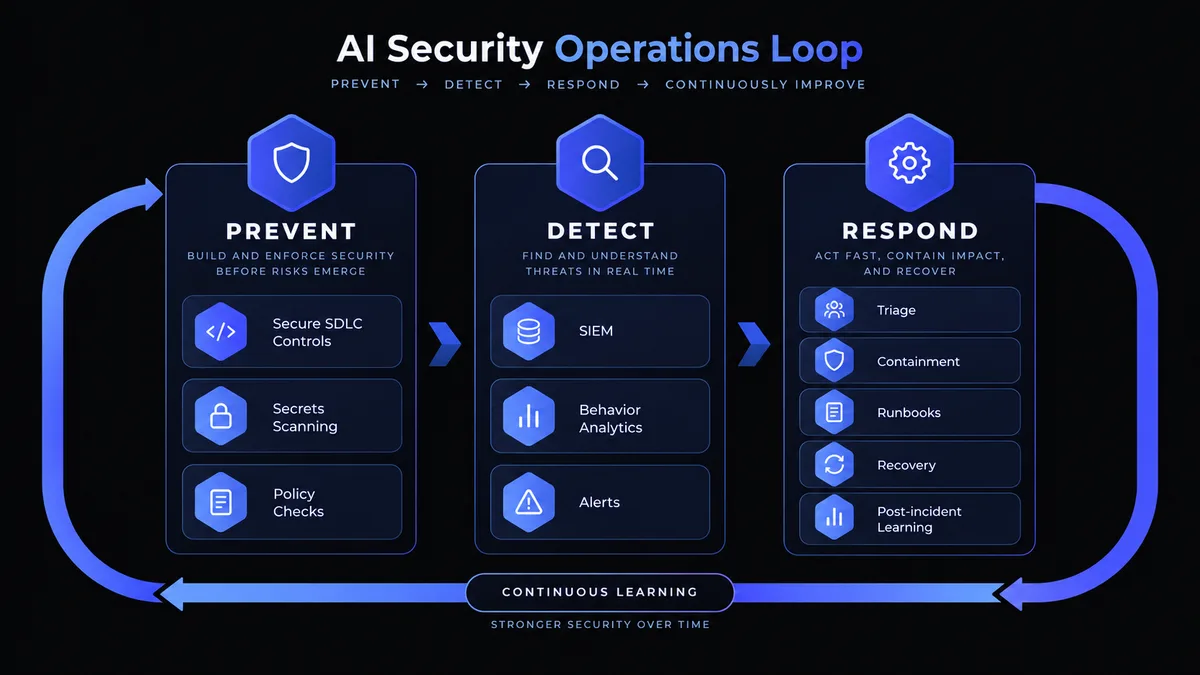
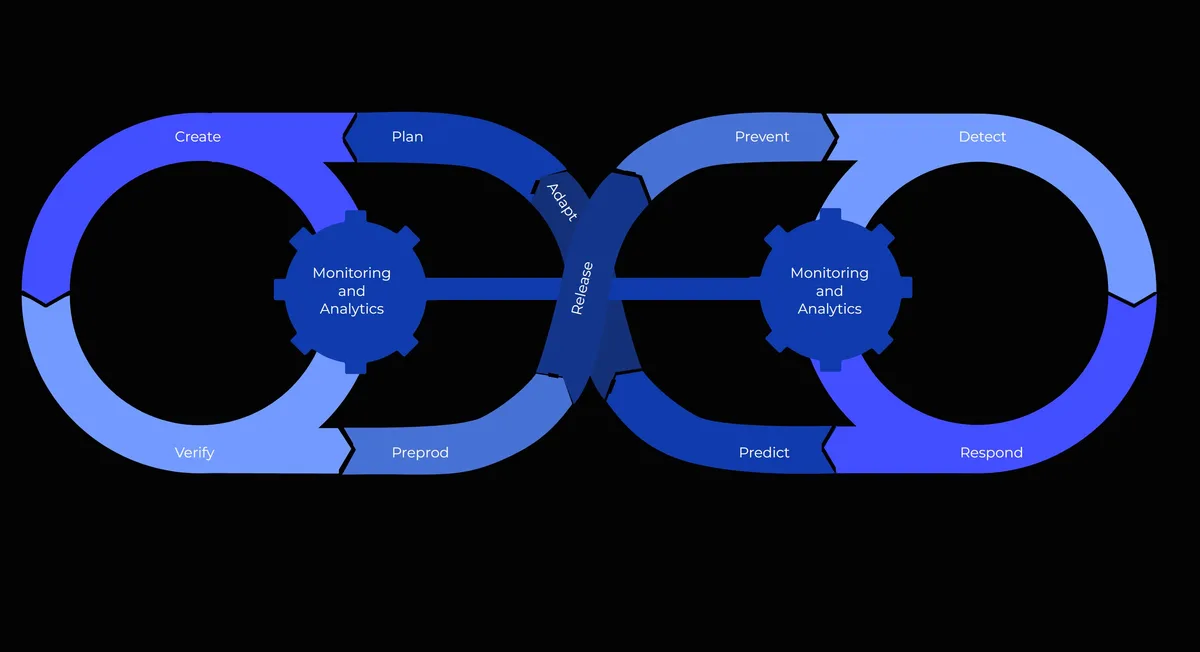
Security operations loop showing preventive controls feeding detection, response, recovery and approved post-incident learning.
September 2026

Security Prevention Agent — Engineering Guide

Engineering guide 08/12: combine deterministic security scanners, threat-model RAG and contextual code review before merging software changes.
Infinity Technologies
InfinitySDLC Engineering Guides
Technologies
Threat Detection Agent in a security operations loop: preventive controls feed detections, bounded analysis and approved incident-response actions.
September 2026

Threat Detection Agent — Engineering Guide

Engineering guide 09/12: enrich SIEM and EDR alerts, resolve entities and build evidence-backed incident timelines without unbounded containment powers.
Infinity Technologies
InfinitySDLC Engineering Guides
Technologies
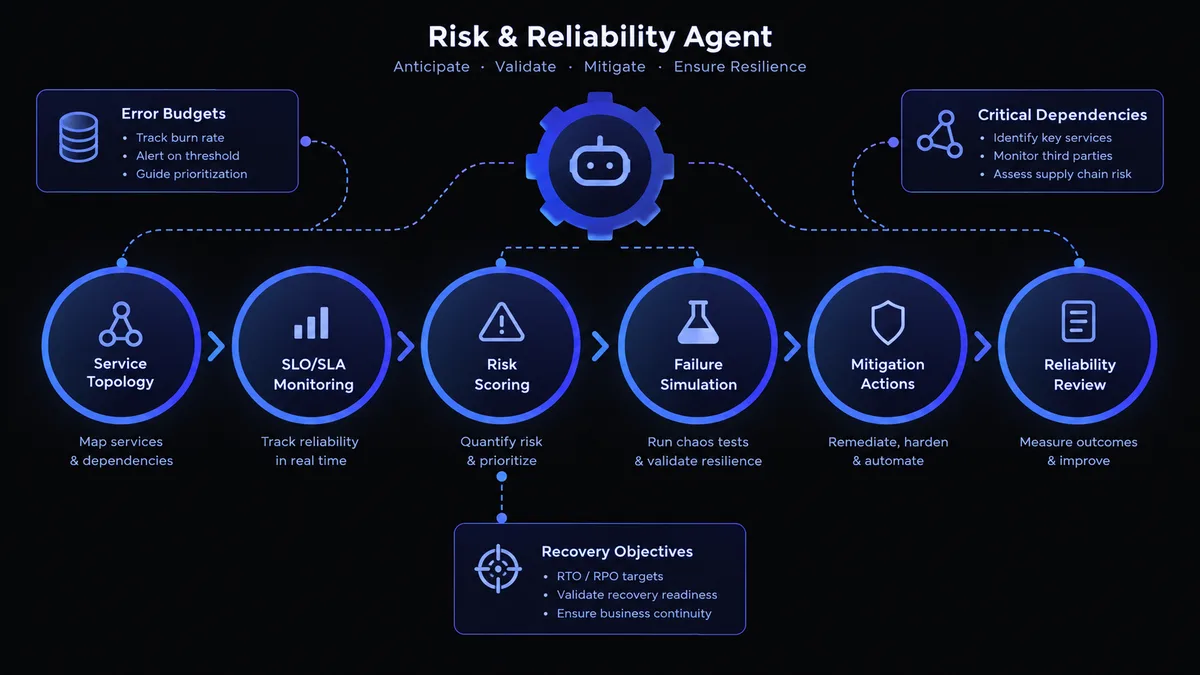
Risk and Reliability Agent combines service topology, SLO posture, change context and verified resilience evidence to produce reviewable risk decisions and bounded experiments.
September 2026

Risk & Reliability Agent — Engineering Guide

Engineering guide 10/12: quantify change risk using SLOs, error budgets, dependency graphs and resilience evidence rather than an ungrounded model score.
Infinity Technologies
InfinitySDLC Engineering Guides
Technologies
Incident Response coordinates triage, approved containment, recovery and post-incident learning within a wider security operations loop.
September 2026

Incident Response Agent — Engineering Guide

Engineering guide 11/12: build an incident copilot with structured state, specialist-agent handoffs, typed runbooks and human-approved mitigation.
Infinity Technologies
InfinitySDLC Engineering Guides
Technologies
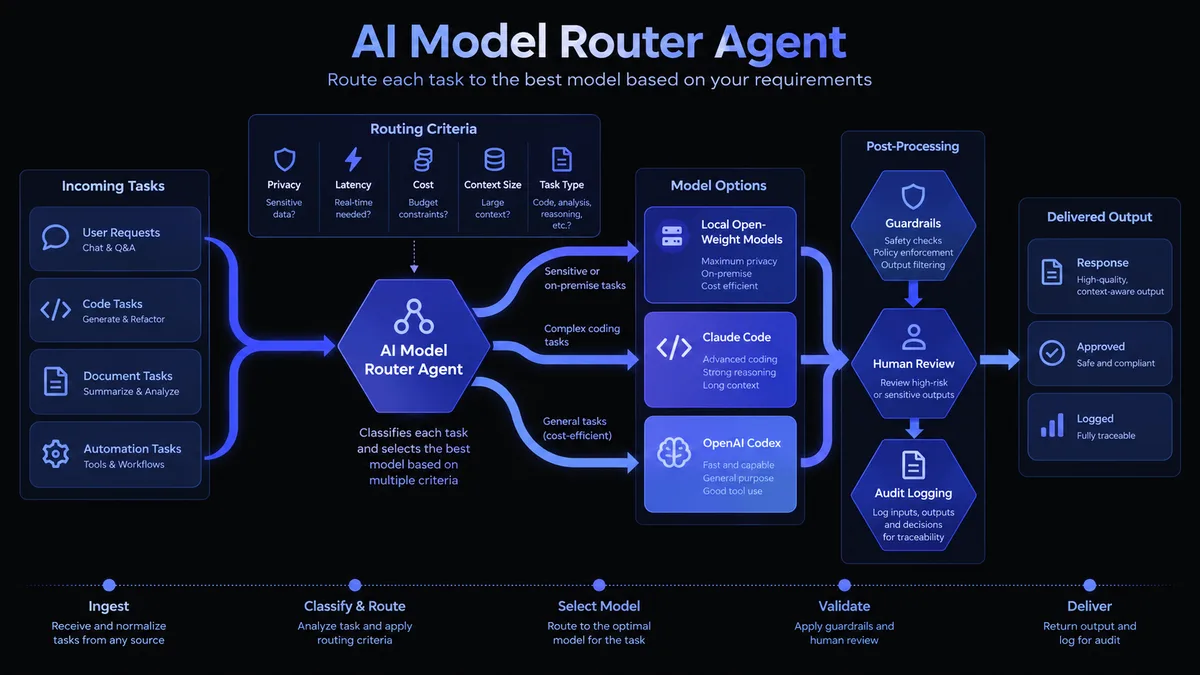
AI model routing control plane showing policy-first eligibility across hosted coding harnesses and local open-weight inference, followed by evaluation, capacity and audit controls.
September 2026

AI Model Router Agent — Engineering Guide

Engineering guide 12/12: route tasks across Claude, Codex and self-hosted models using data policy, capabilities, evaluation scores, cost and availability.
Infinity Technologies
InfinitySDLC Engineering Guides
Technologies
Governed enterprise agent mesh: connected hexagonal agents around a protected platform core.
September 2026

Recruitment Agent: Evidence Assembly Under a High-Risk Regulatory Regime

Engineering guide 01/12: build a Recruitment Agent that assembles requirement-linked evidence, preserves provenance and keeps candidate decisions with humans.
Infinity Technologies
Enterprise Agent Mesh Engineering Guides
Technologies
Governed enterprise agent platform connecting specialist agents around a protected control core.
September 2026

HR Agent: Effective-Dated, Jurisdiction-Scoped Policy Retrieval

Engineering guide 02/12: build an HR Agent that resolves employee context before retrieval, answers against effective-dated policy and routes sensitive cases.
Infinity Technologies
Enterprise Agent Mesh Engineering Guides
Technologies
Shared enterprise agent platform illustration used for the Supply Chain Agent engineering guide.
September 2026

Supply Chain Agent: Exception Narratives Over an Optimiser You Already Own

Engineering guide 03/12: build a Supply Chain Agent that triages planning exceptions, explains shortage causality with provenance and delegates quantities to deterministic solvers.
Infinity Technologies
Enterprise Agent Mesh Engineering Guides
Technologies
Governed enterprise agent platform with specialized nodes around a protected control core.
September 2026

Procurement Agent: Segregation of Duties Encoded in the Tool Layer

Engineering guide 04/12: build a Procurement Agent where approvals, supplier banking and payment authority are structurally outside the model’s tool and credential boundary.
Infinity Technologies
Enterprise Agent Mesh Engineering Guides
Technologies
Enterprise Agent Mesh platform illustration for the Finance Agent engineering guide.
September 2026

Finance Agent: Numbers From Tools, Never From the Model

A production engineering guide to a Finance AI Agent where every figure comes from deterministic tools and immutable fact packs, while the model is limited to grounded narrative and workflow orchestration.
Infinity Technologies
Enterprise Agent Mesh Engineering Guides
Technologies
Shared agent-platform illustration for the Finance Risk engineering guide: connected hexagons surrounding a governance core.
September 2026

Finance Risk Agent: Evidence Assembly, Adversarial Review, and Model Risk Management

Engineering guide 06/12: deterministic treasury calculations, facility-specific covenant definitions, adversarial challenge and human decision authority.
Infinity Technologies
Enterprise Agent Mesh Engineering Guides
Technologies
Shared Enterprise Agent Mesh illustration for the Operations Agent engineering guide.
September 2026

Operations Agent: Durable Execution, Process Conformance, and the Connective Tissue of the Mesh

Engineering guide 07/12: durable workflow state, bounded judgement, process conformance, runbook safety and chaos-tested recovery.
Infinity Technologies
Enterprise Agent Mesh Engineering Guides
Technologies
Shared Enterprise Agent Mesh illustration for the Customer Support Agent engineering guide.
September 2026

Customer Support Agent: Containment Quality, Not Deflection Rate

Engineering guide 08/12: containment quality, account-scoped retrieval, guarded customer sends, escalation packets and evidence-driven support autonomy.
Infinity Technologies
Enterprise Agent Mesh Engineering Guides
Technologies
Shared Enterprise Agent Mesh illustration for the Sales Agent engineering guide.
September 2026

Sales Agent: Make the CRM True, Then Worry About Selling

Engineering guide 09/12: make CRM state evidence-backed before generating selling assistance, with governed field updates, customer commitments and cross-agent handoffs.
Infinity Technologies
Enterprise Agent Mesh Engineering Guides
Technologies
Shared Enterprise Agent Mesh illustration for the Marketing Agent engineering guide.
September 2026

Marketing Agent: Generation Is the Commodity, the Constraint System Is the Product

Engineering guide 10/12: make generation subordinate to market-scoped claims, rights, channel rules, attribution discipline and measurable brand controls.
Infinity Technologies
Enterprise Agent Mesh Engineering Guides
Technologies
Shared Enterprise Agent Mesh illustration for the Legal Agent engineering guide.
September 2026

Legal Agent: The Playbook Is the Program

Engineering guide 11/12: build a Legal Agent where executable playbooks, matter access, contract lineage and privilege boundaries govern model-assisted review.
Infinity Technologies
Enterprise Agent Mesh Engineering Guides
Technologies
Enterprise Agent Mesh platform illustration for the Compliance Agent guide, with blue hexagonal agents and a central governance shield.
September 2026

Compliance Agent: Evidence Logistics, Control Testing, and the Mesh’s Control Plane

Engineering guide 12/12: build a Compliance Agent for reproducible control testing, sealed evidence, curated crosswalks and continuous mesh conformance.
Infinity Technologies
Enterprise Agent Mesh Engineering Guides
Technologies
Enterprise agent platform illustration: a layered control core connects specialized agents, knowledge, models, telemetry and isolated execution.
September 2026

Enterprise Agent Platform Foundation — Engineering Guide

Engineering guide 01/12: build the shared control plane, MCP gateway, ACL-aware retrieval, isolated runtimes and evaluation system for an enterprise AI agent mesh.
Infinity Technologies
InfinitySDLC Engineering Guides
Technologies
Fuzzy logic model of usability of websites of higher education institutions in the context of digitalization of educational services

Fuzzy logic model of usability of websites of higher education institutions in the context of digitalization of educational services

Fuzzy logic model for evaluating university website usability and improving digital experience in higher education
Business
Management
Technologies
Tools
EU countries clustering for the state of food security using machine learning techniques

EU countries clustering for the state of food security using machine learning techniques

The study applies clustering methods to group EU countries by food security levels and develop tailored policy recommendations.
Technologies
Time Series Forecasting of Agricultural Product Prices Using Elman and Jordan Recurrent Neural Networks

Time Series Forecasting of Agricultural Product Prices Using Elman and Jordan Recurrent Neural Networks

A study of Elman and Jordan neural networks for predicting historical agricultural prices using time series data.
Business
Technologies
Identifying Stock Market Crashes by Fuzzy Measures of Complexity

Identifying Stock Market Crashes by Fuzzy Measures of Complexity

This article explores how fuzzy logic and complexity measures can help detect early signals of stock market crashes, offering a more stable and insightful alternative to traditional analysis methods.
Business
Tools
Management
Technologies
Fuzzy Clustering: A Data-Driven Revolution in ESG Portfolio Strategy

Fuzzy clustering approach to portfolio management considering ESG criteria: empirical evidence from the investment strategies of the EURO STOXX Index

Find out more about the new ESG portfolio strategy using fuzzy clustering to align sustainability with strong, adaptive performance.
Technologies
Fuzzy Cluster Analysis: Smarter Trade Timing with Real Profitability

Identifying Moments of Decision Making on Trade in Financial Time Series Using Fuzzy Cluster Analysis

how Fuzzy Cluster Analysis enhances trading strategies by combining technical indicators with probabilistic clustering and financial performance metrics
Technologies
Tools
Secure and Accelerate Software Development with InfinitySecOps™

Infinity Technologies Introduces InfinitySecOps™

A Revolutionary 11-Stage DevSecOps Framework
Technologies
Tools
Introducing InfinityFrame™: A Paradigm Shift in Tech Design and Software Architecture

Introducing InfinityFrame™: A Paradigm Shift in Tech Design and Software Architecture

The Evolving Challenge of Software Architecture
Technologies
Understanding and Applying UX Research: A Comprehensive Guide

Understanding and Applying UX Research: A Comprehensive Guide

Defining the Landscape of User Experience (UX) and UX Research
Product
Mastering Product Roadmaps: A Strategic Guide to Vision, Alignment, and Execution

Mastering Product Roadmaps: A Strategic Guide to Vision, Alignment, and Execution

Defining the Product Roadmap
Product
Visualizing Value: A Comprehensive Guide to Value Chain Canvas Workshops for Strategic Advantage

Visualizing Value: A Comprehensive Guide to Value Chain Canvas Workshops for Strategic Advantage

Visualizing Value Creation for Strategic Advantage
Product