

AI Product Playbook · 12 of 12
A useful recommendation helps someone reach a better choice with less effort. It might surface the right product, suggest a setup template, identify a relevant lesson, or decide that another marketing message would add no value.
Imagine a business software product with hundreds of templates. New customers face an empty workspace and a long catalog. Returning customers keep seeing templates they already use. The opportunity is to adapt the experience to the task, account permissions and current context, then test whether that adaptation improves successful activation and continued use.
Chapter 12 of the AI Product Modernization Playbook brings segmentation, personalization and recommendations together. The practical challenge is broader than selecting a ranking model: establish a useful objective, collect trustworthy evidence, control what may be shown, and measure the outcomes the system actually changes.
On this page
1. Choose one surface and one user outcome
Start with a specific decision surface: related products on a detail page, templates during onboarding, a content feed, search results, or a next-action panel in a CRM. Name its owner and define what a good choice helps the user accomplish.
The primary metric should reflect that outcome. For onboarding, it might be accounts completing a meaningful setup and using it again. For commerce, it might be contribution margin after returns over a defined period. Clicks can diagnose whether people notice recommendations, but clicks alone do not establish satisfaction, incremental sales or lasting value.
Distinguish three capabilities
- Segmentation groups users or accounts into operationally useful categories, such as new administrators or teams with incomplete setup.
- Personalization adapts an experience using permitted information about the user, account or context.
- Recommendation selects and orders items or actions from an eligible set.
A contextual recommendation can be useful without a persistent user profile. A segment can support a simple rule without a learned ranker. An individualized ranking can work without explicit clusters. Choose the smallest capability that can improve the selected job.
Define guardrails alongside the primary metric: returns, complaints, unsubscribes, task completion, exposure concentration and response time. Agree acceptable tradeoffs before the first experiment, so a rise in clicks cannot quietly outweigh deterioration elsewhere.
2. Make segments actionable and revisable
Begin with interpretable lifecycle rules when they answer the business question. “Created an account but has not connected a data source” suggests a useful onboarding intervention. “Cluster 17” does not, unless the team understands what distinguishes it and how to help its members.
Evaluate a segment by the decision it supports
Give every segment a definition, data window, refresh schedule, owner and permitted use. Specify whether membership can overlap, what happens when evidence is missing, and how quickly someone leaves after their situation changes. Retain definition versions so experiment results remain interpretable.
For learned clusters, check feature scaling, outliers, missing values, stability across periods and the influence of heavy users. A high clustering score does not establish that different treatments will help different groups. Validate the proposed action with an experiment or other suitable evidence.
Do not turn temporary behavior into a permanent identity. A user researching an unfamiliar topic may be buying a gift or completing a one-off task. Use recency, explicit preferences and current intent where appropriate, and make correction possible.
In B2B products, decide whether the unit is the person, team or account. A template popular with account administrators may be irrelevant to an analyst. Shared account signals must respect individual permissions and tenant boundaries; aggregation alone is not a sufficient permission model.
3. Record exposures, outcomes and catalog state
Purchase history describes what happened, but not every alternative the user could have chosen. Build an exposure record alongside behavioral events. Distinguish a server response from a rendered recommendation and, where relevant, an item actually visible in the viewport.
| Record | Useful fields | Why it matters |
|---|---|---|
| Decision request | Request ID, permitted context, surface, experiment assignment, policy version | Reconstruct the decision without unnecessary personal data |
| Candidate and eligibility evidence | Candidate sources, catalog version, exclusions, availability and permissions | Separate retrieval failures from ranking failures |
| Served and observed exposure | Item IDs, positions, actual policy probabilities where defined, render or visibility events | Understand what was offered and what the user could observe |
| Outcome | Clicks, task success, purchase, return, hide, complaint and event time | Evaluate both immediate and delayed consequences |
| User controls | Mode, hidden topics, exclusions, preference changes and effective time | Apply choices consistently across surfaces and caches |
Swipe horizontally to read the complete table.
Use consistent identifiers, deduplicate events and allow delayed outcomes to mature. A non-click is not automatically a dislike: the item may never have been seen. A return arriving weeks later must still be attributable to the appropriate decision and evaluation window.
Catalog quality is equally important. Maintain descriptions, attributes, stock, licensing, compatibility and access rights. If “works with your integration” depends on an outdated attribute, a better embedding will not repair the recommendation. Preserve the features available at decision time rather than rebuilding historical evaluations from today’s catalog.
4. Separate retrieval, ranking and list quality
Start with credible baselines: contextual popularity, recently useful items, item-to-item similarity and task-specific rules. Evaluate them against the existing experience. A complex model should earn its operating cost through measured improvement.
Different stages solve different problems
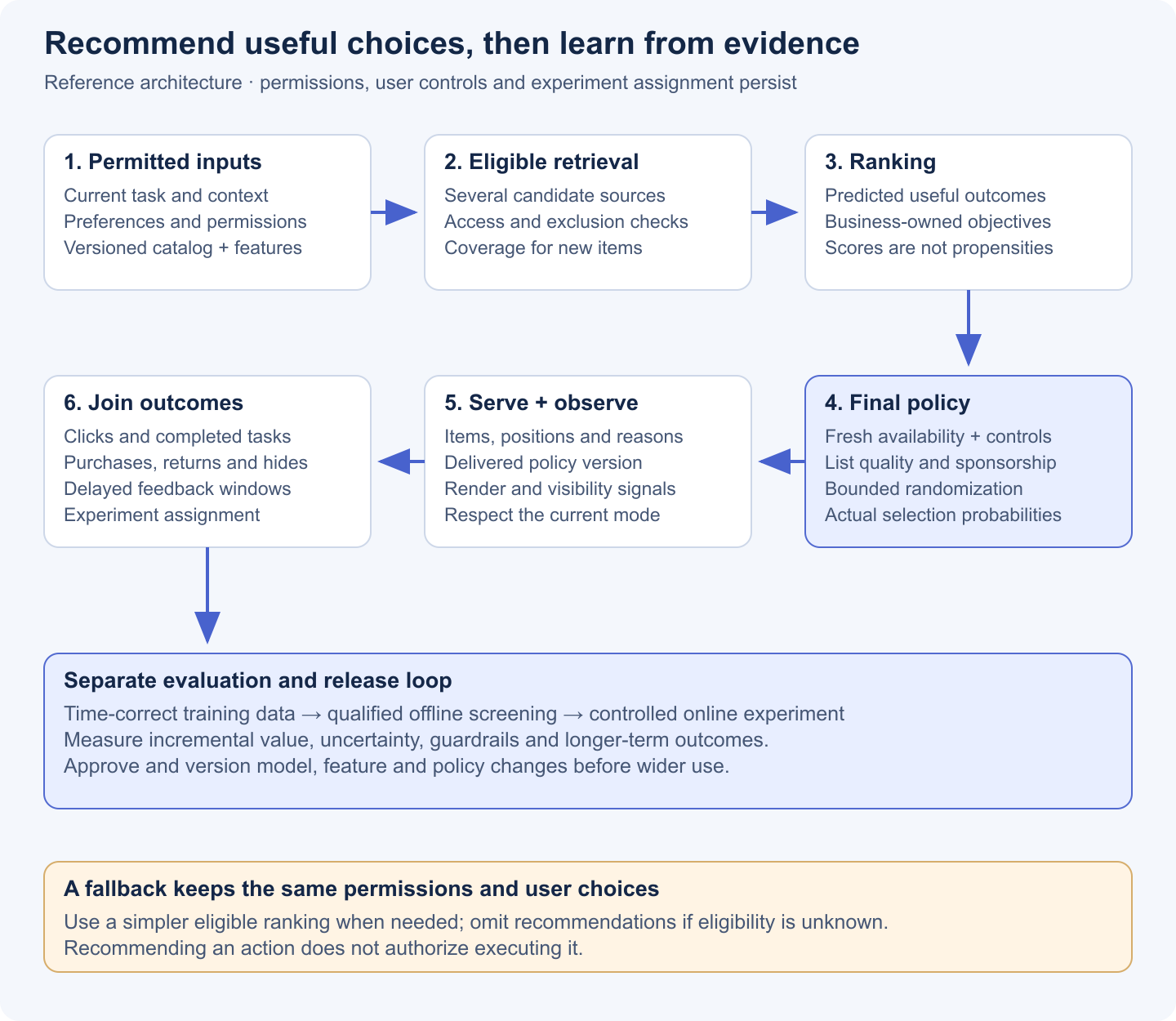
Candidate generation narrows the catalog using several sources, such as co-occurrence, content similarity and embedding retrieval. Ranking evaluates that smaller set more precisely. A final policy stage controls the whole list: duplicates, diversity, sponsorship, exclusions and exposure limits.
YouTube’s 2016 recommendation paper documented separate candidate-generation and ranking networks. The enduring architectural lesson is the separation of inexpensive retrieval from more detailed scoring, not a requirement to copy that historical model or its scale. Source: Covington, Adams and Sargin, 2016.
Measure candidate coverage independently. A relevant eligible item that never reaches the ranker cannot be rescued by improved ranking. Audit candidate sources for new items, less popular categories and different user contexts, using available relevance evidence while acknowledging its gaps.
For ranking, a transparent rule or gradient-boosted model may be a suitable starting point. More complex sequence models become candidates when history, volume and the evaluation setup justify them. Predicting several outcomes can help express tradeoffs, but combining scores requires coherent units, validated predictions and business-owned weights. A weighted score does not eliminate the need for hard constraints.
5. Build a controlled serving and learning loop
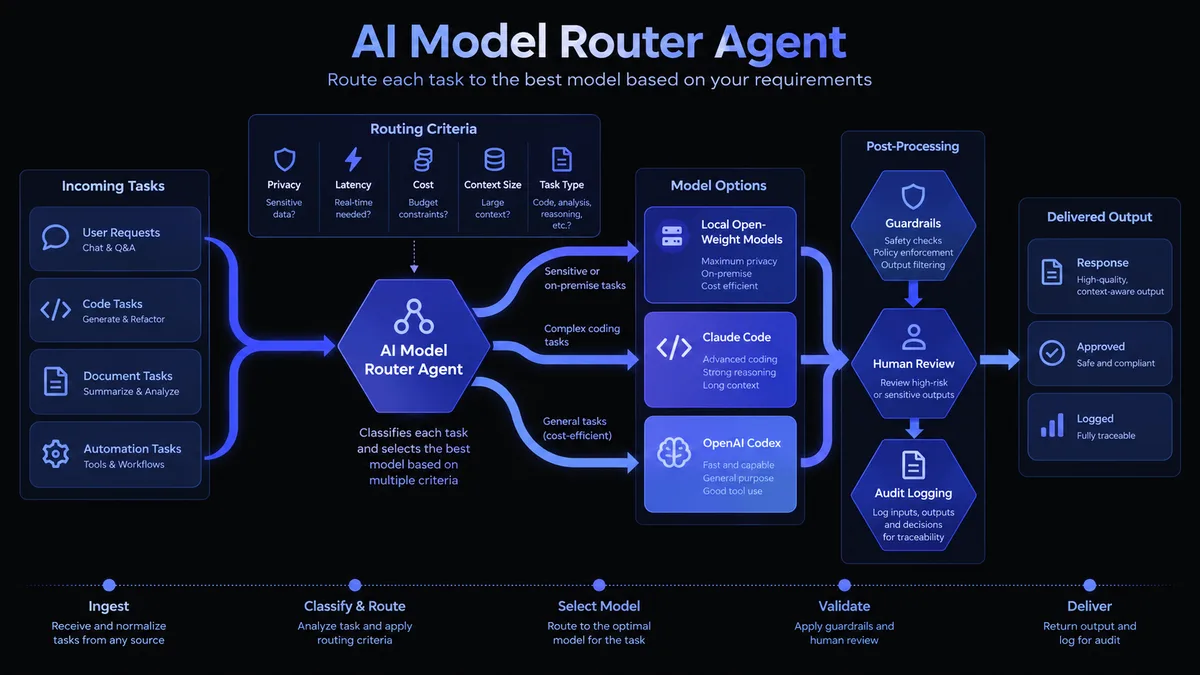
The service should return eligible items, reason metadata and enough decision information to evaluate the result. It should also know when to use a simpler mode. The diagram separates the immediate serving path from the evidence used for future model changes.
Keep policy outside model weights
Product teams need explicit controls for exclusions, campaign slots, maximum repetition and allowed exploration. Version these controls with the models. A merchandising change can alter outcomes as much as a model release, so it belongs in the experiment and decision record.
Apply access rules before restricted content enters a candidate set or an explanation. Recheck fast-changing facts such as availability at serving time. If a cached result is incompatible with a user’s latest preferences, rebuild or filter it before display.
Preserve the distinction between selecting a recommendation and performing an action. Suggesting an integration does not authorize installation. Recommending a message does not authorize sending it. Use the action permissions and execution controls described in the agentic automation article.
6. Design cold start and a useful default
New users and new items have little behavioral evidence. Use item attributes, the current task, explicitly chosen interests and contextual baselines. A few optional onboarding choices can improve relevance without requiring a long history. Avoid forcing users through a survey before they can experience the product.
Netflix’s help documentation describes optional title selections when starting a profile, a diverse popular selection when that step is skipped, and an increasing role for subsequent activity. This is a useful product pattern: begin with a viable default and refine it as evidence arrives. It is not proof of a particular commercial lift for another product. Source: Netflix’s recommendation-system explanation.
Do not confuse missing data with lack of interest
Allocate bounded opportunities for eligible new items to be discovered. Monitor whether they receive meaningful exposure, not just whether they exist in an index. Distinguish a new user, a user who opted out and a returning user whose identity could not be resolved; those states should not silently collapse into a single persistent profile.
A mode described as non-personalized should not secretly use the person’s browsing history. Popularity within a currently selected category can be a useful design, but verify the actual signals and applicable privacy requirements. “Contextual” is a description of the approach, not an automatic exemption from data-protection obligations.
7. Make controls and explanations part of the product
Provide understandable ways to hide an item or topic, correct preferences and switch modes. Explain what resetting history changes, including any separately retained records. Apply changes across retrieval, ranking, caches and queued campaigns; a visible switch that changes only one screen is incomplete.
Explain the real reason
“Because you selected project planning” should correspond to an actual selection signal. A paid placement should be labeled as such, not disguised with a personalized explanation. Store reason codes and the supporting permitted attributes, then render clear text from that evidence.
Define sensitive-category restrictions before collecting features or creating segments. Removing named attributes does not prove their proxies have disappeared from text, embeddings or behavioral clusters. Audit representative outputs and uses, minimize retained data, and avoid explanations that reveal intrusive inferences. Pseudonymous identifiers still require appropriate protection.
The EU Digital Services Act illustrates why scope matters. For covered online platforms, Article 27 addresses recommender transparency and available parameter choices; Articles 26 and 28 restrict profiling-based advertising using special-category data and advertising to recipients known with reasonable certainty to be minors. Article 38 requires a non-profiling option for each recommender of designated very large platforms and search engines. Article 19 provides relevant micro- and small-enterprise exclusions for Section 3, with exceptions. These are scoped obligations, not identical rules for every software product. Confirm applicability with the responsible legal team. Source: Regulation (EU) 2022/2065.
Useful controls should be designed around user expectations as well as applicable requirements. They must continue to work during experiments, exploration and degraded operation.
8. Explore deliberately and log real probabilities
Recommendations influence the evidence used to train the next recommender. Frequently shown items collect more interactions, while unseen items have little chance to demonstrate relevance. Bounded exploration can reduce that blind spot, but must remain inside eligibility, safety and user-control rules.
A ranking score is not an exposure probability
For randomized selection, record the probability assigned by the actual serving policy. Do not manufacture this field by applying a softmax to arbitrary ranker scores. Filtering, pinned placements and list construction can change the distribution; the logged probability must match the decision being evaluated.
A deterministic policy may assign zero probability to alternatives. Historical logs then cannot directly identify what would have happened for those unsupported actions. Inverse-propensity and doubly robust methods need appropriate overlap and valid assumptions; adding a propensity column does not automatically remove bias. Small probabilities can also produce unstable estimates. Source: Dudík, Langford and Li, 2011; Wang, Agarwal and Dudík, 2017.
A page is an ordered collection of items, and their effects can interact. Per-item probabilities are not universally sufficient to evaluate a different full list. Define whether the action is an item, a position-specific choice or a complete slate, then use a logging scheme and estimator suited to that structure. Source: Swaminathan and colleagues, 2017.
Track effective sample size, uncertainty and exposure concentration. An adaptive bandit is a learning policy, not a free replacement for a properly designed comparison of long-term product outcomes.
9. Use offline evidence to screen and experiments to decide
Offline tests can expose retrieval misses, poor ranking, invalid items and policy regressions before using production traffic. Use time-based splits, preserve decision-time features, and report results for new users, new items and important product contexts. Assess how the previous serving policy shaped the available labels.
| Question | Evidence | Interpretation |
|---|---|---|
| Can the system retrieve useful items? | Candidate coverage and recall against available eligible relevance labels | Retrieval capability, limited by label coverage |
| Does it order the candidates well? | Ranking metrics, catalog coverage, diversity and qualified off-policy estimates | A screen for promising policies, not proof of business lift |
| Does it improve the experience? | Randomized comparison on the primary outcome and guardrails | Incremental effect for the tested population and period |
| Does the benefit last? | Persistent program holdout, mature returns, repeat use and retention | Longer-term value and changing effects |
| Does it respect its contract? | Permission, control, explanation, freshness and load tests | Whether the complete serving system is ready |
Swipe horizontally to read the complete table.
Design the comparison before launch
Choose the randomization unit to match the experience. Account-level assignment may fit shared B2B workflows better than user-level assignment. In marketplaces, shared stock and seller responses can create spillovers, so involve experiment specialists rather than assuming users are independent.
Define eligibility, the primary outcome, detectable effect, sample requirements, analysis window and guardrail margins in advance. Check sample-ratio mismatch and instrumentation before interpreting results. Avoid deciding success by repeatedly checking an ordinary significance test without an appropriate sequential design. A non-significant harm estimate is not proof of non-inferiority.
Booking.com’s KDD 2019 paper analyzed about 150 successful customer-facing machine-learning applications validated through randomized controlled trials. Its emphasis on an iterative, hypothesis-driven process is a useful precedent for evaluating the complete product change. The paper is not evidence that any offline metric improvement guarantees commercial value. Source: Bernardi, Mavridis and Estevez, 2019.
10. Calculate incremental value after incentives
Recommendations receive credit for many actions that would have happened anyway. Compare outcomes between assigned groups over the same window, preferably using all eligible assigned units rather than only those who clicked. Selection after treatment can distort the comparison.
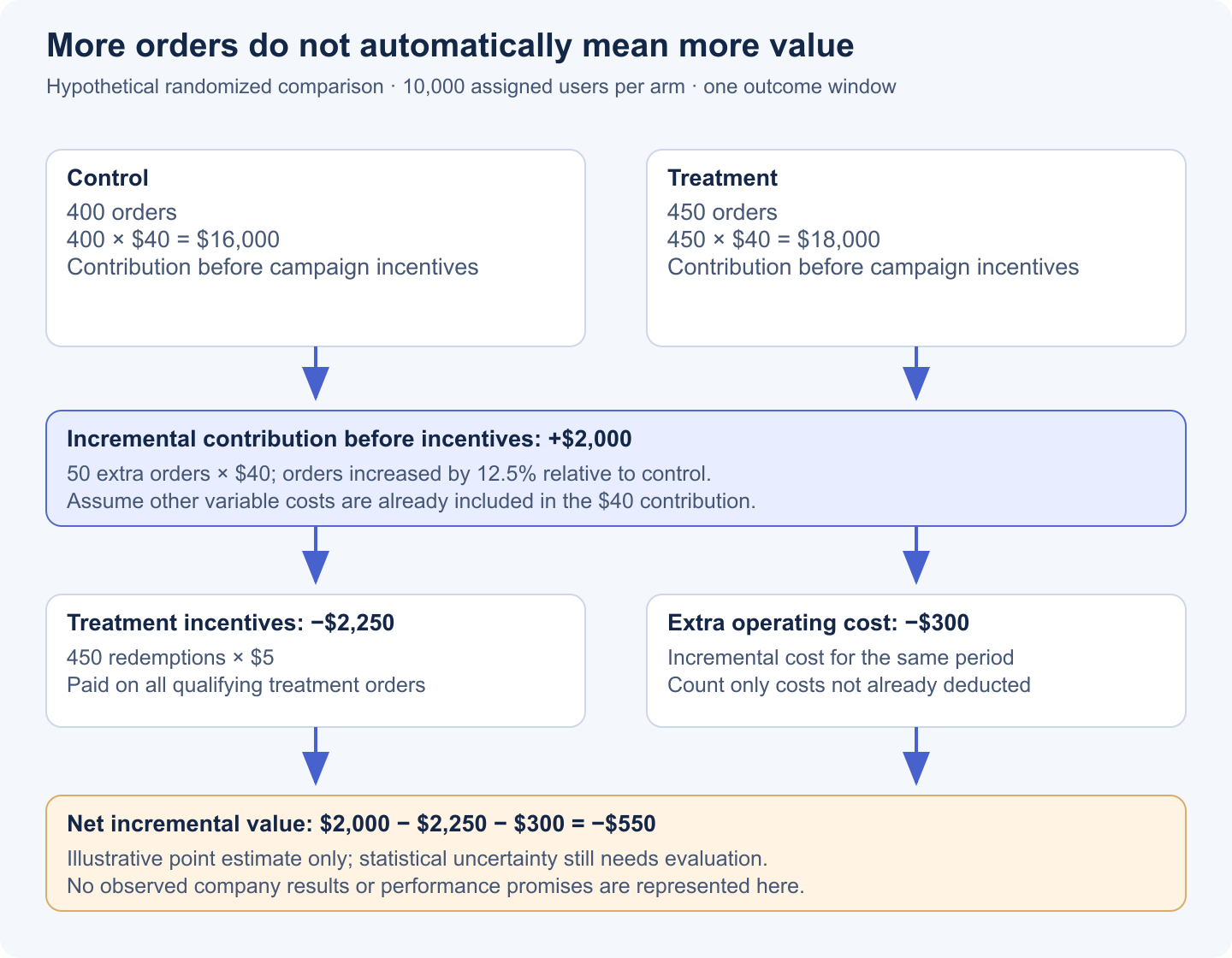
Here, 10,000 users in each arm produce 400 control orders and 450 treatment orders: a 12.5% relative increase in orders. At an assumed $40 contribution per order before the campaign incentive, the extra 50 orders contribute $2,000. If all 450 treatment orders redeem a $5 incentive, that costs $2,250; another $300 of incremental operating cost brings the net difference to minus $550.
The incentive is paid on all qualifying redemptions, not just the estimated incremental orders. If the measured contribution metric already deducts discounts, do not deduct them again. Use the same discipline for returns, delivery subsidies and other costs.
Keep a durable program comparison
A persistent holdout can estimate the combined effect of a personalization program, while individual experiments compare versions within it. Define the baseline, assignment duration and outcome horizon according to the business cycle and available power. A fixed percentage or twelve-month period is not universally appropriate.
Audit contamination: global popularity features, shared inventory, marketing campaigns and models trained on treatment-influenced behavior can affect both groups. State the resulting limits. Retention and satisfaction take time to observe, and a short-term proxy should be checked against those longer-term outcomes.
11. Add next best action and conversational discovery
Ranking an item and deciding to intervene are different questions. A customer with high purchase probability may buy without an offer. A useful next-action policy estimates the expected incremental benefit of an eligible action relative to alternatives, including no action, then accounts for cost and uncertainty.
Separate influence from prediction
Use appropriately randomized campaign data where feasible to learn treatment effects. Evaluate a proposed action policy on held-out experimental evidence and then in a controlled rollout. Individual counterfactual outcomes are unobserved, so validate uplift through aggregate comparisons and policy value rather than claiming to know each person’s exact response. The risk scoring and propensity article explains this distinction further.
Outbound actions need channel permissions, eligibility, budget and shared frequency caps checked at send time. Coordinate across teams so separate campaigns do not overwhelm the same person. Preserve holdout membership through queues and retries. A previously approved recommendation can become inappropriate before dispatch.
For conversational discovery, use a language model to interpret requests such as “similar to this, but suitable for a smaller team.” Convert that request into validated filters and retrieve eligible catalog items. Check identity, access, units and filter meaning, then explain returned items using verified attributes. Do not invent availability, compatibility, prices or reasons.
A language model may help rerank a small candidate set when evaluation justifies its latency and cost. Keep eligibility checks and factual evidence outside free-form generation, and retain a usable path when the language layer is unavailable.
12. Operate for freshness, reliability and control
Set latency and availability budgets from the host product’s needs. Include feature lookup, retrieval, ranking, policy checks and rendering. Precompute stable candidates where helpful, but do not let cached stock, access rights or preferences override current restrictions.
Fallbacks must preserve the same rules
If ranking fails, use eligible candidates in a simpler order. If behavioral features are unavailable, use a permitted contextual baseline. If eligibility itself cannot be established, omit the affected recommendation or use a known-valid subset. Failure should never reopen a hidden topic or expose another tenant’s content.
Monitor the whole path: event loss, duplicate exposures, stale catalog records, empty candidate sets, fallback rates, invalid items, latency, coverage, seller exposure and outcome delays. Review exclusions and boosts with the surface owner. A business configuration change deserves versioning, validation and, when material, experiment treatment.
Keep an operational way to disable a model or campaign without removing user controls. Test preference changes while requests are in flight, a catalog item becoming unavailable, delayed returns, new-item launches and a broken feature feed. Record which candidate source and policy produced each result so incidents can be diagnosed.
For low-volume B2B products, simple rules and content features may remain the strongest economic choice. Use cross-account evidence only within contractual and privacy permissions, and report uncertainty when traffic cannot support precise estimates.
13. Release in stages and connect the roadmap
Build the feature through evidence gates, with time determined by data readiness, integration and the observation window for the chosen outcome.
- Define the contract. Select one surface, its user job, owner, primary outcome, guardrails and permitted data.
- Instrument the baseline. Verify catalog quality, exposure logging, assignment and delayed outcomes. Ship useful controls with the first experience.
- Earn added complexity. Compare simple retrieval and ranking baselines before adopting more expensive models. Add controlled exploration only with valid logging and safeguards.
- Measure incremental value. Run a suitable experiment, account for incentives and uncertainty, and preserve an appropriate longer-term comparison.
- Expand deliberately. Add surfaces, actions or conversational interaction after the initial operating evidence supports them.
This final capability connects naturally to the rest of the Playbook. Knowledge and retrieval supply grounded information; workflow copilots bring assistance into the user’s task; forecasting estimates future conditions; and scenario analysis and optimization allocate constrained resources. Recommendations select useful options, while authorized workflows carry out the chosen actions.
Across all twelve articles, the reusable foundation is consistent: clear data ownership, versioned decisions, explicit permissions, evaluation against a meaningful baseline, and an operating owner. Start with one product problem, demonstrate the outcome, and use the evidence to decide what to add next.
Sources and further reading
This article develops Chapter 12, “Segmentation, personalisation and recommendations,” of the AI Product Modernization Playbook supplied by Infinity Technologies. The architecture and implementation guidance are editorial recommendations. The financial example is illustrative, not an observed result or a performance promise.
- Covington, Adams and Sargin: Deep Neural Networks for YouTube Recommendations, 2016.
- Netflix: How Netflix’s Recommendations System Works.
- Bernardi, Mavridis and Estevez: 150 Successful Machine Learning Models, KDD 2019.
- Dudík, Langford and Li: Doubly Robust Policy Evaluation and Learning, 2011; Wang, Agarwal and Dudík: Optimal and Adaptive Off-policy Evaluation, 2017.
- Swaminathan and colleagues: Off-Policy Evaluation for Slate Recommendation, 2017.
- EU Digital Services Act, Regulation (EU) 2022/2065, particularly Articles 19, 26–28 and 38.
Primary sources checked in October 2026. Historical architectures are identified by publication year. Legal requirements must be assessed for the service and jurisdiction concerned; the implementation patterns above do not by themselves establish compliance.