

AI Product Modernization Playbook · Article 04 of 12
A merchant has accurate product data but an empty description field. A support specialist knows the answer but needs a clear reply. A content team has an approved campaign and needs versions for several markets. AI generation becomes useful when it helps these people finish the work already in front of them.
The model can produce a draft. The product must supply the facts, preserve the user’s intent, apply the right constraints and make the result easy to inspect. It must also distinguish a promising candidate from something that is ready to publish.
This chapter of Infinity Technologies’ AI Product Modernization Playbook covers text, transformations, catalogue content, images, audio and video. Its practical focus is the complete workflow: brief, evidence, generation, checks, review, publication and measurement. Examples and pilot targets are illustrative, not reported Infinity client outcomes.
On this page
1. Start with the asset the user already needs
Choose one content task with a clear owner, destination and success measure. A product-description draft, a release-note summary or an image background is a useful scope. A general “create anything” surface makes it harder to supply relevant context and evaluate quality.
Baseline how long the task takes, how much editing it requires and what the final asset achieves. For a listing, that might include accurate product understanding and conversion. For a course exercise, learning quality matters. For an internal summary, measure whether the reader can recover the important decisions without reopening every source.
Count usable results, not generations
More variants create more storage, checks and review work. Track accepted drafts, time to a usable asset and downstream performance. A feature that produces ten versions while forcing the user to repair all ten has moved the work rather than removed it.
Define the first release around a narrow outcome: “Create an editable description from approved attributes, without inventing missing specifications.” That gives product, engineering and content owners the same behavior to assess.
2. Match the controls to the generation workflow
Drafting and transformation have different evidence boundaries. A rewrite should preserve the source’s meaning. A new product description needs an approved fact set. A generated scene needs rights and visual checks. Treat these as distinct workflows even when they share a model gateway.
| Workflow | Primary context | Essential check |
|---|---|---|
| Draft inside an editor | User intent, product state and permitted sources | The user can inspect, edit and deliberately use the result |
| Summarize or rewrite | The selected source and requested transformation | No added facts; important qualifications survive |
| Catalogue copy | Approved attributes and applicable claims | Every specification and commercial statement has support |
| Marketing variants | Audience, channel, brand examples and approved wording | Variants stay within the same factual and policy boundaries |
| Images and scenes | Licensed source assets and a visual brief | The depicted product and intended meaning remain accurate |
| Voice or video | Approved script, source media and consent where required by policy | Identity, script fidelity, provenance and disclosure are checked |
Swipe the table to see all columns.
Start with draft-first behavior. User-authored content remains under the user’s control. Business-managed content may need a different reviewer and explicit release policy. Automated publication, if appropriate later, should be limited to an approved asset class, template, market and channel.
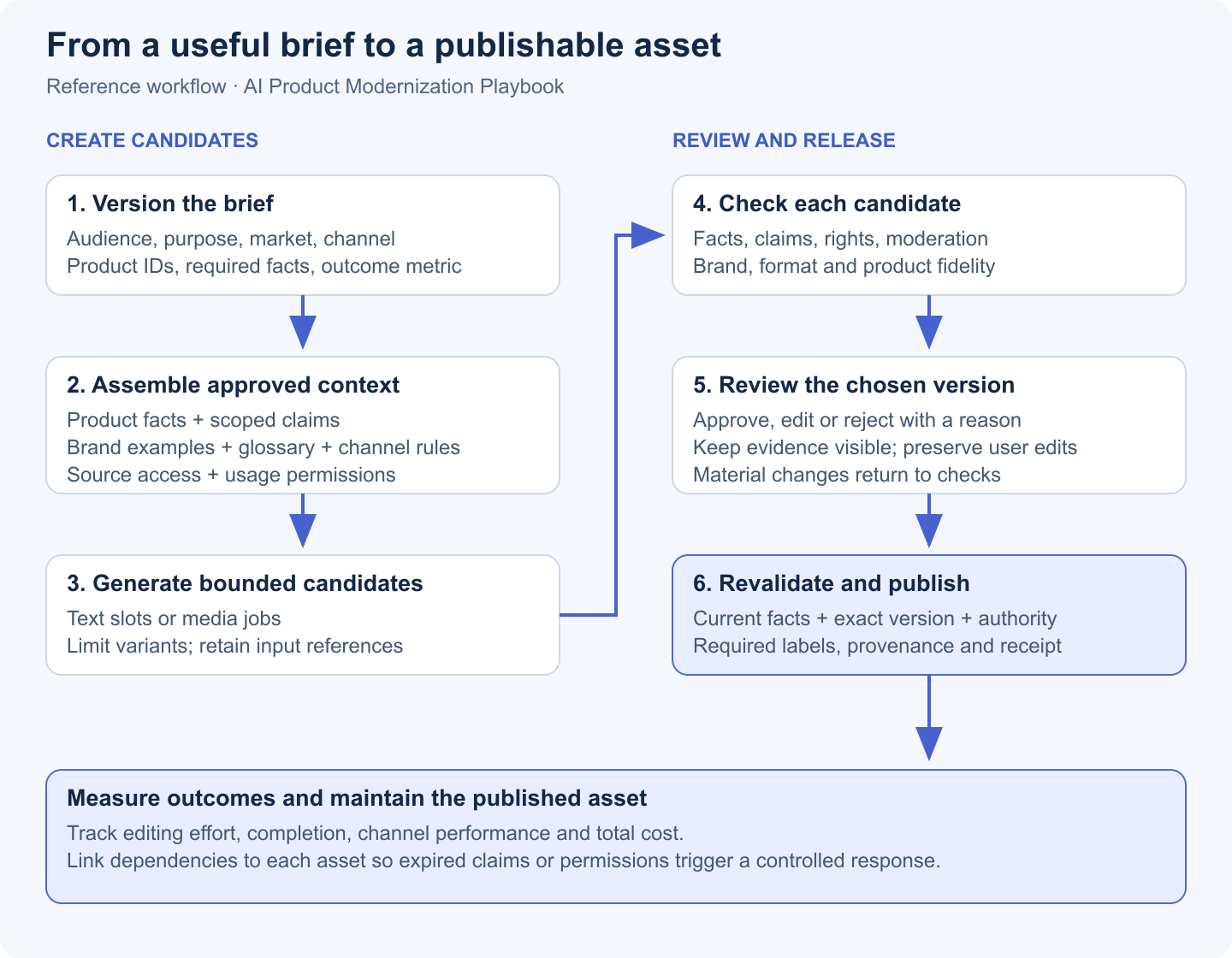
3. Build the workflow around a versioned brief
A brief should be structured data: audience, purpose, channel, market, product identifiers, language, required facts and intended outcome. Include constraints such as tone, length, mandatory wording and prohibited content. Record the brief version so that two model outputs can be compared against the same task.
Assemble context from authoritative systems
Load product facts from the product information system, approved claims from a controlled library, brand examples from the content team and usage permissions from asset records. Resolve tenant and source access before passing material to the model. A document or uploaded brief remains input data, not authority to override product policy.
Generate into explicit slots where the format allows: headline, body, bullet points, call to action and alt text. Slots make limits and required elements testable. For media, keep the visual brief, source assets and output specifications together.
Separate creating a draft from publishing it
The generation endpoint should return candidates and check results. The publishing service should revalidate the chosen version, current facts and applicable permissions before a channel write. A model timeout, a failed check or an unavailable provenance service must not silently turn into permission to publish.
The Knowledge and RAG chapter explains how to retrieve applicable evidence; the same source discipline supports fact-based generation.
4. Keep facts and approved claims under explicit control
A model can infer a plausible specification from similar products. That is precisely what a catalogue feature must prevent. Missing battery life, materials or compatibility should remain missing until the data owner supplies them. Conflicting attributes need resolution before copy is generated at scale.
Use references for wording that must remain exact
Store approved claims with identifiers, product scope, market, channel, evidence, required qualifications, owner and validity dates. Where exact wording matters, let the model select an allowed reference and let the renderer insert the approved text and its required qualification. Validate references against the allowed set; an invented identifier is not evidence.
This limits paraphrase drift. “Tested under specified conditions” must not become “guaranteed in all conditions” because the latter makes a stronger headline. Surrounding prose also matters: unchanged approved words can acquire a misleading implication when placed beside a new promise or image.
Combine deterministic checks for values and required text with semantic review for unsupported implications. A separate checking component helps isolate responsibilities, but model-based checks remain fallible and can share errors with the generator. Calibrate them against expert judgments rather than treating a passing score as proof.
Recheck volatile facts at release time
Prices, availability and offer dates can change between draft and publication. Bind approval to the exact content version and relevant data snapshot. If a material fact changes, invalidate the old approval or regenerate the affected slot and recheck it. Refreshing a price alone is insufficient if the surrounding offer wording is now stale.
5. Make transformations preserve meaning
For shortening, rewriting and summarization, the source bounds the output. Preserve numbers, names, negation, uncertainty and conditions. A shorter sentence that drops “for eligible accounts” has changed the message, even if it sounds clearer.
Define preservation rules by task. A meeting summary may omit conversational detail but must retain decisions and unresolved questions. A tone change can soften phrasing without adding a promise. A translation can adjust syntax without inventing a feature or removing a limitation.
Localize from the target market’s context
Language is only one dimension. Units, naming conventions, product availability, approved claims and required qualifications can differ by market. Load the target glossary and applicable source data, then route uncertain or consequential wording to a qualified reviewer.
Use translation memory and approved terminology where they help consistency. Back-translation can reveal some mistakes, but two fluent versions can preserve the same error. Native review and targeted tests for dates, quantities and culturally sensitive language remain important.
Keep the original visible and allow users to compare versions. Regenerating a selected paragraph should not overwrite a carefully edited document. Record what changed so that recurring corrections lead to better examples and rules.
6. Preserve product fidelity in images, audio and video
For catalogue imagery, distinguish the product from the scene around it. Where the product must remain exact, retain the approved source image as a protected layer and generate the surrounding background. Check packaging, proportions, color, accessories and the impression created by the final composition.
Verify the final rendered asset
A protected mask does not automatically preserve every boundary pixel or prevent a misleading scene. Compare the product region before and after compositing, using tolerances appropriate to resizing and color management. Human review should catch semantic changes, such as accessories appearing to be included when they are not.
Render important prices, logos and required wording from controlled text and graphic layers. This keeps those elements editable and checkable. Inspect the final crop, contrast, safe areas and text legibility at each channel size. OCR can help find unwanted or incorrect text; it does not replace visual review.
For voice and video, retain the approved script and check the final transcript, pronunciation, synchronization and captions. Under the Playbook’s product policy, an identifiable person’s cloned voice or likeness requires a recorded permission scope and a withdrawal process. A generic synthetic presenter should not be presented as a real customer or employee.
Keep emotionally important brand work under experienced creative direction. A faster render or a technically clean frame does not establish that an audience will respond well to it.
7. Track rights, provenance and disclosure separately
Record where every input came from and which uses are allowed. Relevant scope may include editing, commercial distribution, channels, territories, duration and identifiable people. A license to display an asset is not automatically permission to use it for model training. Check model-service terms and source-asset permissions for the actual workflow.
Provenance describes history, not truth
Store the brief, input references, model and configuration, transformations, checks, reviewer and output hash. Where supported and appropriate, attach signed Content Credentials. The C2PA explainer makes an important distinction: provenance can provide evidence about origin and history, but cannot by itself establish whether content is factual. It also explains that provenance metadata can be removed.
Preserve an internal record independently of embedded metadata. Check what survives channel upload and transcoding. Visible audience labels, signed credentials and internal audit records serve different purposes; one should not be assumed to replace the others.
Make market rules maintained configuration
Have the responsible policy owner define disclosure and review requirements for each asset class, market and channel, including any distinction between system-provider and publisher obligations. Version those decisions and review them as rules change. Avoid a single hard-coded “AI label” rule applied to every kind of content.
Do not fabricate testimonials, customer experiences or expert endorsements. The FTC’s consumer-reviews guidance explains the US rule addressing fake or false reviews and testimonials. A generated portrait or a disclosure label does not make an invented customer experience genuine.
8. Put generation beside the work, with useful review controls
Place “draft from product data” beside the description field and rewrite controls beside selected text. Return the result to an editable draft. Make acceptance, editing and publication separate actions so that generating a candidate cannot accidentally send it to an audience.
Show the sources and constraints that matter: which attributes were used, which claim references were inserted and which checks need attention. Reviewers should be able to inspect the evidence without leaving the task.
Reduce review work without hiding uncertainty
Present a small number of meaningfully different candidates. Let the user replace only the headline or selected passage while preserving other edits. In bulk catalogue work, show one row per item with source attributes, generated copy and clear flags. Bulk approval should apply only to the rows and scope explicitly selected.
Capture rejection and edit reasons such as unsupported fact, wrong tone, missing qualification or poor localization. Edit distance is a useful workload signal, but it is not a correctness score: a tiny change can fix a major factual error, and an unchanged draft may have been reviewed carelessly.
For asynchronous media jobs, show progress, allow cancellation and preserve completed work when a later stage fails. Do not require the user to regenerate an expensive asset simply because a thumbnail or channel upload failed.
9. Manage publication and withdrawal as a lifecycle
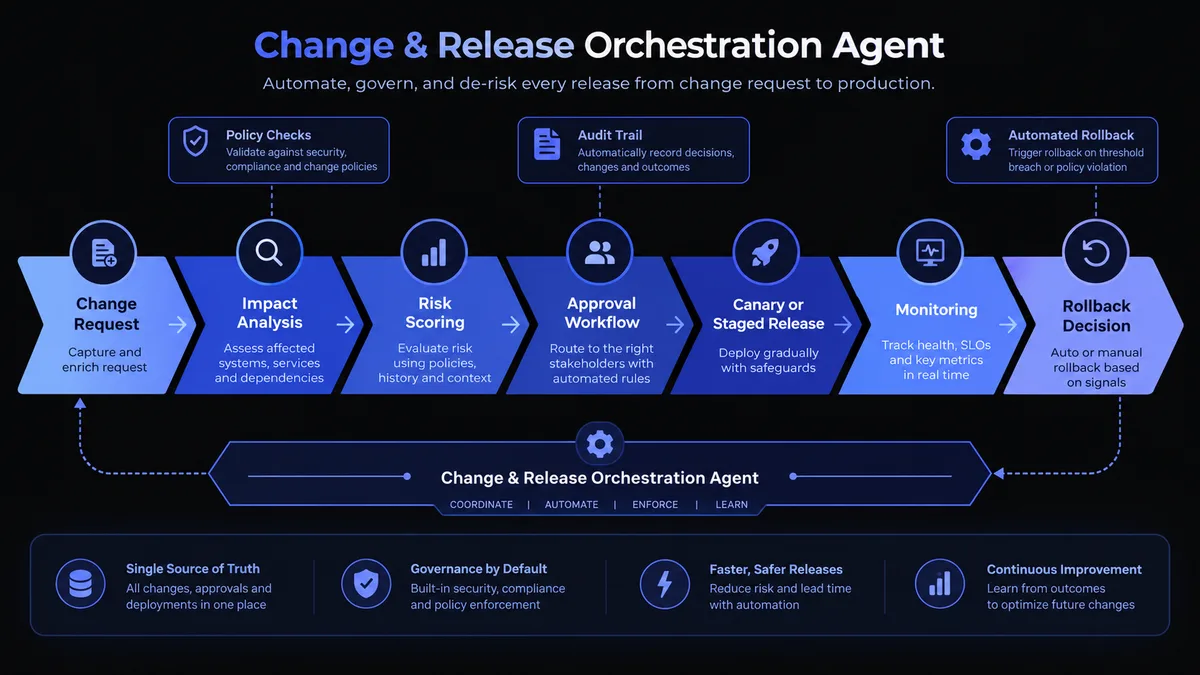
Keep distinct states for generated, checked, in review, approved, publishing, published and withdrawn. An approval belongs to a particular content version and policy context. Edits to material wording, inputs or disclosure should trigger the relevant checks again.
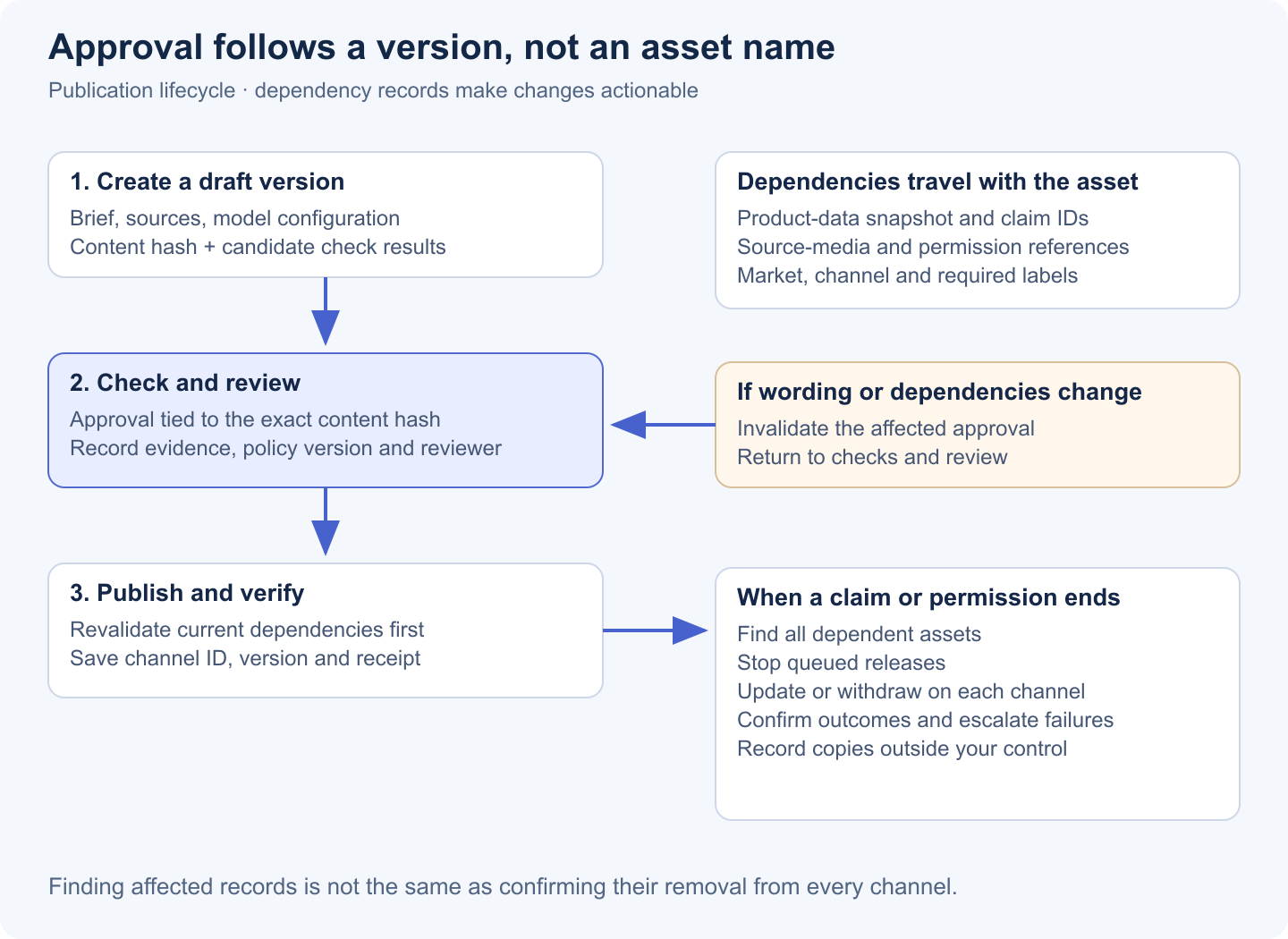
Record channel identifiers and publication receipts. Use idempotency or channel-specific reconciliation so that a retry after a timeout does not create duplicate posts. A successful API response should be followed by a check that the intended version, images and required labels actually appear.
Link published assets to the claims, source media and permissions they depend on. When a claim expires or a source is withdrawn, find affected assets, stop queued releases and initiate updates or takedowns. Track partial failures and escalate channels that cannot be changed automatically.
A database query cannot recall every copy from the internet. The product should distinguish confirmed removals, requested removals and content beyond its control. That makes incident handling more credible than a single “withdraw all” button with no delivery evidence.
10. Evaluate fidelity, usefulness and channel performance
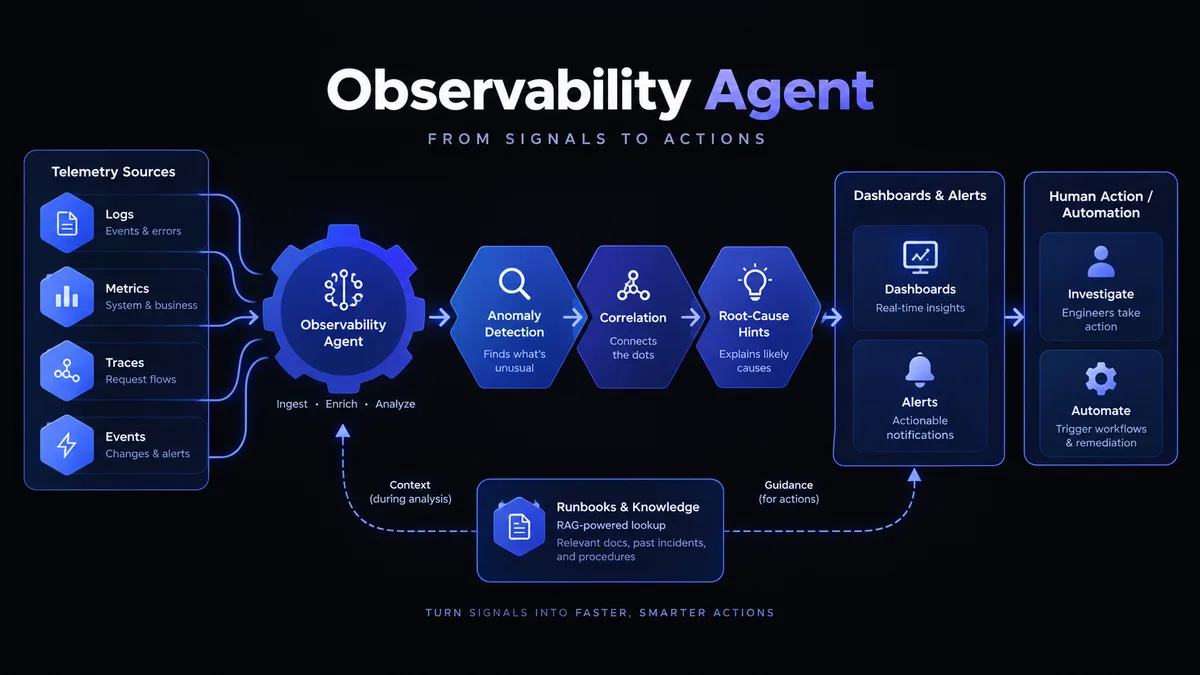
Build a representative brief set before launch. Include missing attributes, contradictory facts, expired claims, unsupported comparisons, ambiguous locales and assets with restricted usage. Test the full rendered result, not just the model’s raw response.
| Dimension | What to measure | Useful interpretation |
|---|---|---|
| Factual fidelity | Traceable facts, retained qualifications and unsupported claims | Fluent wording cannot compensate for a wrong specification |
| Brand and localization | Blind reviewer comparisons, terminology and market suitability | Calibrate automated scores against people responsible for the voice |
| Media quality | Product fidelity, text, captions, cropping and final presentation | A valid file can still communicate something misleading |
| Rights and release controls | Invalid permissions, changed versions and failed required checks | Ineligible content must not reach the publication path |
| User effort | Acceptance, editing time, revision reasons and abandonment | Measure the work removed from the whole task |
| Channel outcome | Conversion, completion, learning or another predefined metric | Compare against the existing content with appropriate quality guardrails |
Swipe the table to see all columns.
An illustrative pilot might target a 25% reduction in median editing time while meeting a predefined non-inferiority margin on the channel metric. Set sample size, exposure period and acceptable uncertainty before testing. These are planning choices, not universal benchmarks. Zero observed failures in a small seeded set does not prove that every future output will comply.
Use randomized comparisons where practical, hold important conditions stable and track complaints, returns or corrections as well as clicks. When testing many variants, account for repeated comparisons and avoid declaring a winner from a small early fluctuation. A predictive performance score can rank candidates; it cannot replace an outcome experiment.
11. Learn from published product examples
Amazon: generation belongs in listing creation
In its announcement of expanded listing tools, Amazon reported more than 100,000 sellers using its generative features and acceptance of suggested attributes nearly 80% of the time with minimal edits. It also encouraged sellers to review details before submission. These are adoption and acceptance measures, not a guarantee that every attribute is correct. Our takeaway is to place assistance directly in the existing creation workflow and retain visible review.
Duolingo: reusable content structure supports scale
Duolingo’s April 2025 announcement described 148 new language courses created and launched in less than a year through generative AI, shared content systems and internal tooling. Its approach reused a base course across languages. The expansion primarily supported beginner levels. Our inference is that reusable content structure and expert ownership matter alongside generation; the announcement alone does not establish equivalent learning outcomes for every course.
Both examples describe their own products and operating conditions. They support design lessons, not a forecast of savings or performance for another team.
12. Roll out one asset class and market at a time
Begin with a low-risk, high-frequency task and reviewed drafts. Compare generated and existing content without revealing the origin to reviewers where feasible. Use the results to improve context, templates and checks before broadening access.
Promote automation only for a defined template, asset class, channel and market after the quality and outcome gates are met. High-consequence claims and sensitive creative work can remain under specialist review. A successful product does not need every workflow to become autonomous.
Budget for the entire path to a published asset
Count generation attempts, checks, media processing, review time, licensing, storage, publishing and rework over the same period. Divide by successfully published assets that meet the quality bar. Include abandoned candidates in the cost numerator so that repeated regeneration is visible.
Cap variants, deduplicate near-identical candidates and reserve expensive methods for tasks where they improve results. Smaller or specialized models may suit stable formats, but compare them on the actual brief set. Protect tenant boundaries when caching context or reusing outputs.
If a provider fails, offer an evaluated fallback or a conventional template. If required release checks fail or are unavailable, retain an explicitly unverified draft and pause publication. Do not let a fallback bypass data-processing permissions or content policy.
Version prompts, models, templates, claims and check configurations. Re-run affected evaluations after changes, review brand-sensitive samples and monitor correction reasons after release. Treat a change in output behavior as a product change, even when the API shape stays the same.
13. Turn the Playbook into a concrete feature
A practical first increment includes an asset baseline, a structured brief, approved context, an editable draft experience, a review policy and an evaluation set. It also records which content version was published and how to find every asset affected by a changed claim or permission.
Infinity Technologies’ Playbook approach starts with the content task and its constraints, then connects generation to the product’s editor, data sources and publishing flow. The question to answer is specific: can users finish this asset faster while preserving factual accuracy, brand intent and measurable usefulness?
Explore the document-processing chapter for turning source files into validated data, or connect with Infinity Technologies to scope one generation workflow and the evidence it should use.
Next in the series: copilots inside the user’s workflow—contextual assistance where decisions and work already happen.
Sources and further reading
Based on the Content Generation chapter of Infinity Technologies’ AI Product Playbook. Primary sources checked on 14 October 2026, Kyiv time. Diagrams are original explanatory illustrations; the hero is an original AI-generated editorial image.