AI Product Modernization Playbook · Article 03 of 12
A user uploads an invoice, a claim or an application form. A few seconds later, the product has filled the relevant fields, highlighted an unclear value and explained what still needs checking. The user stays inside the workflow instead of copying information between a PDF and a form.
That is the useful promise of AI document processing: move information from a file into a business process while keeping its meaning, evidence and uncertainty intact. Reading the page is one step. Classifying it, extracting the right fields, validating them and safely saving the result are the rest of the product.
This chapter of Infinity Technologies’ AI Product Modernization Playbook describes that complete path. It focuses on typed data, field-level evidence, independent checks and an efficient review experience. Examples, thresholds and rollout shapes are illustrative; they are not reported Infinity client results.
On this page
1. Choose a document workflow with a measurable outcome
Start with one document family and one downstream task. “Extract supplier invoices into a reviewed accounting record” is a workable scope. “Understand every business document” is not a useful release boundary. Agree which audience benefits, which fields matter and what a completed document looks like in the receiving system.
Measure monthly volume, handling time, correction rate, exception causes and the cost of rework. Include the time people spend locating missing information or reconciling inconsistent records. If the real bottleneck is an absent purchase order, a faster extractor will simply create exceptions sooner.
Pair automation with an accuracy floor
Straight-through processing means a document completes a defined path without human intervention. Define that path precisely: classification alone, validated data capture and successful posting are different milestones. Report the automation rate beside independently audited error rates for the documents that bypass review.
A higher straight-through rate is useful only if quality remains acceptable. Review volume can fall because extraction improved—or because the system stopped checking. The product dashboard must make that distinction visible.
2. Separate extraction, review and business authority
Document AI can appear as upload-to-prefill, an operational inbox, a customer capture flow or a specialist review workspace. These experiences share a pipeline, but they do not share the same authority.
| Workflow | Useful AI output | Boundary |
|---|---|---|
| Classify and route | Document type, language, page ranges and destination queue | Unknown or mixed types go to triage |
| Extract and prefill | Typed fields linked to source regions | Missing or unreadable values remain unresolved |
| Validate and match | Evidence for totals, duplicate checks and record matches | Rules and authoritative systems determine pass or fail |
| Compare or summarize | Source-linked differences, clauses and draft briefs | Specialists retain interpretive decisions |
| Save to the system of record | A validated, versioned record ready for a controlled commit | Separate service authorization, caps and retry controls apply |
Swipe the table to see all columns.
For an invoice feature, keep bank-detail changes, business approvals and payment release outside the extractor’s tools and credentials. Reading an account number does not authorize using it for payment. The controlled posting service should resolve the payee through an approved vendor identifier and the authoritative master record.
Likewise, recognizing an identity field does not establish identity, and detecting a signature does not authenticate it. Treat those as separate product capabilities with their own evidence and decision policies.
3. Build a durable pipeline around the document
Create a persistent workflow for each intake event. Stages should be independently retryable, observable and able to pause for review. A slow OCR service should not block every other document, and a failed downstream connection should not trigger a new extraction or a duplicate posting.
Capture the original before transforming it
Assign a document ID, preserve the original under the applicable retention policy and record its tenant, source channel, content hash and access classification. Scan and isolate untrusted uploads before parsing them. Apply page, size and processing limits so that a malformed file cannot consume unlimited resources.
Check for a usable text layer before running optical character recognition. Born-digital text can preserve details better than re-reading a rendered image, but a text layer can also be stale, incomplete or inconsistent with the visible page. Route suspicious mismatches to review. Preserve the original and the transformation history for every derived page image.
Classify, extract, validate, decide
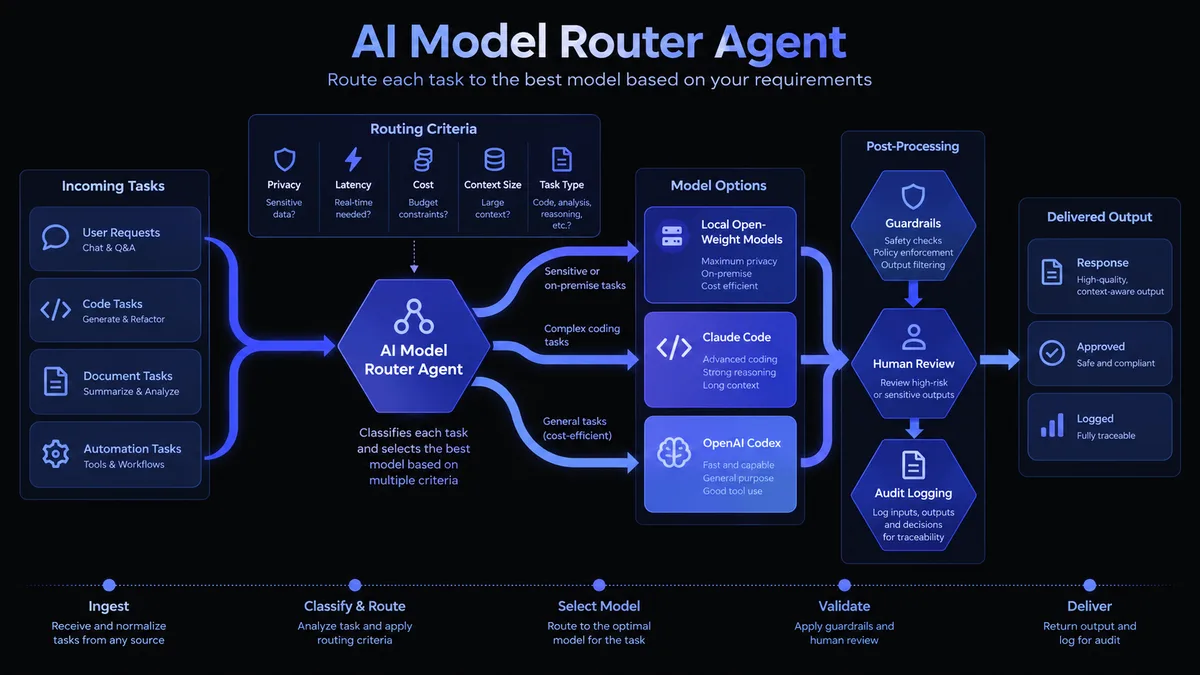
Split document bundles into explicit page ranges. Unknown types go to triage rather than the nearest-looking schema. Extract fields, normalize them in code and run validation. A policy service then chooses review, rejection or a bounded path to the system of record. The model produces candidate data; it does not choose its own authority.
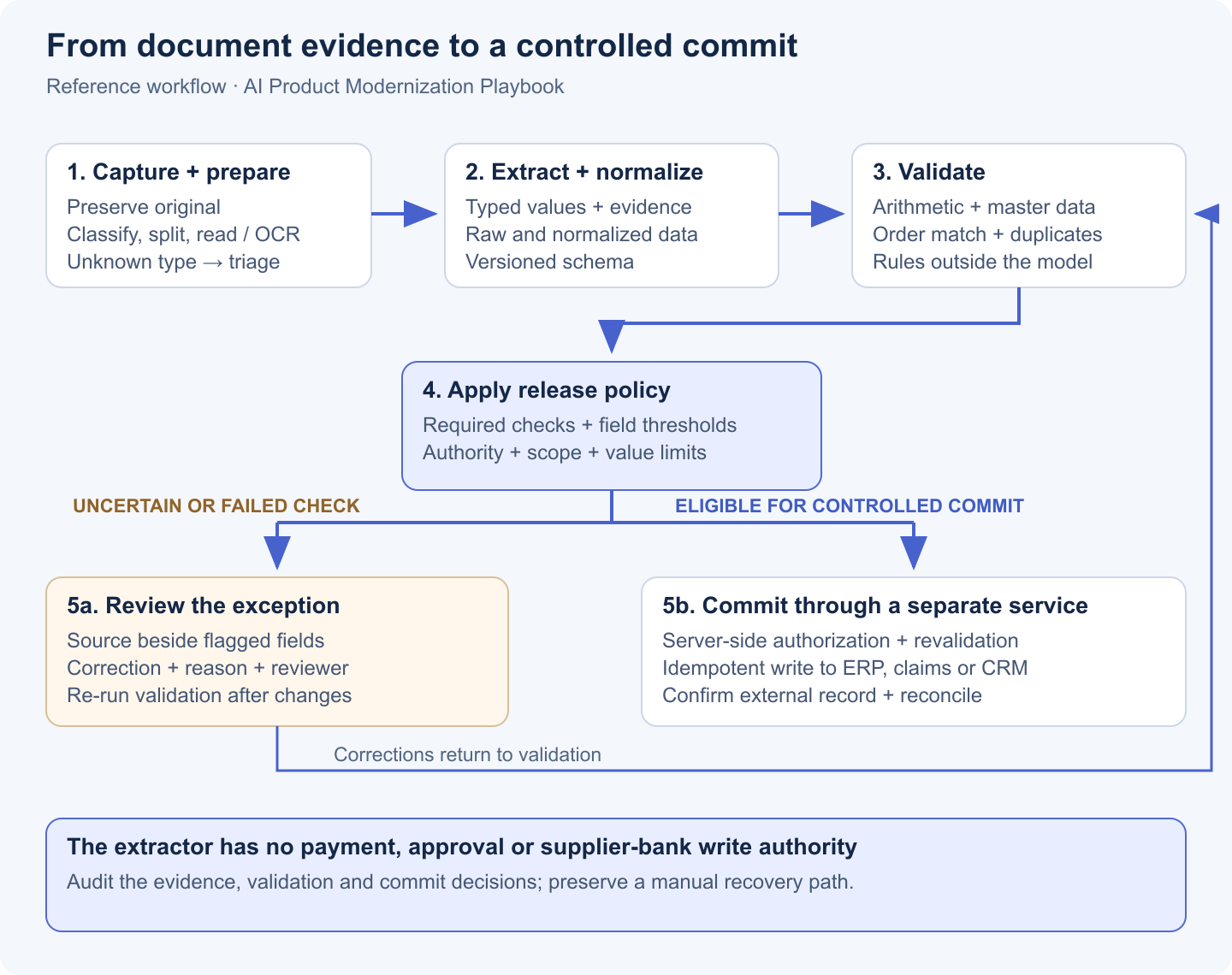
Expose meaningful states to the product: received, processing, needs review, ready to commit, committed and failed. A timeout should show a recoverable state, not a spinner that leaves the user uncertain whether to upload again.
4. Give every field a schema and an evidence trail
The schema belongs to the process owner. Define field names, types, requiredness, criticality, allowed values and validation rules together. Version the schema so that historical records remain interpretable after a new field or rule is introduced.
Store the raw value separately from the normalized value. A field record should also retain document and page identifiers, a source region, extractor version, confidence information, validation status and correction history. An inferred value and a directly observed value must never be indistinguishable.
| Field property | Illustrative value | Why it matters |
|---|---|---|
| Field path | invoice.total_gross | Identifies the business meaning, not just a location on the page |
| Observed text | 1.284,50 € | Preserves what the source actually shows |
| Normalized value | Amount 1284.50; currency EUR | Supports deterministic comparison and arithmetic |
| Evidence | Document version, page 1, total-box coordinates | Lets a reviewer inspect the exact source region |
| Decision state | Needs review: total does not reconcile | Keeps a plausible extraction from becoming a trusted record prematurely |
Swipe the table to see all columns.
Normalization must preserve meaning. The normalized amount above will not literally appear in the source with the same punctuation, so evidence checks should compare the raw text and the recorded transformation. Do not reject legitimate normalization—or accept a fabricated value—using a simplistic substring check.
Represent missing, illegible, ambiguous and not applicable as distinct states. An empty field is useful information. Filling it from a familiar supplier pattern can turn uncertainty into a convincing error.
5. Use the simplest extractor that meets the quality bar
Stable high-volume layouts may work well with templates or specialized layout models. Variable layouts may justify a vision-language model constrained to the document schema. Evaluate both on the actual document mix, including poor scans and unfamiliar suppliers. Model choice should follow measured field quality, latency and total operating cost.
Escalate selectively
Use a cascade when it improves economics: a reliable inexpensive path first, then a stronger method for uncertain regions or fields. Preserve context when escalating; a cropped amount without its column header can change meaning. Bound the number of retries so that a difficult document reaches a person instead of cycling indefinitely.
Line items deserve a separate evaluation. Multi-page tables, repeated headers, discounts, merged cells and wrapped descriptions can produce correct-looking headers while dropping or duplicating rows. Test row alignment and reconciliation, not just whether the final JSON is valid.
Agreement is a signal, not independent proof
A second extraction can help detect critical-field disagreements. However, two calls to the same model—or two methods reading the same corrupted scan—can repeat the same error. Measure their joint failure patterns. For high-consequence fields, combine extraction checks with authoritative records or a review policy rather than assuming that agreement guarantees correctness.
Fine-tuning becomes a candidate when a document family is stable and corrected examples are available. The required data volume and benefit depend on the task. Keep a held-out set, compare with the existing path and retain a fallback for unfamiliar layouts.
6. Validate business meaning outside the model
Run arithmetic, reference checks and business rules in deterministic services. Verify totals with explicit rounding and tax rules, compare quantities and prices with the relevant order, and resolve suppliers through master data. A syntactically valid tax or bank identifier is not proof of ownership or legitimacy.
Use both file-level and business-level duplicate checks. A hash detects the same bytes arriving twice. A rescanned or regenerated copy can have a different hash while representing the same invoice. Compare supplier, invoice number, date, amount and workflow status, with an exception path for legitimate corrections or credit notes.
Never repair an extraction merely to pass a rule
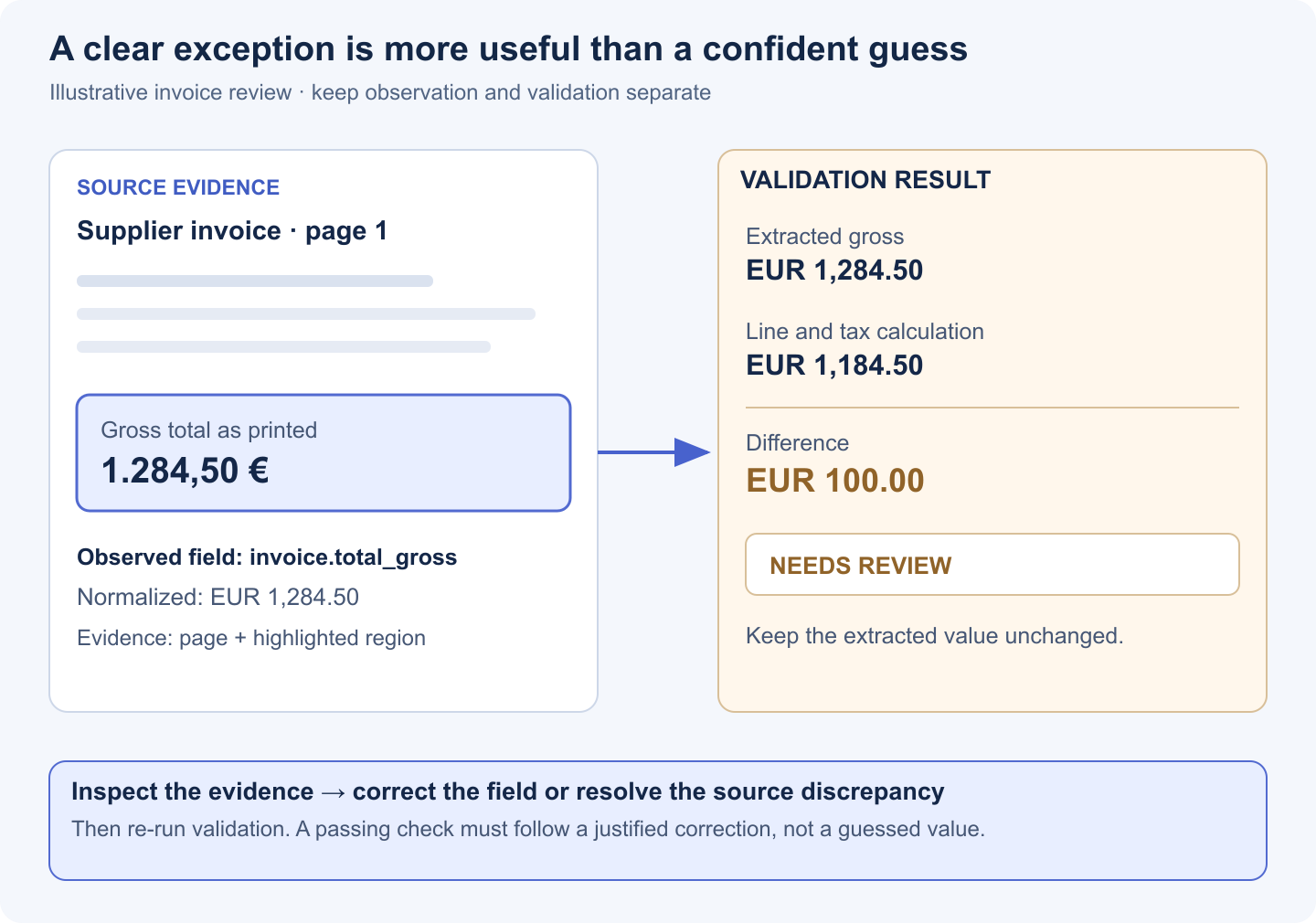
Suppose an invoice shows a gross total of EUR 1,284.50 while its validated line and tax calculation yields EUR 1,184.50. Preserve both observations and display the EUR 100.00 difference. The document may be wrong, the extraction may be wrong or a charge may be missing. Automatically rewriting the total hides the problem.
Locale handling also belongs in explicit rules. Resolve decimal separators and dates from reliable context, not from a model’s preference. If “03/04/2026” remains ambiguous, request clarification or review. Record the rule used and retain the original text.
Checks vary in strength: arithmetic tests internal consistency; a purchase-order match adds a separate reference; neither proves that a document is authentic. Design the acceptance policy around the consequences of the remaining uncertainty.
7. Make human review a first-class product flow
Place the page and fields side by side, with the relevant source region highlighted when a reviewer focuses a field. Prioritize flagged and critical fields while keeping the complete document accessible. Show plain-language reasons: “The line total differs by EUR 100.00” is more useful than “Rule 14 failed.”
Support keyboard navigation, clear unresolved states and deliberate confirmation of material corrections. Save who changed what, the before-and-after values and a reason such as misread, wrong region, missing source or normalization error. Corrections should re-run the affected validation rules before release.
Calibrate thresholds against observed outcomes
Microsoft’s Document Intelligence guidance describes confidence at several extraction levels and its use in routing predictions to human review; not every field returns a score. In your product, verify how scores behave on representative held-out documents. A model’s self-reported confidence should not automatically become a calibrated probability of correctness.
Set thresholds by field and consequence. An optional description and a payment amount do not warrant the same treatment. Expected error cost can inform review routing, but hard authority rules and mandatory checks still apply. Review itself is fallible, so audit reviewed outcomes as well as automated ones.
Watch queue age, handling time and downstream correction rates together. If reviewers are overwhelmed, fix extraction, capture or upstream data quality; do not quietly relax critical checks to make the queue disappear.
8. Commit validated data through a separate service
The commit service should accept a document identifier, approved business identifiers, a versioned field set and an idempotency key. It rechecks the applicable authorization, validation results and value limits server-side. Extractor output is input to this service, never permission to bypass it.
Bind approval or automated eligibility to the exact field-set version being committed. If a user edits an amount after review, the old decision is no longer sufficient. Load current master-data references again where changes would affect the action.
Design for uncertain outcomes
An integration timeout may occur after the receiving system has saved the record. Retry with the same idempotency key and reconcile the external record before creating another. For multi-step operations, persist each outcome and provide a tested correction, cancellation or reversal path appropriate to the receiving system.
Distinguish “extracted,” “validated” and “saved successfully” in the user interface. Show an external reference only after confirming the commit. Keep a manual recovery path for failures that cannot safely be retried.
Requests for missing information should begin as reviewable drafts with approved templates. Sending them is another workflow with its own authority; it is not a hidden side effect of parsing a document.
9. Protect documents, sensitive fields and model boundaries
Classify data before choosing the processing route. Use only models, storage regions and subprocessors approved for that data class and contractual context. Restrict tenant access throughout originals, page images, extracted fields, review screens, logs and evaluation copies. Retention applies to derived artifacts as well as the uploaded file.
Extract only the fields required for the workflow. Avoid copying identity, payroll or health information into general-purpose logs. Redact or restrict diagnostic samples and evaluation datasets, and make deletion behavior explicit across caches and derived records.
Documents are untrusted input. Hidden text or a visible instruction to “approve this invoice” is content to analyze, not an instruction to execute. Keep the extraction environment without payment, approval or supplier-master write capabilities. Combine input isolation, schema checks and backend authorization; detecting suspicious prose alone is not a reliable security boundary.
Contract processing needs additional context: definitions, cross-references, amendments and the governing agreement family. A clause extraction can support specialist review, but a detached paragraph is an incomplete basis for interpreting obligations. The Knowledge and RAG chapter covers source applicability and evidence retrieval for such workflows.
10. Evaluate the long tail and the auto-accepted path
Build an adjudicated reference set by document type, language, supplier or source, layout and capture quality. Include missing fields, confusing tables, duplicates, ambiguous locales and unfamiliar types. Split near-duplicate documents across datasets carefully so that repeated templates do not inflate measured generalization.
| Measure | Test deliberately | Release implication |
|---|---|---|
| Classification and splitting | Unknown types and bundles with several documents | Misroutes must be visible and recoverable |
| Critical-field accuracy | Amounts, identifiers and consequential dates | Report errors on auto-accepted values separately |
| Line-item quality | Multi-page tables, negative lines and repeated headers | Check rows and totals, not just field presence |
| Missing-value behavior | Blank, cropped, illegible and ambiguous fields | Uncertainty must survive extraction |
| Validation and authority | Seeded mismatches, duplicates and attempted bank changes | A failed required control blocks the automated path |
| Operational completion | Peak arrivals, review backlog and downstream outages | Measure successful completion within the business SLA |
Swipe the table to see all columns.
An illustrative pilot might require at least 99.5% accuracy on auto-accepted critical values, while allowing a lower automation rate until evidence improves. That is a planning example, not a universal safety standard. Define the matching rule, denominator, sampling method and uncertainty before using it as a gate. A small test set with no observed errors does not establish a zero-error system.
Audit a random sample of auto-accepted documents independently, then add targeted samples from new layouts and recent failures. Keep those sampling purposes distinct when estimating overall error. Refresh the reference set from corrections without contaminating the held-out benchmark.
11. Learn from published implementations
Uber: line items and review design matter
In its April 2025 account of TextSense, Uber described a reusable document platform with OCR, language-model extraction, business-rule post-processing and a side-by-side review interface. Uber reported a 70% reduction in average invoice handling time and 25–30% cost savings compared with its manual process. Its discussion also distinguishes header accuracy from line-item performance. Our takeaway is to evaluate the complete workflow and difficult rows, rather than choosing a model from header-field accuracy alone.
Rocket: document and data-point automation are different
Rocket Companies’ April 2024 announcement reported that Rocket Logic automatically identified nearly 70% of more than 1.5 million documents received monthly. It separately reported that nearly 90% of 4.3 million extracted data points in February 2024 were processed automatically. Those are different denominators and should remain separate in a product dashboard. The announcement also describes underwriter oversight.
These are company-reported results in their own operating environments. They illustrate useful design and measurement choices; they are not forecasts for another product or evidence of Infinity delivery results.
12. Roll out with review capacity and recovery in mind
Start in shadow mode: process representative documents while the existing workflow continues, and compare field-level results. Then introduce prefill with full review. This tests the actual user experience and produces corrections before the product relies on automated acceptance.
Enable straight-through processing for a narrow, stable slice only after its quality and authority controls meet the agreed gate. Expand by document family, source group and value limit separately. Keep each change reversible through configuration.
Plan for the workload beyond model inference
Capacity includes OCR, model calls, validation dependencies, storage and people. Replay peak arrival patterns and measure whether the review team can handle the resulting exceptions. Prioritize queues by business consequence and due time, with protection against low-priority work being forgotten.
Calculate cost per successfully completed document over a defined period: capture, processing, validation, review, support and downstream rework divided by completed documents. Count retries and unresolved work in the operating picture. Faster inference is not a saving if reviewers spend longer repairing its output.
When OCR is unavailable, queue work with visible status. When the main extractor is unavailable, use only validated fallback methods and increase review where needed. When the receiving system is unavailable, hold validated records for controlled retries. Preserve a manual route throughout.
Treat model, prompt, parser, schema and normalization changes as releases. Run the affected benchmark, compare results on shadow traffic and monitor correction reasons after rollout. A supplier layout change may affect one slice sharply while the overall average appears stable.
13. Turn document AI into a product increment
A practical first increment has a defined document family, a business-owned schema, a tested evidence record, independent validation and a review screen people can use efficiently. It also has a clear receiving-system contract and a baseline against which improvement can be measured.
Infinity Technologies’ Playbook approach begins with those artifacts: a process baseline, a critical-field map, representative labeled documents, an extractor comparison and a business case that includes review and downstream errors. The implementation connects capture, evidence, validation and product experience before increasing automation.
For a related authority design, see the Procurement Agent engineering guide, which separates model-assisted preparation from approvals and financial execution. To discuss document processing inside your product, connect with Infinity Technologies around one document family and the task it should complete.
Next in the series: content generation—building useful drafts, transformations and creative workflows into a product.
Sources and further reading
Based on the Document Processing chapter of Infinity Technologies’ AI Product Playbook. Primary sources were checked on 13 October 2026. Diagrams are original explanatory illustrations; the hero is an original AI-generated editorial image.
- Uber Engineering: Advancing Invoice Document Processing at Uber using GenAI (17 April 2025).
- Rocket Companies: Introducing the Rocket Logic AI Platform (9 April 2024).
- Microsoft Learn: Interpret and improve accuracy and confidence scores.
- Infinity Technologies: Segregation of Duties Encoded in the Tool Layer.