

AI Product Modernization Playbook · 08 / 12
Anomaly detection becomes valuable when an unusual event reaches the right person early enough to change the outcome. The product must connect a signal to evidence, an owner and a response that fits the situation.
Consider an operations team opening its monitoring dashboard to find hundreds of red indicators. Some reflect a planned deployment, others a delayed data feed, and several describe the same underlying incident. Somewhere in that queue is a problem that needs attention now. A more sophisticated detector will not necessarily make that problem easier to find.
This chapter of the AI Product Playbook explains how to add useful anomaly detection to an existing product. It covers reliable inputs, contextual baselines, model selection, alert budgets, investigation workflows and outcome measurement. The goal is a system that helps users respond to meaningful incidents while making the cost of false alarms and missed events visible.
On this page
1. Define the incident and the useful response
Begin with a concrete incident class: an unexpected billing gap, a degrading machine, a broken data feed, suspicious account activity or a conversion drop after a release. State what harm matters, how the team discovers it today, and how much time is needed to do something useful.
Write an incident contract
Specify the monitored entity, event boundary, response owner, investigation deadline and allowed actions. For a data pipeline, the contract might identify a materially incomplete batch before downstream reports are refreshed, route evidence to the data owner, and allow a controlled quarantine while the batch is checked. Define how a batch is released and who handles the exception.
Separate unusual behavior from the incident you care about. A successful campaign can produce an unusual sales spike. A small, familiar pattern can still represent material loss. An anomaly score measures departure from a learned reference; it does not automatically measure harm, fraud probability or the urgency of intervention.
Match notification urgency to the decision
A page should request an immediate response, while a ticket or digest can support work that can wait. Google's Monitoring Distributed Systems describes this distinction and emphasizes actionable monitoring. Apply the same discipline to customer-facing features: “tell me when something changes” needs a definition of what deserves interruption and what belongs in a daily review.
2. Monitor the inputs before interpreting the signal
A detector cannot distinguish a healthy process from a silent sensor unless the product models data availability explicitly. Missing, late, duplicated, stale and invalid readings are separate states. Do not turn a missing observation into a zero or carry a stale value forward indefinitely while displaying a green status.
Preserve time, identity and operating context
Store event time and arrival time, stable entity identifiers, units, sampling intervals and quality flags. Define a late-data policy: how long to wait for a complete window, when to issue a provisional result, and how corrections affect an existing incident. Reprocessing a historical batch should not accidentally page the team as though a new incident had just begun.
For a machine, include operating mode, load, maintenance and sensor changes. For a business metric, include calendar effects, traffic mix, campaigns and deployments. For an account, use authorized history and relevant peer context without mixing tenants or exposing another customer's activity in the evidence pack.
Historical replay must reproduce the information available at the decision time. A chargeback, maintenance finding or corrected record that arrived later belongs in the eventual outcome, not in the original feature snapshot. Version preprocessing and normalization as carefully as the model. The forecasting chapter develops the same principle for predictive features.
3. Start with understandable baselines
Rules and statistical baselines are useful first candidates. Known engineering limits, impossible values, reconciliation failures and missing heartbeats often have direct explanations. Seasonal residuals, robust reference ranges and trend detectors can identify deviations that static thresholds miss.
Choose a method for a specific failure pattern
Compare multivariate methods such as isolation forests or local outlier models when combinations of otherwise ordinary signals matter. Consider sequence or reconstruction models when temporal structure justifies their complexity. Graph features can help reveal relationships across entities, but a shared device or address is evidence to investigate rather than proof of coordinated abuse.
Distinguish detecting outliers in a potentially contaminated training set from detecting novelty relative to a reference set believed to represent normal behavior. The scikit-learn documentation explains this distinction and the different assumptions of supported methods. A model's contamination setting should not be presented as an independently measured incident rate.
As reliable labels accumulate, benchmark supervised incident classifiers against the existing detector. They may improve precision for known incident classes; they do not automatically dominate every unsupervised method, and they still need checks for unfamiliar failures. Select the simplest approach that improves performance at the actual operating threshold.
Avoid learning the failure as normal
An adaptive baseline can absorb slow deterioration. Compare a recent baseline with a longer-term reference and monitor persistent trends. Freeze or exclude confirmed incident periods under a documented training policy. After maintenance, sensor replacement or a genuine regime change, explicitly review the reference instead of letting an unexplained reset erase the evidence.
4. Build the incident workflow around the detector
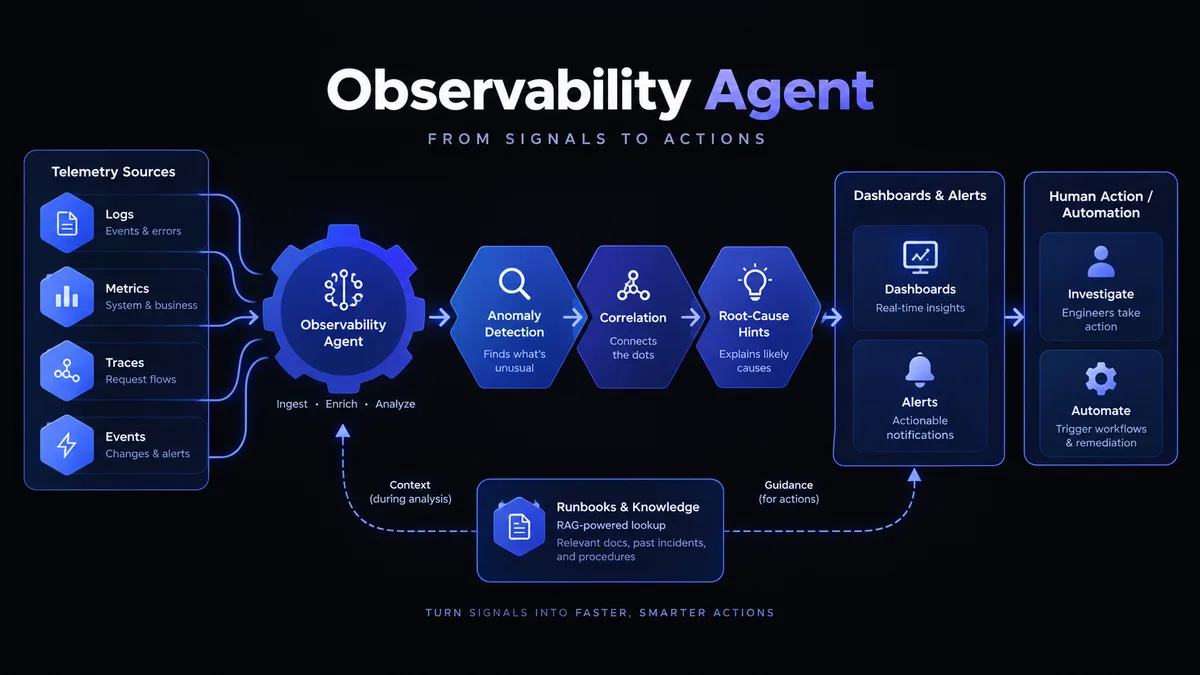
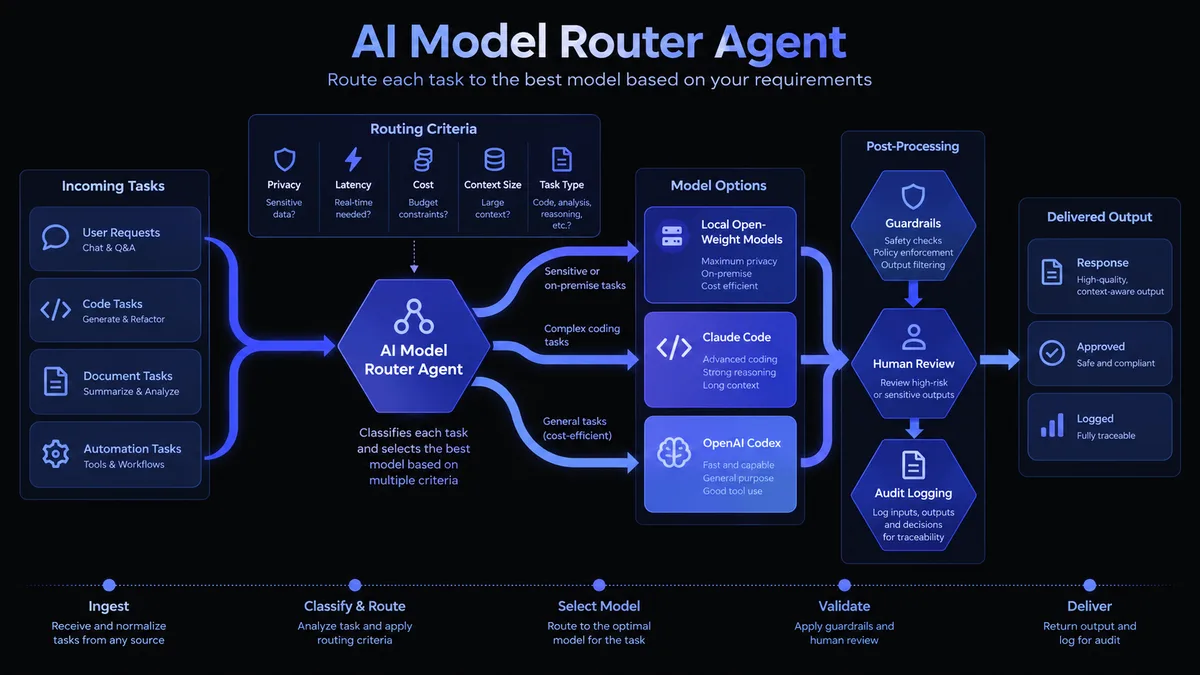
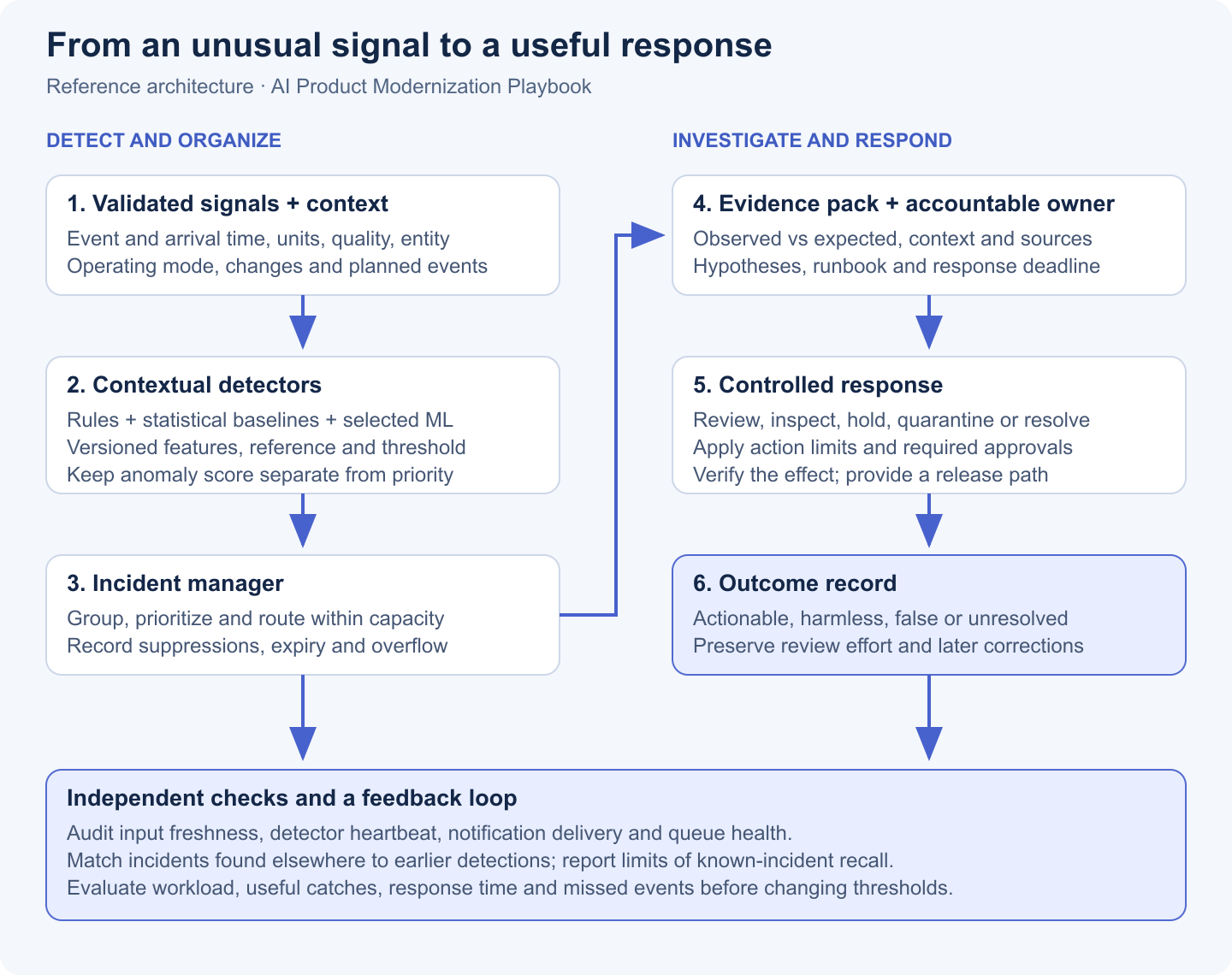
A production system needs more than scoring. Separate ingestion, feature computation, detection, incident management, evidence retrieval, response and outcome capture. These components may share infrastructure with other AI capabilities, but their responsibilities should remain inspectable.
Version the decision record
Each candidate should carry the tenant and entity, event window, arrival time, detector version, baseline version, score, applicable threshold and evidence references. Link candidates to an incident identifier so repeated signals can be evaluated and handled together without losing their individual history.
Record the incident owner, severity rationale, routing policy, acknowledgement, suppression, action and eventual outcome. Keep the score distinct from any calibrated incident probability and from business priority. Rescaling two model scores to the same numerical range does not make them equally meaningful; learn and validate a combination rule when evidence supports one.
A separate stream should capture incidents discovered by audits, customers, technicians or other controls. Match them to earlier detection records within an explicit time window. This supports analysis of known misses, while acknowledging that incidents nobody discovers remain outside the dataset.
5. Set thresholds with base rates and capacity in view
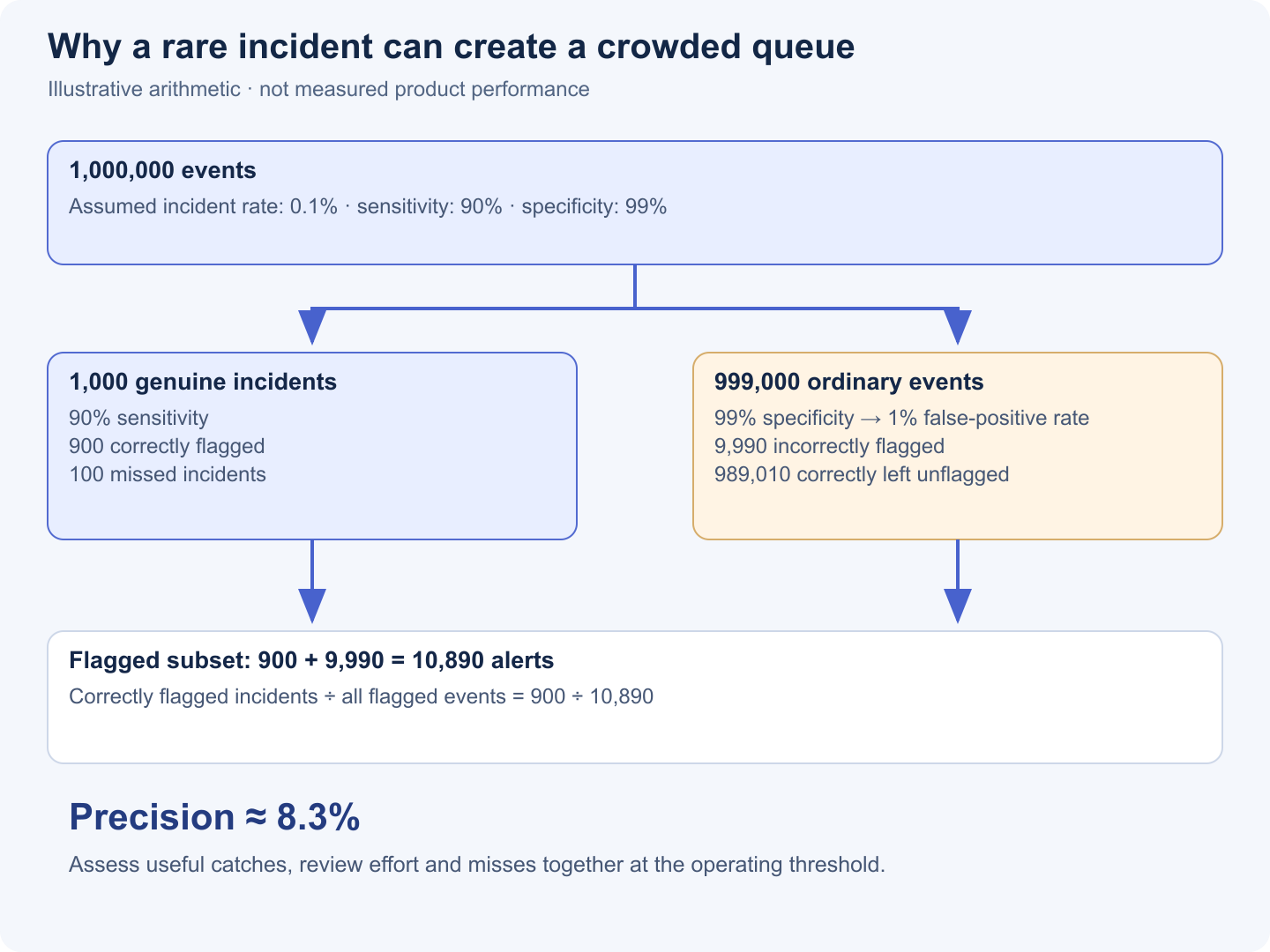
Rare incidents make false alarms expensive even when a detector sounds accurate. In an illustrative population of one million events, suppose 0.1% are genuine incidents. A detector with 90% sensitivity and 99% specificity catches 900 incidents but also flags 9,990 ordinary events. Only about 8.3% of its 10,890 alerts correspond to incidents.
Budget the whole queue
Set an operating budget in investigation effort as well as alert count. Five complex incidents may require more work than fifty straightforward checks. Evaluate thresholds after deduplication and grouping, using the combined load from all detectors that share a team. Measure peak demand and backlog age, not just the daily average.
Use an explicit overload policy: prioritize material incidents, reserve capacity for urgent events, route lower-priority work to a digest, and escalate sustained overload. A queue cap must not silently discard critical candidates or conceal a worsening incident rate. Retain enough records to audit what was delayed, suppressed or dropped.
Raising a threshold changes misses as well as workload. Compare both effects before release. Fixed top-k ranking can force alerts during quiet periods and hide a surge during an attack; combine ranking with minimum evidence requirements and a separate urgent-event path where the incident contract requires it.
6. Reduce noise with context, grouping and expiry
Condition baselines on relevant operating states. A startup sequence should not be judged against steady operation, and a holiday should not inherit an ordinary weekday reference without validation. Context should explain a deviation, not automatically excuse it: a deployment or campaign can itself introduce a real failure.
Group symptoms without hiding distinct incidents
Define grouping keys using tenant, entity, incident class and a suitable time window. Correlated signals may belong to one investigation, but unrelated failures on the same asset should remain distinguishable. Preserve child alerts and allow operators to split an incorrectly grouped incident.
Prometheus Alertmanager illustrates three useful mechanisms: grouping related alerts, inhibiting dependent notifications when another alert is active, and time-bounded silences. A product can use those concepts without assuming that grouping has established the root cause.
Give every suppression a reason, scope, owner and expiry. Show how much monitoring it affects and review recurring extensions. Persistence checks, cooldowns and different thresholds for opening and closing an incident can reduce flapping, but they also add delay. Evaluate that delay against the time available to respond, and preserve independent hard-limit checks where needed.
7. Give the operator an evidence pack
The investigation screen should answer practical questions: what changed, compared with which reference, over what time, and why does it matter now? Show observed and expected values with units, data freshness, relevant context and the affected entities. Link to the underlying records rather than asking the operator to trust a generated explanation.
Distinguish observations from hypotheses
Contributing features, similar past incidents and a nearby deployment are useful clues. They do not establish cause. Label possible explanations as hypotheses and show the checks that could confirm or reject them. If the detector has only a novelty score, avoid a badge that implies a calibrated probability of failure.
A language model can summarize evidence returned by authorized tools, assemble a timeline and propose the next runbook step. Require its numerical statements and citations to match those records. Treat logs, ticket text and retrieved documents as untrusted content; text inside them must not grant access or authorize an action. Keep diagnosis and action approval grounded in the validated workflow.
Make the next step easy: assign the case, request a specific inspection, open a work order or review a quarantined batch. For customer-facing monitors, offer clear sensitivity choices, notification channels, digests and an explanation of how each setting changes interruptions. Record the configuration version used for every notification.
8. Separate detection from authority to act
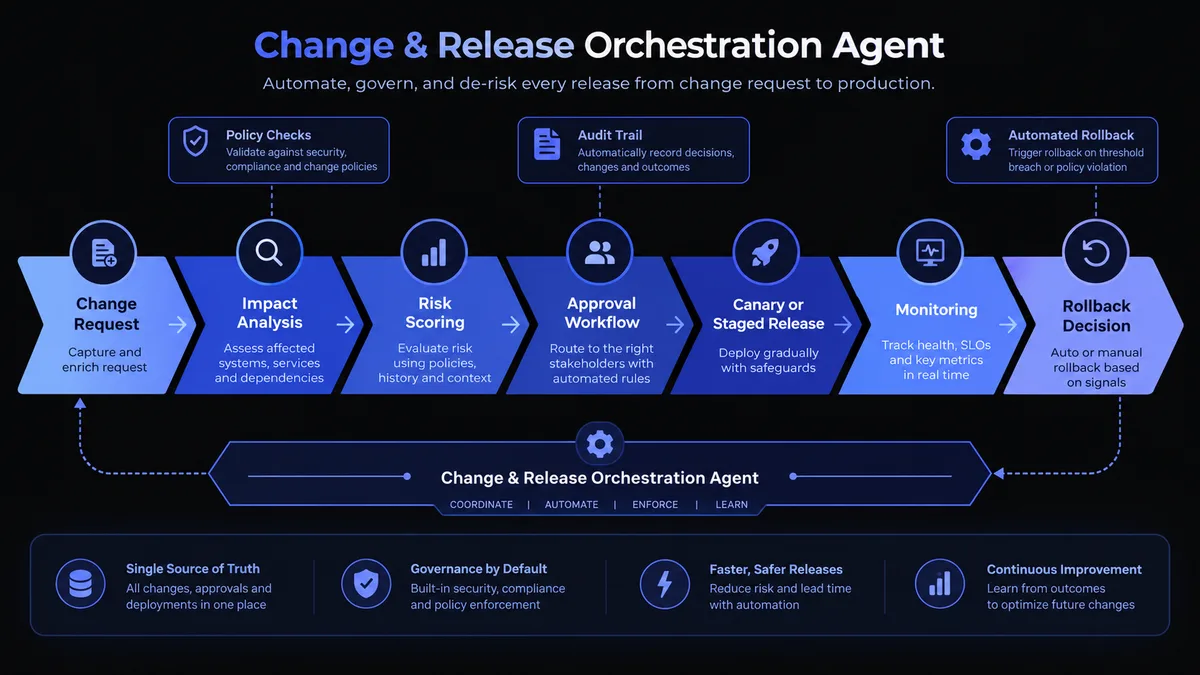
A high anomaly score should not itself grant permission to change production systems or restrict a person's access. Define allowable responses by incident class, evidence, current state and impact. A useful progression is evidence-only monitoring, operator-approved actions, and narrowly bounded automation once the complete response has been evaluated.
Design the release path before the hold
A temporary hold, pause or quarantine needs a deadline, accountable owner, status visibility and a tested release path. Reversible actions can still create harm: delayed payments, stalled reports or interrupted production have real costs. Track those effects and verify that the action changed the intended target only once.
For consequential decisions about individuals, provide meaningful review, inspect error patterns across relevant groups where lawful and appropriate, and make corrections possible. Human review must include evidence and the authority to disagree; adding a confirmation button alone does not establish a reliable decision process.
In industrial systems, condition monitoring can inform maintenance and controlled response. Treat independent engineered safety functions as a separate design responsibility. A predictive model's evaluation does not certify it to replace those functions. The agentic automation chapter covers bounded tools, verification and recovery for downstream actions.
9. Capture outcomes without manufacturing certainty
Use an outcome taxonomy that reflects both technical detection and operational value: confirmed actionable incident, real but harmless deviation, false detection, and unresolved or insufficient evidence. Keep “no action taken” separate from “nothing was wrong.” A case may be real but too late to mitigate, or remain unconfirmed because an investigation could not be completed.
Make denominators visible
Report actionable precision among resolved investigated cases: actionable incidents divided by actionable incidents, harmless deviations and false detections. Show unresolved and unreviewed volume alongside it. If you also report technical anomaly precision, name that metric separately. Excluding harmless deviations from the operational denominator would hide work that consumed attention without requiring a useful response.
Labels mature at different speeds. A transaction can receive a later dispute, and a suspected component fault may require inspection. Evaluate comparable maturity windows and preserve revisions. A new detector should not appear better simply because its difficult outcomes have not arrived yet.
Investigating only flagged cases creates selection bias. Where practical and authorized, review a representative sample of unflagged activity and incorporate independently discovered incidents. A stratified sample needs its sampling probabilities accounted for when estimating population rates. Recall on known incidents remains a limited view when discovery itself is incomplete or biased.
10. Evaluate incidents and response, not isolated points
Replay history in chronological order, including late data, contextual changes, suppression rules and response queues. Hold out later periods and, when testing transfer to new assets or customers, hold out those entities too. Fit preprocessing within the training period. An offline change-point method that sees the whole sequence must not be credited with knowing the future during an online replay.
Swipe horizontally to read all columns.
| Question | Metric or test | Interpretation |
|---|---|---|
| Are interruptions useful? | Actionable precision at the operating threshold; review effort | Include harmless deviations as operational noise and show unresolved outcomes. |
| What is being missed? | Recall on known incidents; review of sampled unflagged cases | Report discovery and sampling limits; avoid claiming complete recall from incomplete labels. |
| Is there time to act? | Detection delay, acknowledgement time and remaining intervention lead time | Include data delay, persistence windows and queue waiting, not only model latency. |
| Can the team cope? | Incidents per shift, investigation minutes and backlog age | Measure combined load, burst behavior and overflow handling. |
| Are responses proportionate? | False holds, release time, reversals and user impact | Evaluate the policy and operator workflow alongside the detector. |
| Does monitoring survive failure? | Seeded missing feeds, stale features, routing failures and scorer outages | Confirm independent health signals and the documented fallback. |
Define an incident matching rule before scoring: entity, interval, allowed detection window and treatment of duplicate alerts. One alarm near the end of a long incident should not retroactively make every earlier point a successful detection. Report event-level catches, misses and first useful detection time.
Test normal transitions as well as failures: launches, seasonal peaks, maintenance and sensor replacements. Injected faults are useful for verifying paths and known behaviors, but success on synthetic patterns does not establish recall on all future incidents. Compare the candidate with existing monitoring at similar operating cost and acceptable response delay.
11. Read deployment evidence with its limits
Knight Capital: warnings need a response system
In its account of Knight Capital's August 2012 trading incident, the SEC reported that an internal system generated 97 automated emails identifying an error before the market opened. The messages were not designed as system alerts and were not acted on that day. The firm ultimately lost more than $460 million. This was a failure of deployment and controls, not a benchmark of an AI detector. The lesson for anomaly products is to test whether a signal reaches an accountable responder with an effective action path. See the SEC's original release.
Mastercard: detection and false positives belong together
Mastercard's February 2024 announcement of Decision Intelligence Pro described relationship-based transaction assessment. It reported an average 20% improvement in fraud detection in initial modelling and more than an 85% reduction in false positives in its own analysis. These are company-reported findings from the announcement, not independently established results for every customer or a promise for another product. Their practical relevance is the joint attention to detection and legitimate activity incorrectly flagged. See Mastercard's announcement.
12. Roll out with a fallback and a health signal
Start with historical replay, then shadow mode, where candidates are generated and sampled for review without new automated interventions. Pilot with one incident class and a team that can record outcomes. Validate routing, acknowledgement, investigation, response and release together before expanding the monitored population.
Watch the monitoring system itself
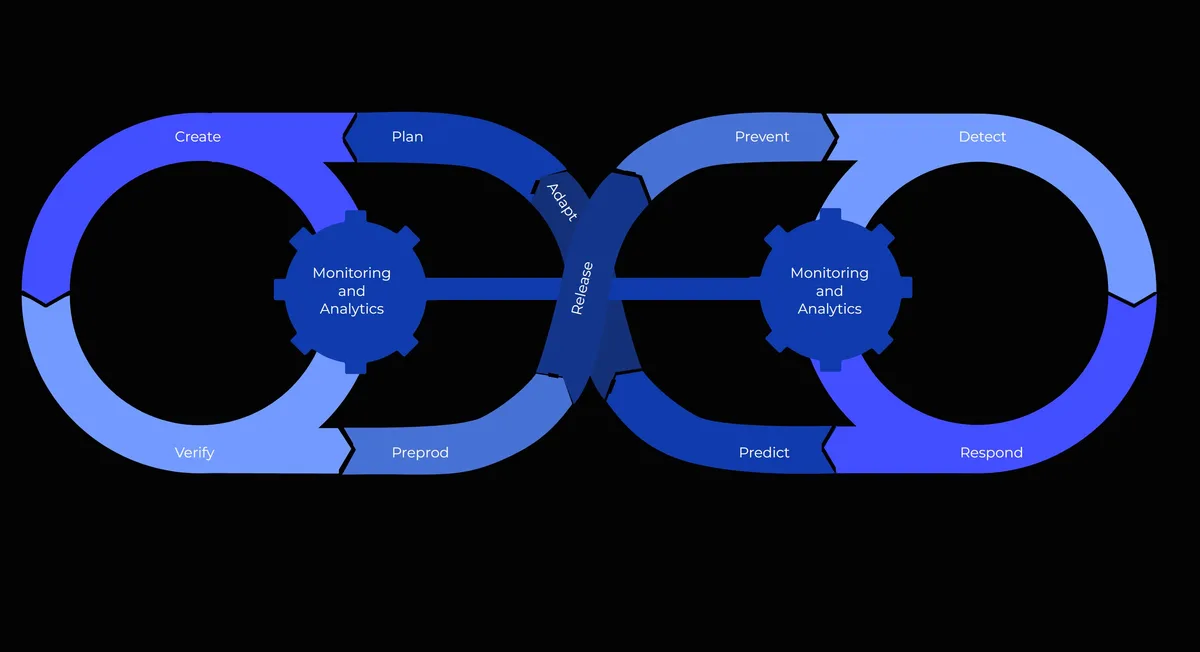
Track input coverage, feature freshness, completed scoring windows, detector heartbeat, notification delivery and queue health. An independent check should detect when the scorer or its notification path disappears. A sudden drop in alert volume can mean improvement, a broken feed or evasion; examine supporting evidence before treating it as success.
Choose a fallback for each domain. A scoring timeout may use a validated rule set, route uncertain work to review or pause a particular automated response. There is no universal “conservative” default: an indiscriminate block can be as harmful as allowing everything. Show degraded monitoring explicitly and record which decisions used fallback behavior.
Treat threshold, feature, suppression and response-policy changes as releases. Compare them on historical and live shadow data, record the expected tradeoffs, and keep a rollback path. For edge deployments, test connectivity loss, local buffering, version consistency and updates through the site's change process.
Estimate value using confirmed incidents, the plausible benefit of earlier intervention, review effort, false-intervention costs and platform cost. Avoid presenting the full potential loss of every flagged event as money saved. Counterfactual loss is uncertain; use ranges, transparent assumptions and prospective comparisons where feasible.
13. Build one complete monitoring capability first
The first release should cover one incident class from signal to outcome. Deliver an incident contract, input-quality checks, a baseline detector, chronological evaluation, an evidence screen, a response owner and an outcome record. Include an overload policy, expiring suppressions and a tested fallback from the beginning.
Use early investigations to improve context and labeling before adding model complexity. Expand when the team can show that the system catches meaningful incidents in time, fits its operating capacity and handles mistakes predictably. That evidence makes anomaly detection a dependable product capability.
If you are planning this feature in an existing product, begin with the incidents users already investigate and the actions they can realistically take. Those workflows reveal which signals are worth collecting and which model improvements would change the outcome.
Next in the series: risk scoring and propensity—how to turn predictions about future outcomes into calibrated, reviewable product decisions.
Sources and further reading
This article develops the anomaly detection and monitoring chapter of the AI Product Playbook. The architecture, scorecard and base-rate example are implementation guidance and illustrative arithmetic, not measured Infinity Technologies client results. Primary references were checked for the external claims below.
- Rob Ewaschuk, Google SRE, Monitoring Distributed Systems, for actionable monitoring and notification urgency.
- Prometheus, Alertmanager documentation, for grouping, inhibition, routing and timed silences.
- scikit-learn, Novelty and Outlier Detection, for method assumptions and the distinction between outlier and novelty detection.
- U.S. Securities and Exchange Commission, SEC Charges Knight Capital With Violations of Market Access Rule, October 16, 2013, for the incident and warning-message findings.
- Mastercard, Mastercard supercharges consumer protection with gen AI, February 1, 2024, for the explicitly company-reported modelling results.