


The table of content
Introduction: Modernizing High-Stakes Investment Decisions
In the rapidly evolving renewable energy sector, the process of technical, financial, and ESG due diligence for new assets—such as solar, wind, or hybrid projects—remains a significant operational hurdle. Traditionally, investment teams have been forced to rely on slow, manual workflows and the subjective judgment of experts to parse through thousands of pages of complex documentation. This "rule-based bottleneck" creates substantial "deal drag," where the time required to identify critical risks can lead to missed opportunities or the late discovery of deal-breaking inconsistencies.
Infinity Technologies addresses these structural inefficiencies with the AI-Driven Due Diligence Engine. By moving away from manual read-throughs, the platform provides an automated analysis of asset documentation, identifying hidden risks and benchmarking performance against established portfolio standards. This "Infinity Proposition" utilizes advanced technologies like GraphRAG and Document AI to transform raw data into a navigable map of contractual obligations and technical risks. The primary strategic objective is to accelerate deal execution and lower risk premiums by replacing guesswork with standardized, data-backed evaluations that ensure long-term investment success.
AI-Powered Renewable Deal Intelligence & Risk-Aware Investment Execution
Unified Deal Intelligence &
Operational Performance
Effective investment management requires a unified view that connects diverse data points across technical, financial, and ESG domains. The platform provides a centralized Deal Overview designed to create a faster, more consistent decision-making environment for solar, wind, and hybrid projects across multiple markets. By automating the extraction of key signals and providing standardized scoring, the system ensures that every potential acquisition is evaluated against a rigorous, uniform framework.
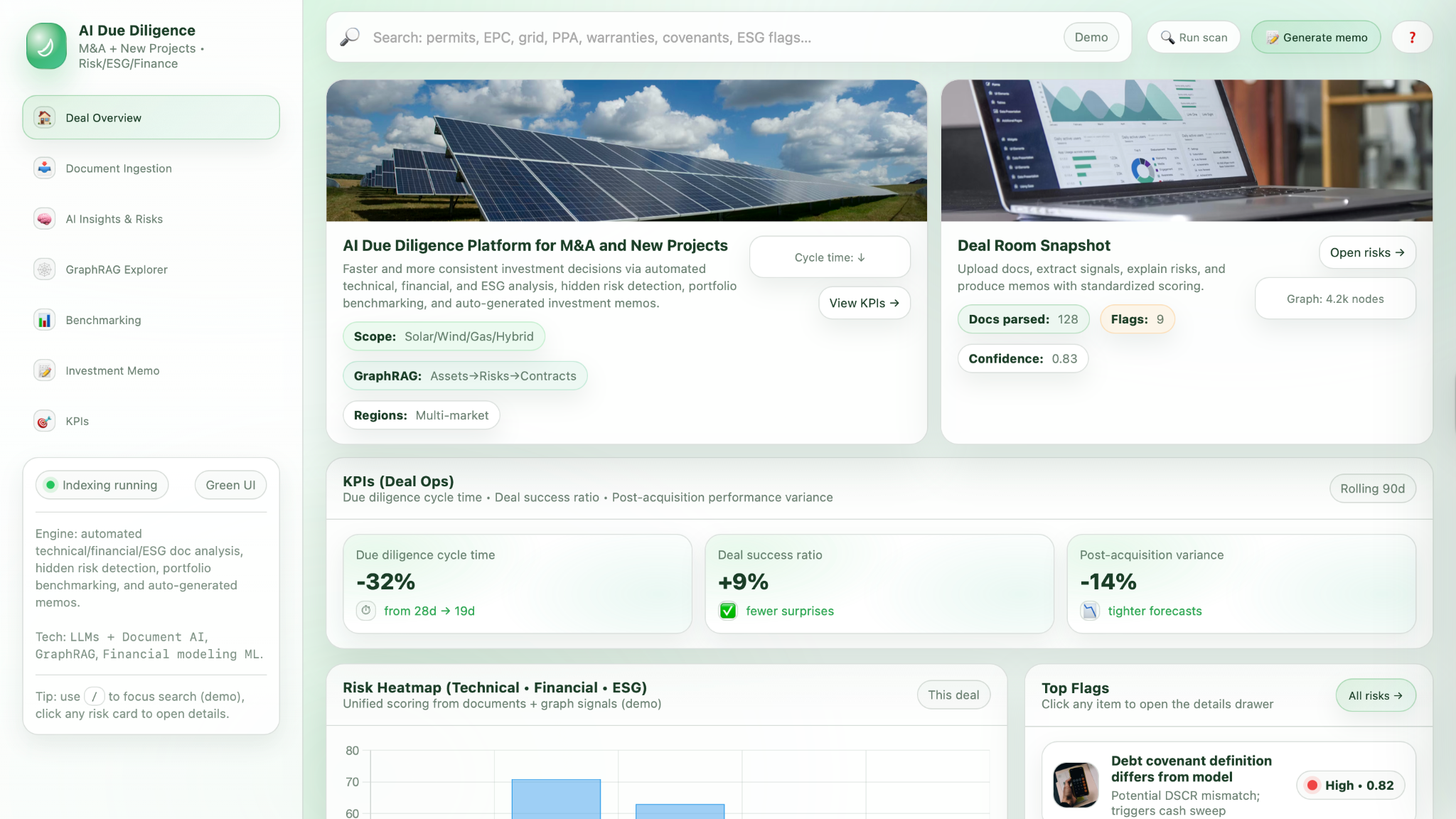
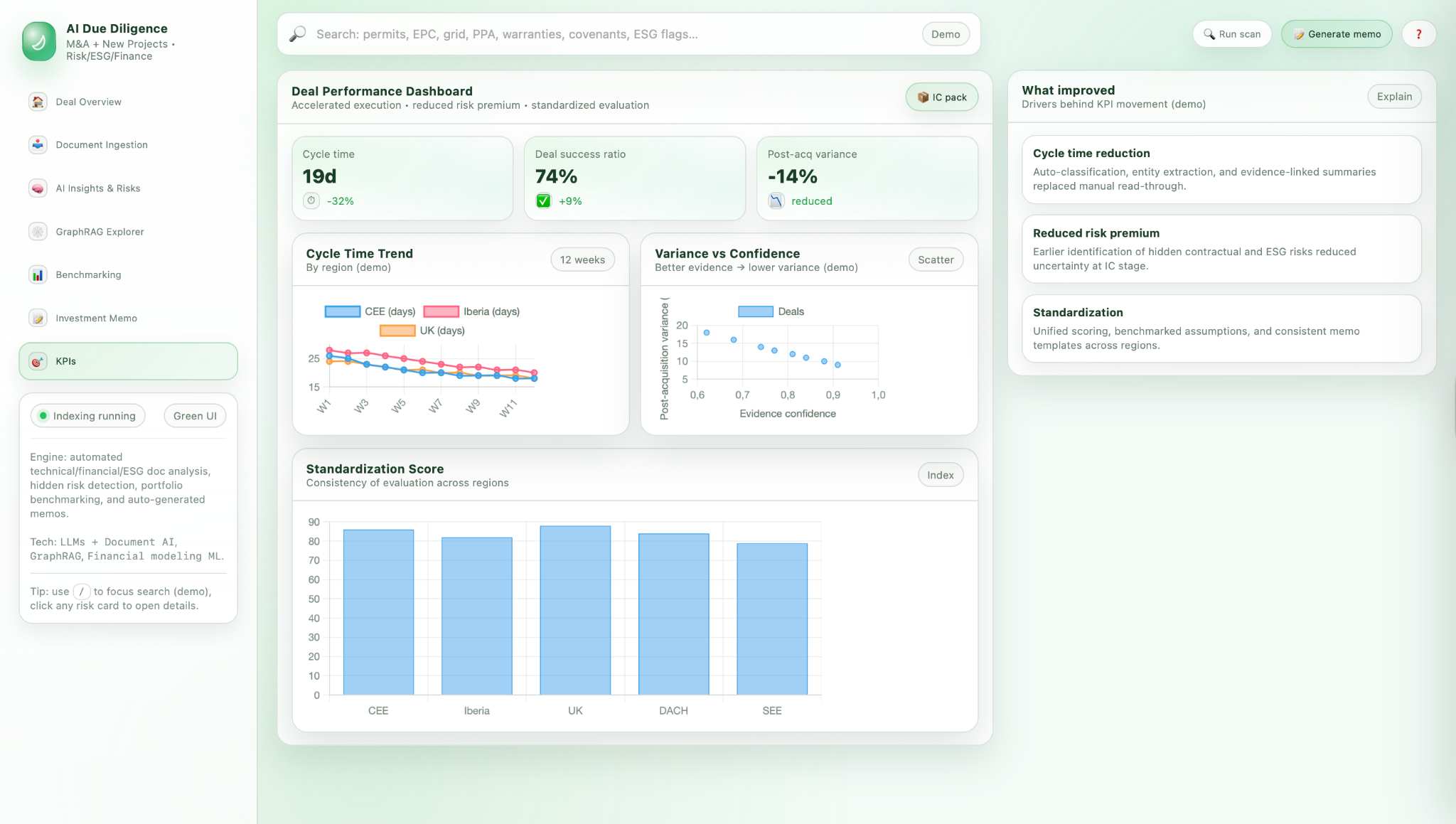
The operational impact of this centralized intelligence is immediate and measurable. The engine has demonstrated a 32% reduction in the due diligence cycle time, effectively cutting the process from 28 days down to 19 days. This increased speed is paired with higher quality outcomes, including a 9% increase in the deal success ratio and a 14% reduction in post-acquisition variance. These improvements stem from the AI’s ability to provide tighter forecasts and ensure fewer "surprises" occur after the deal is closed.
To further mitigate risk, the platform utilizes a Risk Heatmap that scores technical, financial, legal, and ESG factors using evidence gathered from the entire document set. High-priority flags—such as debt covenant definitions that differ from the financial model or ESG audit exceptions—are surfaced immediately with high confidence scores (e.g., 0.82) to prevent financial penalties or operational delays.
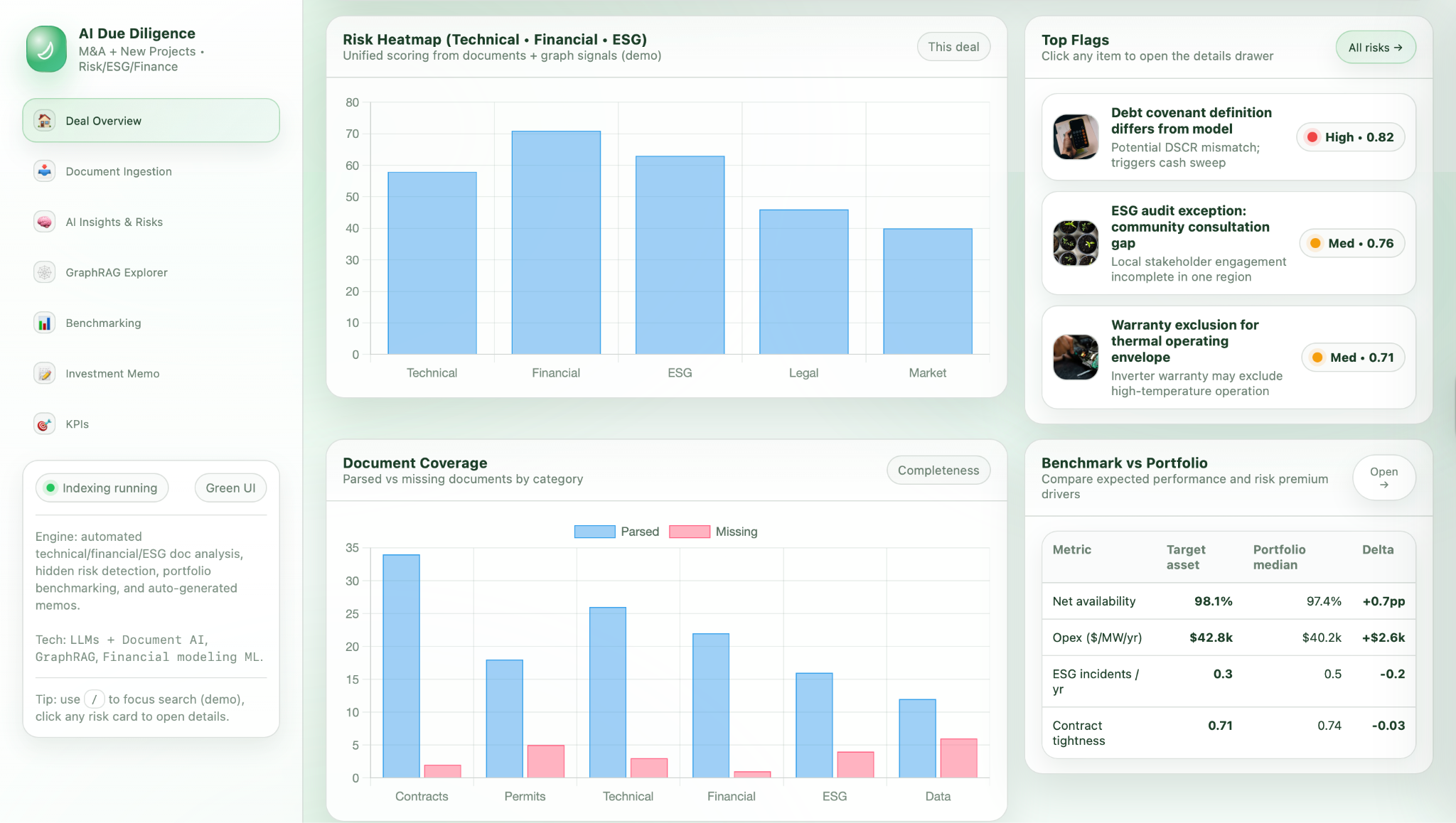
Strategic insight is deepened through Portfolio Benchmarking, which compares the target asset's performance against established portfolio medians. By identifying specific deltas in metrics like Net Availability (+0.7pp) or Opex (+$2.6k), investors can validate their assumptions and ensure that target assets meet the required performance standards before committing capital.
Automated Ingestion&
Advanced Relationship Mapping
A primary challenge in large-scale due diligence is the sheer volume of unstructured data. The platform addresses this through Intelligent Document Pipelines that automate the ingestion, classification, and extraction of critical data points. By utilizing a Virtual Data Room (VDR) structure, the system streamlines the indexing of EPC agreements, PPAs, and grid studies into a searchable database. This automated pipeline identifies key entities, parties, and obligations, significantly reducing the time spent on manual document sorting.
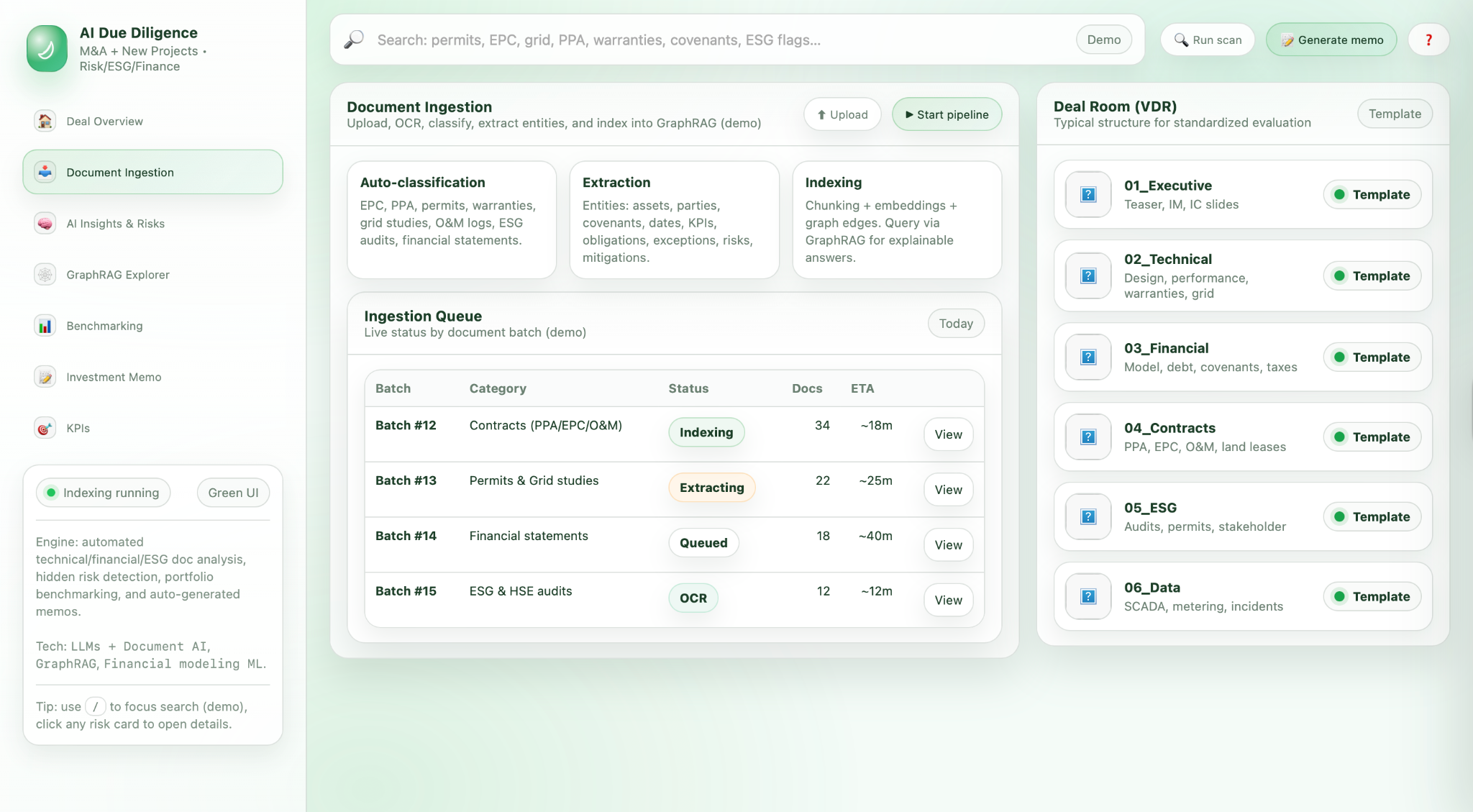
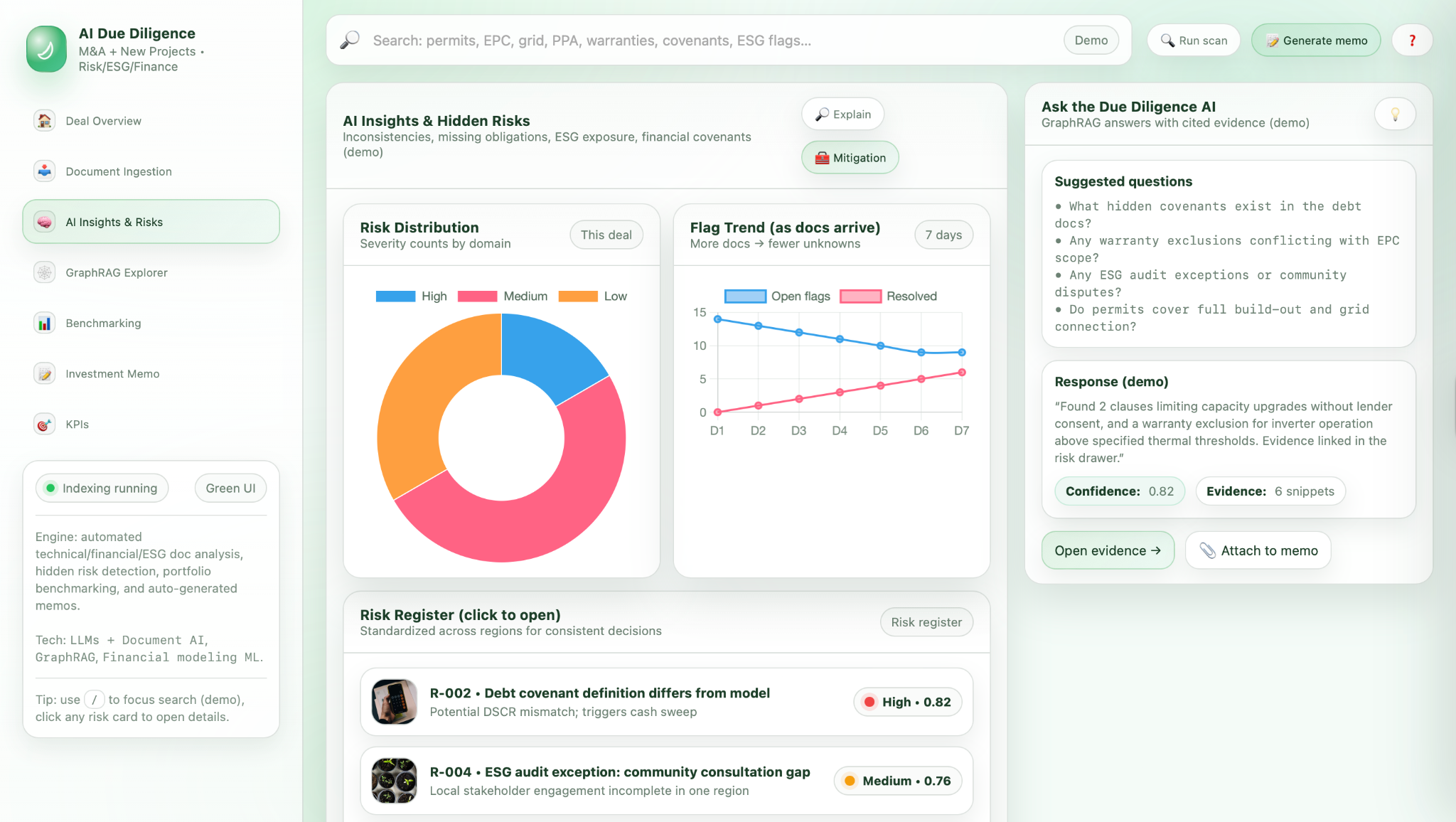
Once the data is ingested, the engine applies AI-driven analysis to detect inconsistencies and hidden risks that manual reviews might overlook. The "AI Insights and Hidden Risks" feature identifies critical flags—such as warranty exclusions for high-temperature operations or misaligned grid study assumptions—backed by specific evidence and confidence scores. Users can query the AI directly to find hidden covenants or conflicting clauses, receiving responses grounded in the source documentation with cited snippets.
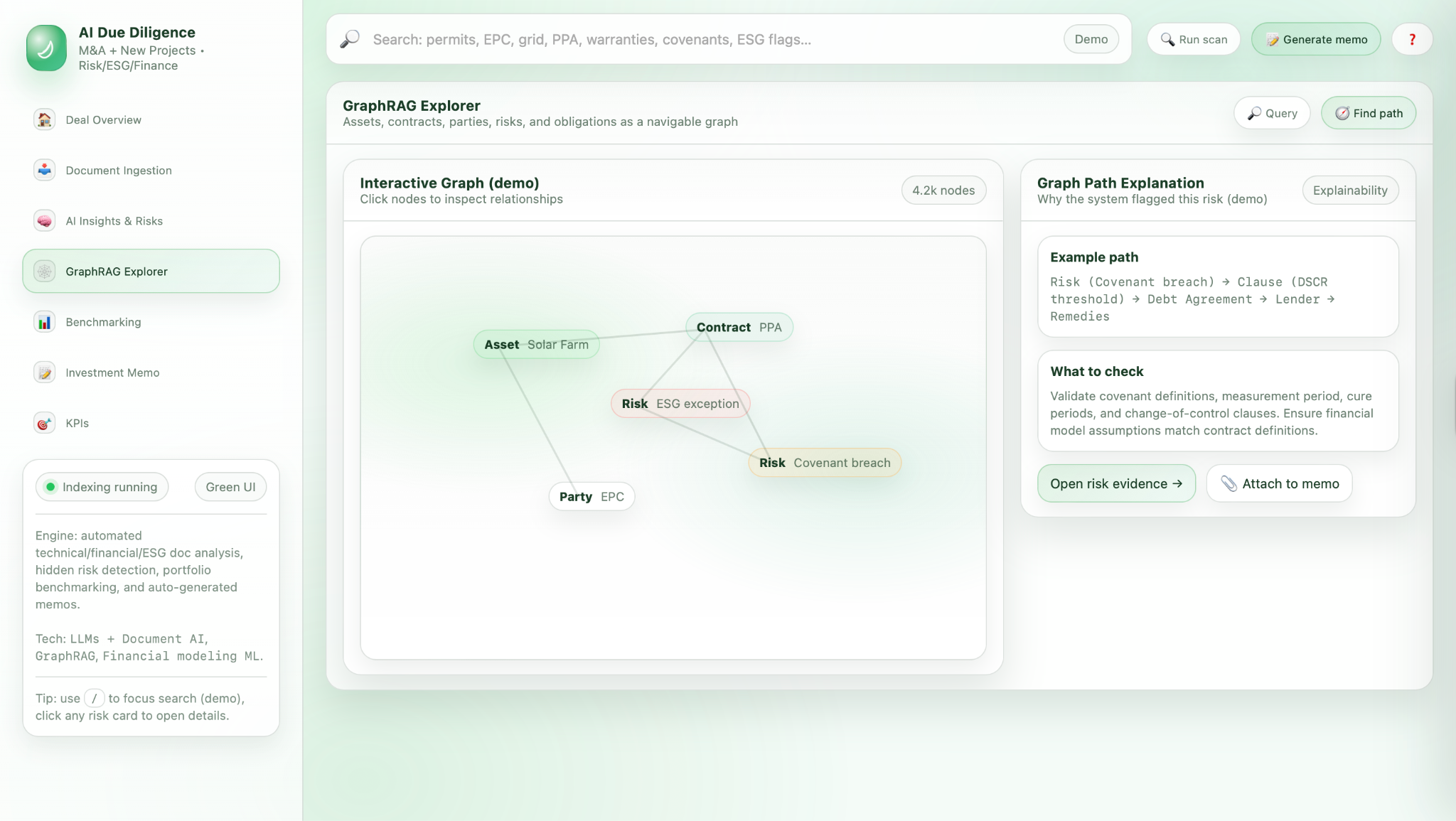
To navigate the complex web of project stakeholders and legal obligations, the platform utilizes GraphRAG Exploration. This technology maps the relationships between assets, parties, and contracts as an interactive, navigable graph consisting of thousands of nodes. For example, the system can visualize how a specific "ESG exception" relates to a "PPA Contract" and a "Solar Farm" asset, providing a clear explanation of why a particular risk was flagged. This relational mapping ensures that investment teams understand the secondary impacts of any single contractual breach or technical failure.
Comparative Analysis&
Actionable Deliverables
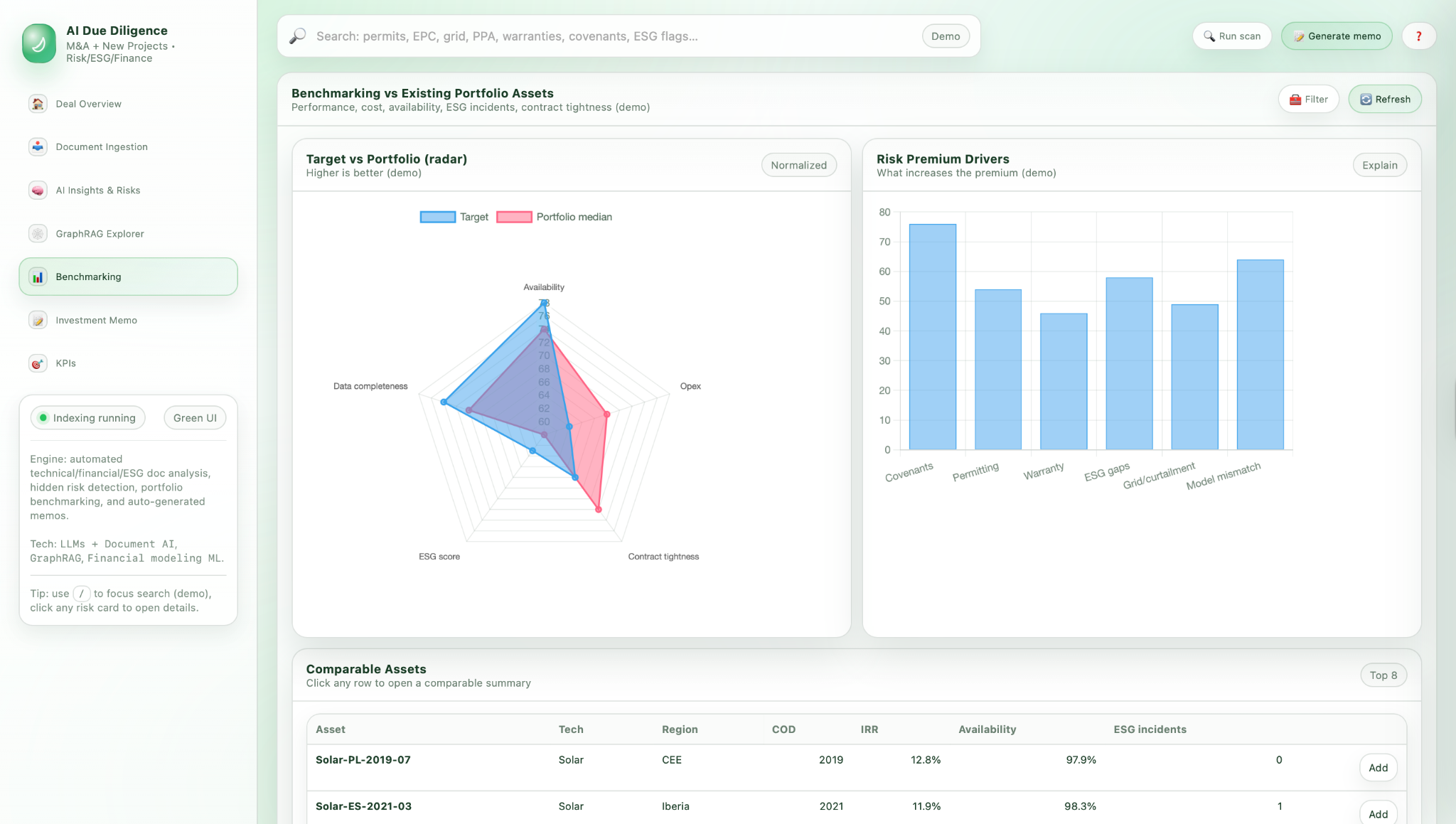
To move from risk identification to final investment decisions, the engine provides a comprehensive suite of comparative tools. The platform features Dynamic Benchmarking, which uses normalized radar charts to compare a target asset against the median performance of an existing portfolio. This allows teams to visualize how a new project stacks up in critical areas such as data completeness, ESG scores, and contract tightness. By identifying the specific drivers behind a risk premium—such as permitting delays or warranty gaps—the system helps investors adjust their models to reflect a more accurate valuation.
Further validation is achieved through the Comparable Assets module, which allows for a side-by-side review of regional projects. This feature enables teams to verify technical data and financial metrics, such as Internal Rate of Return (IRR) and net availability, against actual outcomes from similar assets in the same region (e.g., CEE, Iberia, or DACH). Access to these real-world comparables ensures that investment assumptions are grounded in historical performance rather than theoretical projections.
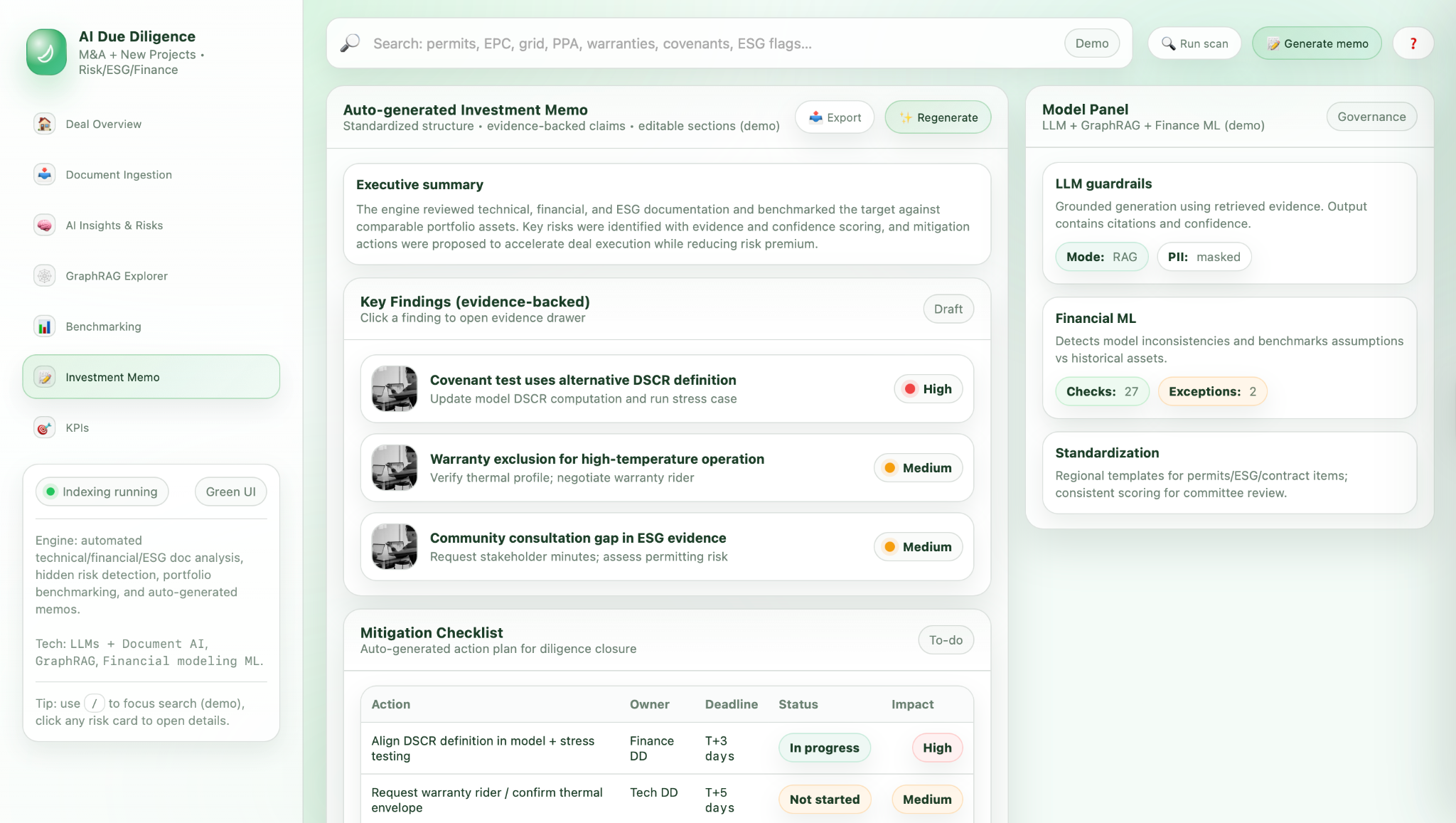
The output of this analysis is an Auto-generated Investment Memo, a standardized, evidence-backed document designed for committee review. These memos include executive summaries, key findings supported by cited documentation, and a Mitigation Checklist to guide the deal toward closure. The system also includes a "Model Governance" panel that tracks financial ML checks and ensures that all LLM-generated content is grounded in retrieved evidence, protecting the firm from "hallucinations" or inconsistent regional templates.
Finally, the platform ensures long-term accountability through a Deal Performance Dashboard. This module monitors operational trends, such as the cycle time reduction achieved across different regional offices (CEE, Iberia, UK). By tracking the "Variance vs. Confidence" scatter—which illustrates how better evidence leads to lower post-acquisition variance—the system proves the business value of its standardized evaluations. This ongoing performance tracking ensures that the efficiency gained during the due diligence phase translates directly into tighter, more reliable post-acquisition results.
Conclusion: Standardizing the Future of M&A
The transition toward the AI-Driven Due Diligence Engine marks a fundamental shift in how high-stakes investment decisions are made in the energy sector. By replacing manual, labor-intensive read-throughs with intelligent auto-classification and relationship extraction, the platform effectively eliminates the "deal drag" that historically slowed down market participation. This move toward automated diligence allows teams to process thousands of pages of complex documentation with unprecedented speed and precision, ensuring that no critical contractual obligation is overlooked.
Sustainable growth in a competitive landscape is built on a foundation of deep investment confidence. By identifying hidden contractual inconsistencies and ESG risks—such as warranty exclusions or community consultation gaps—much earlier in the evaluation stage, the engine reduces the risk premium associated with new acquisitions. This proactive risk detection ensures that post-acquisition performance aligns with initial financial models, protecting the project’s long-term IRR.
The final vision for this technology is to establish a unified, benchmarked standard for investment evaluation across global energy regions. Whether analyzing assets in the CEE, Iberia, or the UK, the platform provides a consistent regional template that removes the subjectivity of expert-only judgment. By integrating advanced technologies like GraphRAG and financial modeling ML, Infinity Technologies is creating a data-driven future where due diligence is not just a defensive necessity, but a strategic tool for scaling global renewable portfolios.


Our success stories

.png)
.png)
.png)
.png)



























.avif)
















Tell us about your project needs