Buffer & bottleneck optimization between FC, CVX, storage & lift

AI/ML
IoT
Web Development
About the Task
Build a discrete-event digital twin using PLC event data to analyze blocking, starvation, and optimize speed and buffer policies
results
Improved material flow stability and reduced blocking/starvation losses across the line
results
Increased throughput without additional equipment through optimized buffer and speed control policies
Services used
Build Product
Build Strategy
Web Development

The table of content

Introduction

The purpose of this use case is to stabilise the flow of material between FC, CVX, storage and lift tables so that panels move smoothly through the line without frequent stops or sudden rushes. When flow is stable, throughput increases without new machines, operators feel less pressure to constantly “babysit” buffers, and the line becomes more predictable from shift to shift. Instead of treating blocking and starvation as random noise, the use case turns them into measurable, controllable phenomena that can be improved through clear rules and digital‑twin experiments.

Buffers and bottlenecks are central because they quietly decide how much of the installed capacity the factory actually uses. If storage fills up too often, FC or CVX are forced to wait even though they could run faster; if buffers run empty, downstream segments sit idle and lose output they could have produced. On the FC + CVX line, the active bottleneck can shift between CVX, storage, FC and lift tables depending on product mix, speed settings and stack sizes, which makes it hard to optimise by intuition alone. By mapping where and when each segment becomes the bottleneck, the use case shows exactly which part of the line limits throughput and how buffer policies and speed settings should change to keep the whole system in balance.
Data Used

Event data along the FC–CVX–storage–lift path

To understand how material really flows through the FC + CVX line, the system listens to the signals that already exist along the path from FC to CVX, through storage, and finally to the lift tables. It tracks when panels arrive at the CVX infeed, when they leave towards storage, when the intermediate transport declares itself full, and how individual storage positions are used. It also records stack input and output movements, clamp positions, “stack not in position” states, and lift‑table position switches, together with line‑speed and creep‑speed settings, product type, order and shift. Seen together, these signals describe not only where panels are, but also when parts of the line are blocked by full buffers or starved because no material has arrived yet.

Converting raw PLC signals into an event log

All of these PLC bits and sensor states are time‑stamped and transformed into a clean event log that describes what happens on the line in the order it actually occurs. Instead of thousands of low‑level signals, the event log contains higher‑level events such as “panel entered CVX infeed,” “intermediate buffer became full,” “lift table reached load position,” or “stack not in position activated.” This structured timeline is what drives and validates the discrete‑event digital twin: it is used to estimate realistic processing and transfer times, to infer buffer capacities and typical blocking/starvation durations, and to check that the simulated system reproduces the same patterns of throughput, WIP and waiting time as the real line. Once this alignment is achieved, the same event framework becomes the basis for analysing bottlenecks and testing new buffer and speed policies in simulation.
Technical Realisation

Discrete‑event digital twin of FC, CVX,

storage and lift

At the core of this use case is a discrete‑event digital twin that mirrors how panels move through FC, CVX, storage and lift tables. Each station is modelled as a “server” with processing times taken from real cycle‑time data, while intermediate belts and storage positions are represented as buffers with capacities inferred from their full/empty behaviour. Logical rules from the PLC, such as “do not load when stack is not in position,” “clamp must be open to unload,” or “lift must be at load level before transfer,” are built into the twin so that simulated blocking and starvation arise for the same reasons as on the real line. The model is tuned until simulated throughput, WIP and waiting times match what is observed in production closely enough to be trusted for what‑if analyses.

Bottleneck and buffer analytics in the twin

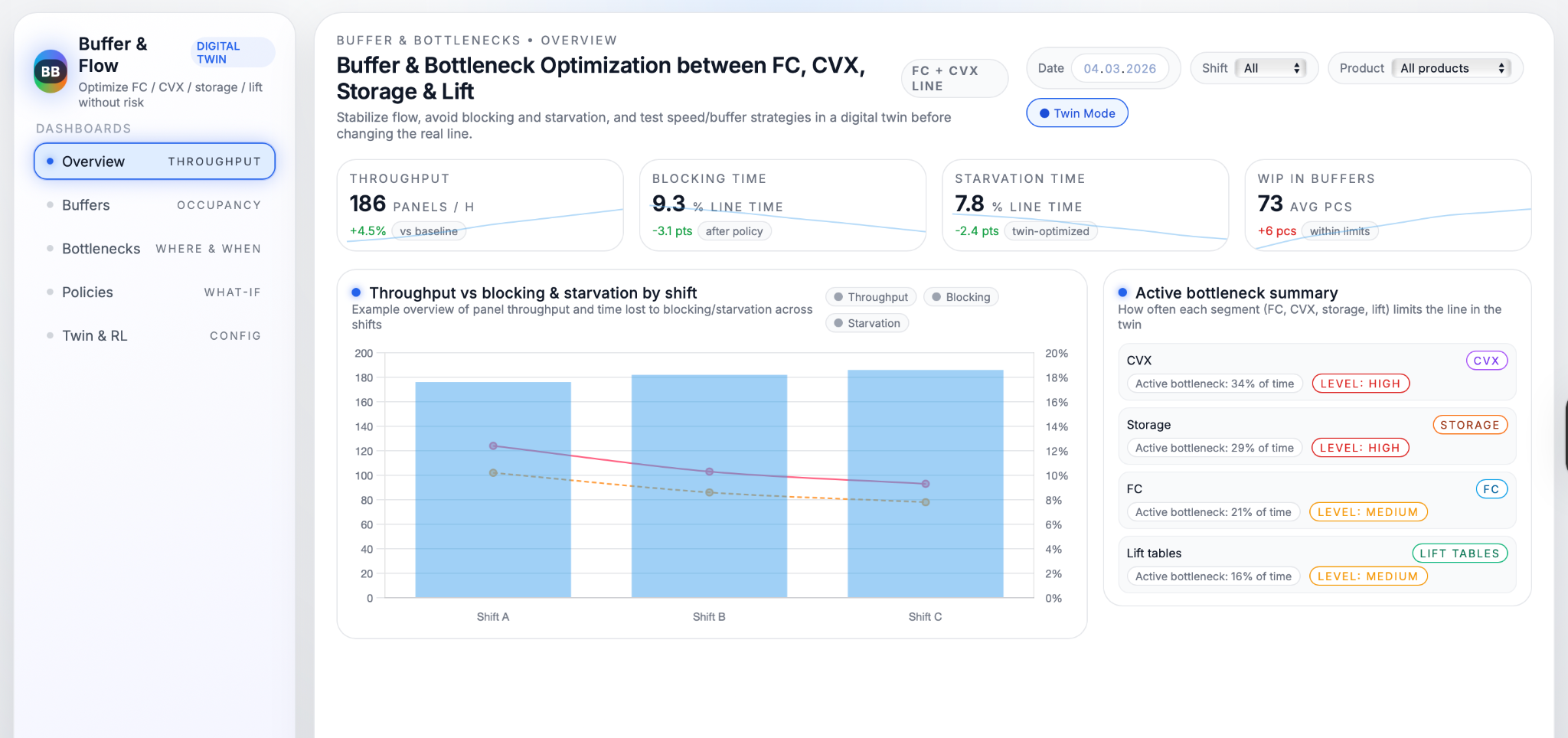
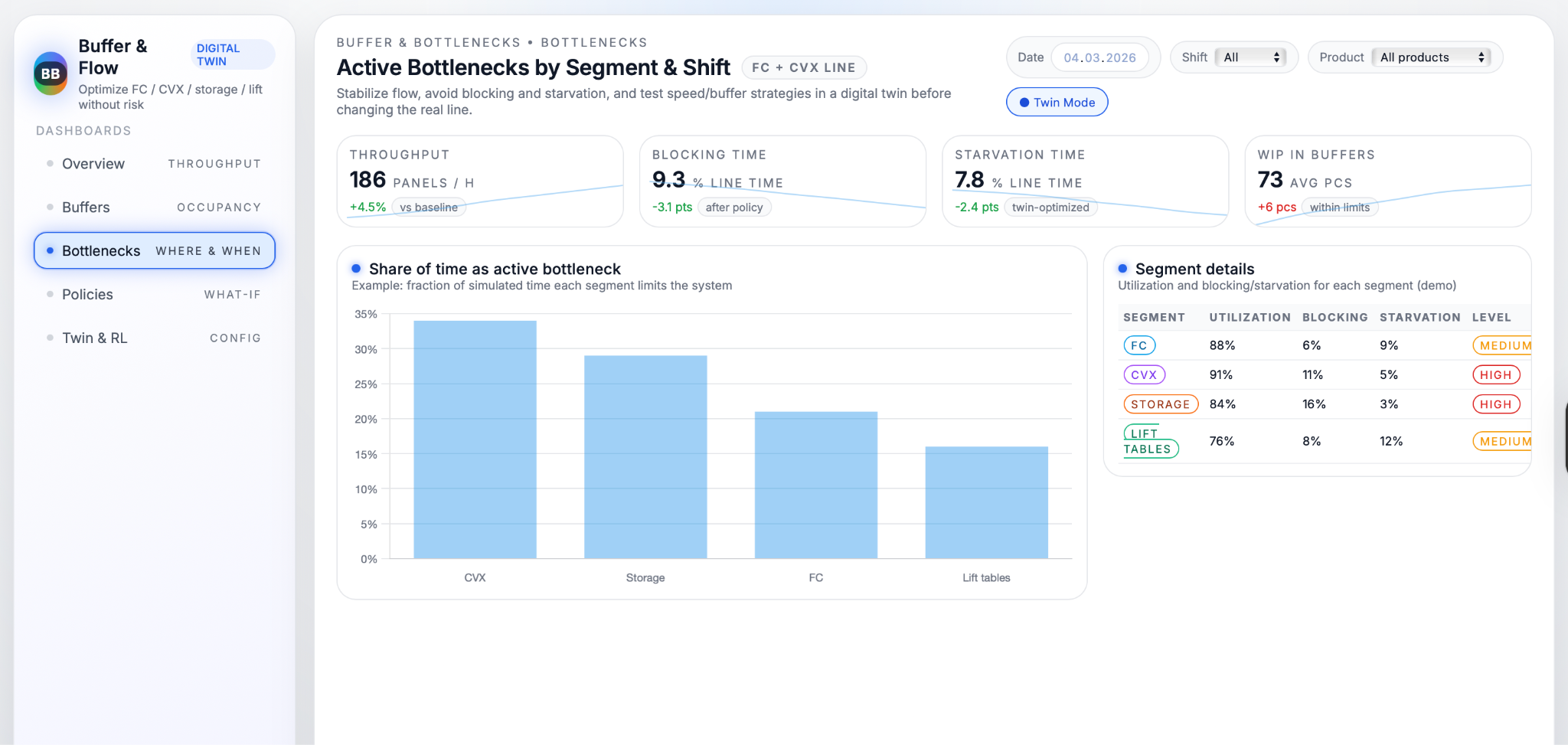
Once the twin behaves like the real system, it becomes a safe environment for detailed bottleneck and buffer analysis. For every simulated shift, the model records how much time each segment (FC, CVX, storage, lift) spends busy, waiting because upstream is empty (starved), or blocked because downstream is full. From this, it calculates how often each station acts as the active bottleneck and how this changes with different products, speeds and stack sizes. At the same time, each buffer’s occupancy is tracked over time, including the share of time it is full or empty and how often states such as “intermediate transport full” or “stack not in position” directly cause FC or CVX to wait. These metrics reveal structurally over‑used or under‑used buffers and show where small changes in capacity or control could have the biggest effect on flow stability.
AI‑based speed and buffer policy optimization

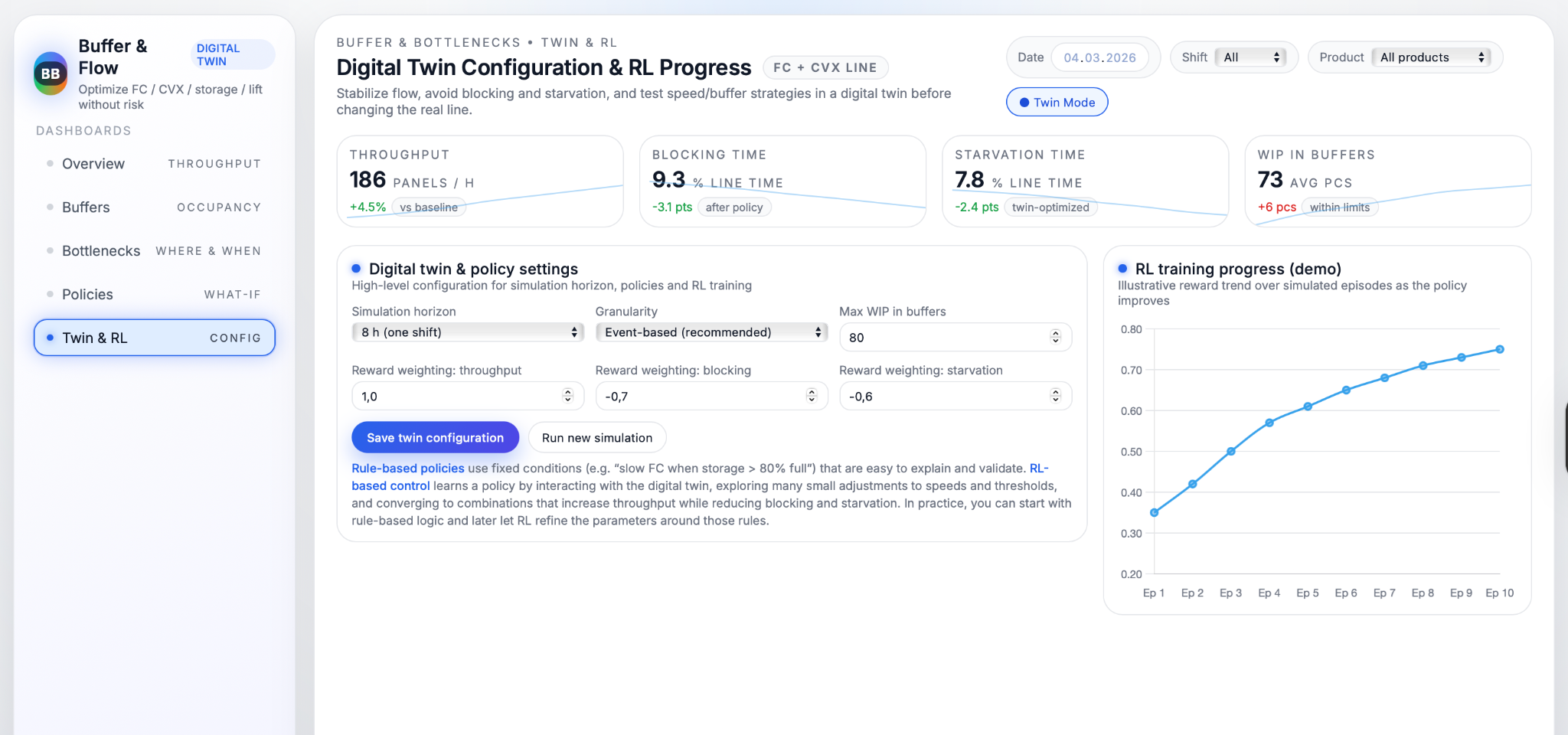
On top of the calibrated twin, AI methods search for better ways to control speeds and buffers without risking the real line. Simple versions test fixed rules such as “slow FC when storage occupancy exceeds 80%” or “increase storage creep speed when CVX output is frequently waiting” and compare their impact on throughput, blocking and starvation. More advanced versions use reinforcement learning, where an agent repeatedly runs simulated shifts, trying different combinations of speed and buffer thresholds, receiving rewards for higher throughput and lower blocking/starvation, and gradually converging on effective policies. Because all of this happens in simulation, the system can explore thousands of variations and identify a small set of rules that deliver clear improvements, such as “for product A, increasing storage creep speed by 10% and slowing FC at 80% buffer level reduces FC starvation by around 7% while increasing throughput by roughly 3–4%.” These policies can then be reviewed by engineers and, once accepted, implemented as PLC logic or operator guidelines on the real FC + CVX line.
Dashboards and Operator Support

Visualising bottlenecks,

blocking and starvation

The dashboards turn the results of the digital twin into views that are easy to read during day‑to‑day work. For each shift, they show how panel throughput compares with the percentage of time lost to blocking and starvation, so teams can immediately see whether flow problems are getting better or worse. A dedicated bottleneck section highlights which segment—FC, CVX, storage, or lift tables—acts as the main limiter over time, making it clear where attention and improvement projects should focus instead of relying on gut feeling.

Buffer metrics and occupancy profiles

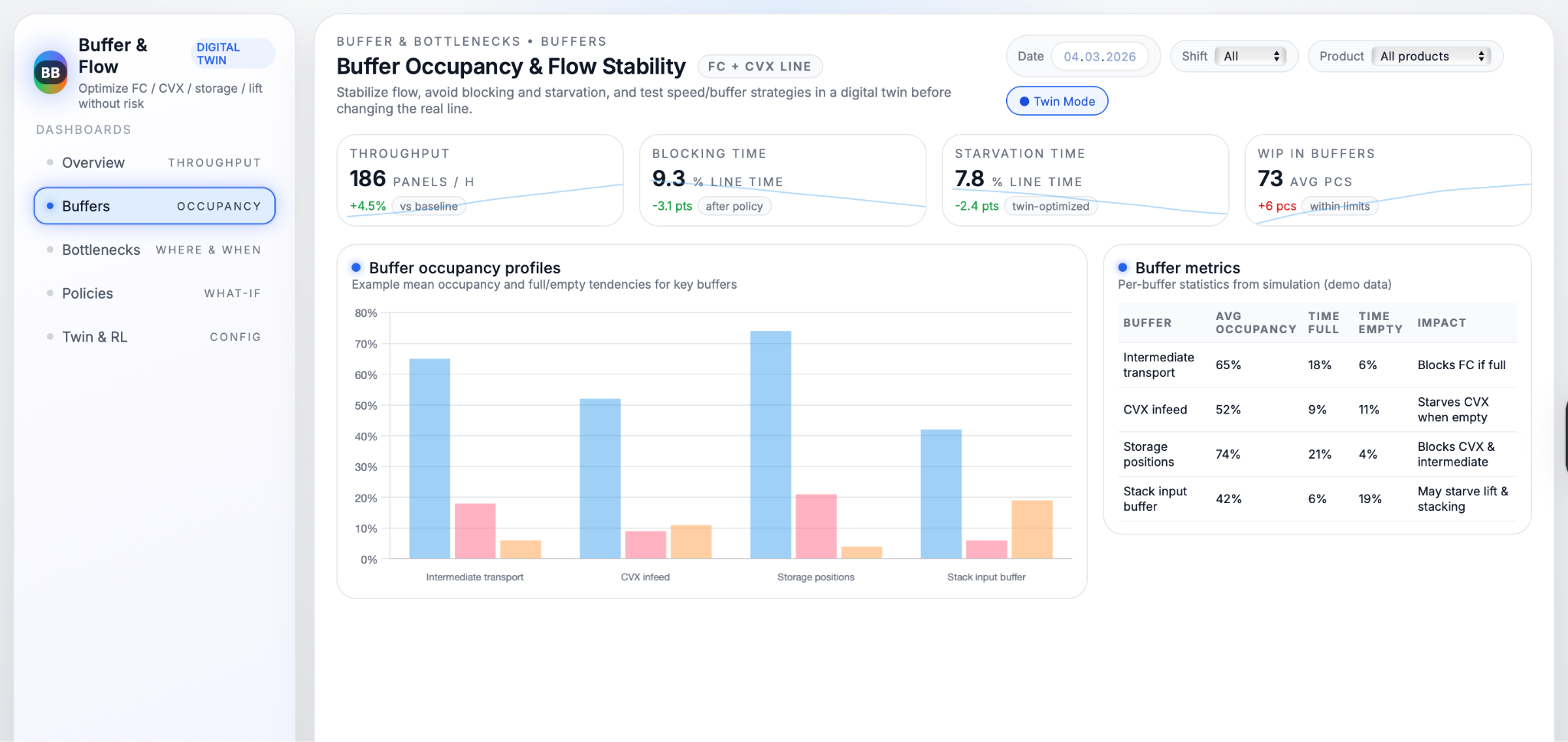
Buffers get their own set of metrics, because they are the “shock absorbers” of the line. Occupancy profiles show the typical fill level for each key buffer, together with how often it is full (blocking upstream) or empty (starving downstream). Tables next to the charts explain the impact of each buffer, for example “Intermediate transport: blocks FC when full” or “CVX infeed: starves CVX when empty,” so engineers and operators can quickly understand what a high “time full” or “time empty” value really means. This combination of charts and plain‑language explanations helps everyone see whether buffers are doing their job or whether they need different speed settings, capacity, or control rules.

Policy recommendations

and workflow integration

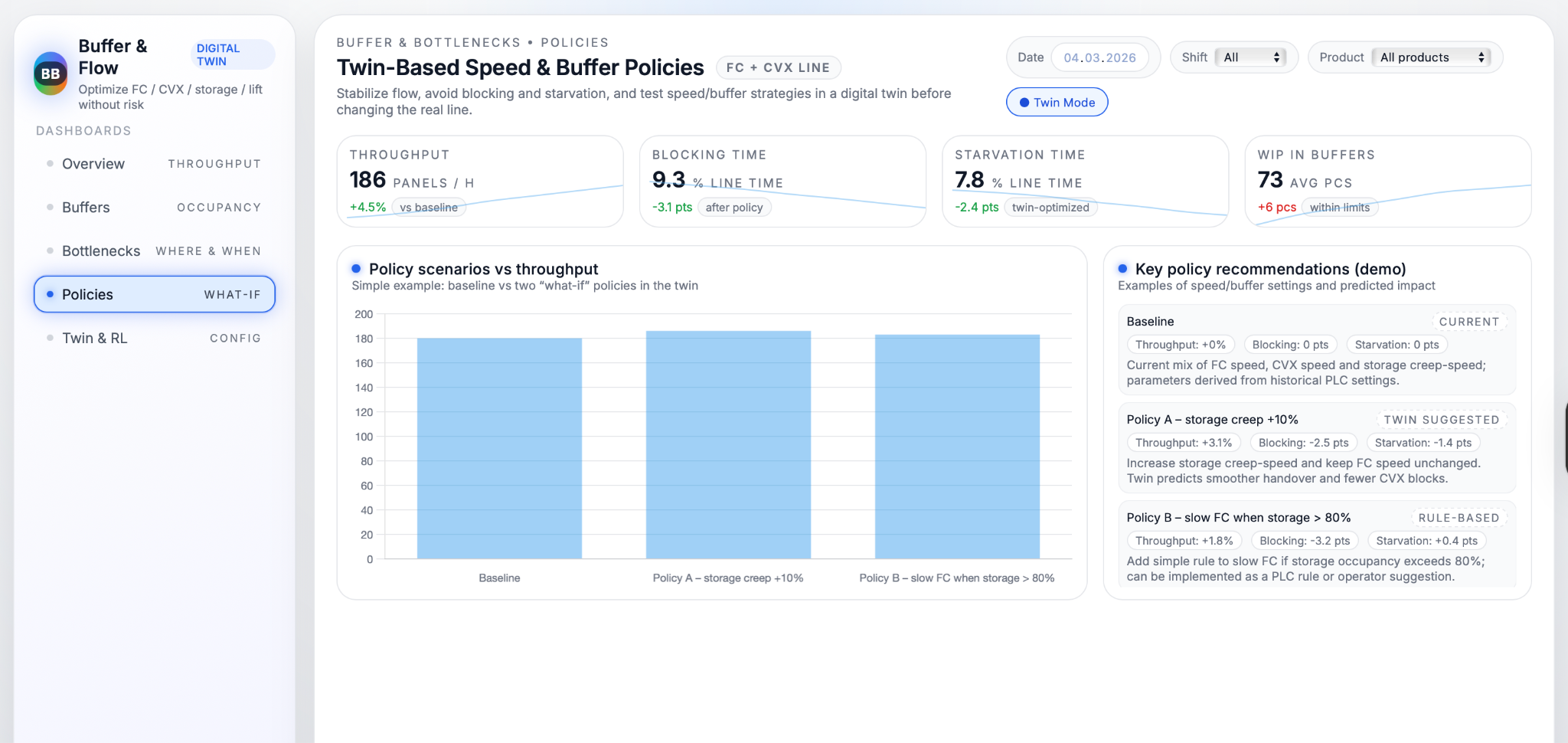
To make the optimisation work usable on the shopfloor, the system summarises the best‑performing policies as simple, product‑specific recommendations. For each product or family, it might propose settings such as “storage creep speed = X, FC slowdown threshold at Y% storage occupancy, CVX speed Z,” alongside expected effects like “throughput +3%, FC starvation −7%, storage blocking −5%.” These recommendations can be turned into standard parameter tables in the production handbook, into recipes in the control system, or into advisory messages on operator screens. They are reviewed and updated periodically—such as once per quarter—so that buffer and speed policies stay aligned with the current product mix and demand pattern rather than becoming a one‑off tuning exercise.
Business Value

Higher throughput without major CAPEX

By reducing the time the line spends blocked or starved, the use case increases the number of panels that FC and CVX can process with the equipment you already have. Instead of investing in new machines, the factory unlocks extra effective capacity simply by running the existing line in a more balanced way. This makes it easier to handle higher demand or absorb peaks without large capital projects.

More stable flow and lower operator stress

When buffers and speeds are tuned properly, material moves through the line in a steadier rhythm, with fewer sudden stops and urgent restarts. Operators no longer have to constantly “play the buffers” by intuition, deciding on the fly when to slow FC or nudge storage creep speed. Clear, validated rules and better visibility mean fewer fire‑fighting moments, smoother shifts, and a calmer working environment.

Better bottleneck visibility

and targeted improvements

The digital twin and dashboards make shifting bottlenecks visible instead of hidden in day‑to‑day noise. Teams can see exactly which segment—FC, CVX, storage, or lift—is limiting throughput in different scenarios, and by how much. This allows improvement efforts and maintenance investments to be directed precisely where they have the most impact, rather than spreading time and budget across the line based on guesswork.

Continuous optimization

with evolving data and policies

Because the system is driven by live data and a configurable twin, it does not stop delivering value after the first tuning round. As product mix, speeds, or operating practices change, new data feeds back into the model, and buffer and speed policies can be re‑evaluated and improved. Over time, this creates a continuous‑improvement loop, where the line is periodically re‑optimised and the gap between theoretical and actual throughput keeps narrowing.

Conclusions

The Buffer & Bottleneck Optimization use case shows how a digital twin and simple policy logic can turn a complex flow problem on the FC + CVX line into something visible, measurable, and improvable. By translating raw PLC signals into an event‑driven model of FC, CVX, storage and lift tables, it becomes possible to replay how panels move through the system, see exactly where blocking and starvation occur, and test alternative speed and buffer strategies without touching the real equipment. What used to be handled through operator intuition and trial‑and‑error becomes a structured process where hypotheses are checked in simulation, the best options are selected, and only then are they rolled out to production with clear expectations on their impact.

In practical terms, this brings several benefits at once: higher throughput from the existing line, more stable flow, less operator stress, and a much clearer view of which segment is the true bottleneck at any given time. Just as importantly, it creates a framework for continuous optimisation: as new products, speeds, or layouts are introduced, the same twin and policy engine can be updated, re‑run and used to refine rules again. Over time, the FC + CVX line moves away from one‑off tuning projects and towards an ongoing, data‑driven way of managing buffers and bottlenecks, where improvements can be quantified and explained instead of relying on gut feeling.

Build Product
Build Strategy
Web Development

Our success stories

Buffer & bottleneck optimization between FC, CVX, storage & lift

Digital twin and AI optimization for buffer flow and bottleneck management on the FC + CVX production line
AI/ML
IoT
Web Development

Predictive maintenance of drives & motion axes

Predictive maintenance solution for drives and motion axes on the FC + CVX production line.
AI/ML
IoT
Web Development

Predictive maintenance for heating & glue system

Predictive maintenance solution for the Heating & Glue system on the FC + CVX production line.
AI/ML
IoT
Web Development

Full OEE and Lost‑Hours Analytics for the FC + CVX Line

Digital OEE and lost-hours analytics solution for the FC + CVX high-throughput veneer production line.
AI/ML
IoT
Web Development

Automatic stop detection & classification: Micro-stop Analytics

Advanced micro-stop analytics with ML-assisted classification and root-cause insights
AI/ML
IoT
Web Development
CRM/ERP

Automatic stop detection & classification: Microstop

Micro-stop Monitor detects and classifies short production stops using PLC data and rules
AI/ML
IoT
Web Development

AI Regulatory & Licensing Compliance Copilot

AI copilot for regulatory and licensing compliance across multiple jurisdictions
AI/ML
CRM/ERP
Web Development

AI Due Diligence Platform for M&A and New Projects

AI platform for automated M&A and new project due diligence
AI/ML
CRM/ERP
Web Development

Autonomous Dispatch & BESS AI Optimization

AI engine for portfolio dispatch and BESS optimization across volatile energy markets
AI/ML
IoT
Web Development

AI Asset Health & Degradation Prediction System

AI system for asset health monitoring and degradation prediction
AI/ML
IoT
Web Development

AI CO ₂ Calculator & ESG Impact Platform

AI-powered platform for automated CO₂ accounting and ESG reporting
AI/ML
Web Development

Oll.tv: From Vision to Reality — Crafting Ukraine’s Leading Streaming Platform

Oll.tv launched as Ukraine’s leading IPTV/VOD platform with 200K+ users and a seamless multi-platform experience
Mobile Development
Web Development

Cyber BMS: Rethinking Infrastructure Management for the Digital Age

Cyber BMS upgraded its system with modular design, automation, and real-time dashboards
CRM/ERP
Mobile Development
Web Development

Transforming Logistics Operations with Infinity Technologies

Infinity Technologies redesigned a logistics operator system, automating workflows and enabling mobile operations across all branches.
CRM/ERP
Mobile Development
Web Development

Infinity Technologies in Logistics

Infinity Technologies built a smarter logistics platform with better UX and full digital integration.
CRM/ERP
Mobile Development
Web Development

Cross-recipe: Energy vs Quality Analysis

A data-driven system optimized veneer press energy usage while maintaining product quality.
AI/ML
IoT
Feedforward Press Correction

Feedforward Press Correction

A leading engineered wood manufacturer implemented a predictive press control system powered by data and machine learning.
AI/ML
IoT
Web Development
“Bad-Sheet” Routing

“Bad-Sheet” Routing

Automated system for detecting and routing defective veneer sheets using real-time sensor data and analytics.
AI/ML
IoT

Early Fan Failure Detection

Plant A deployed an on-prem predictive maintenance system for fans, reducing unplanned downtime by 38%.
AI/ML
Predictive Hydraulic Filter Change

Predictive Hydraulic Filter Change

Predictive maintenance system for hydraulic filters reduced downtime and optimized maintenance scheduling in a large industrial plant.
IoT
AI/ML

Infinity Technologies in PetTech

A smart genetic testing platform that helps pet owners and breeders easily access and understand their pets’ DNA insights through a single digital solution.
AI/ML
IoT
Mobile Development

Infinity Technologies in Healthcare

How Infinity Technologies is transforming healthcare with digital platforms that enhance patient engagement, streamline operations, and boost business performance.
Mobile Development
Web Development
CRM/ERP

Intelligent Budgeting: How AI-Powered Financial Planning Transforms Business Strategy

A case study on how intelligent budgeting transformed financial planning, decision-making, and organizational agility.
AI/ML
CRM/ERP
Smarter Product Management Through Interactive Constructors and Real-Time Analytics

Smarter Product Management Through Interactive Constructors and Real-Time Analytics

An interactive, analytics-powered product constructor enabled smarter pricing, faster product decisions, and improved profitability across a complex portfolio.
AI/ML
CRM/ERP
The Power of Precision: How One Company Achieved 99.1% Sales Forecast Accuracy

The Power of Precision: How One Company Achieved 99.1% Sales Forecast Accuracy

A large-scale sales forecasting system achieved 99.1% accuracy across hundreds of products using data-driven, automated models.
AI/ML
CRM/ERP
Smarter Energy Forecasting in Manufacturing

Smarter Energy Forecasting in Manufacturing: Turning Data Into Cost Savings

A real-world case study on how predictive energy forecasting helps manufacturers cut costs and improve efficiency.
IoT
AI/ML
CRM/ERP
Smarter Hatching: How Predictive Modeling Transforms Poultry Incubation

Smarter Hatching: How Predictive Modeling Transforms Poultry Incubation

A poultry farm used AI and real-time data to optimize incubation, improving chick quality and operational efficiency.
AI/ML
IoT
Web Development
Predictive Analytics in Healthcare: The Future of Cardiovascular Risk Detection

Predictive Analytics in Healthcare: The Future of Cardiovascular Risk Detection

Predictive analytics model for early cardiovascular risk detection using non-invasive population data.
AI/ML
CRM/ERP
Smart Fraud Detection: How Predictive Analytics is Reshaping Social Welfare Systems

Smart Fraud Detection: How Predictive Analytics is Reshaping Social Welfare Systems

A public agency used predictive analytics to overhaul fraud detection in social welfare distribution.
AI/ML
Risk-Based Oversight of Social Benefits: Catching Fraud Without Hiring More Staff

Risk-Based Oversight of Social Benefits: Catching Fraud Without Hiring More Staff

Case study: shifting from random checks to risk-based fraud detection in social benefits.
AI/ML
Predicting Employee Turnover: How Data Turns Retention into a Strategy

Predicting Employee Turnover: How Data Turns Retention into a Strategy

This article explores how predictive analytics is transforming employee retention from a reactive process into a strategic advantage.
AI/ML
IoT
CRM/ERP
How Predicting Customer Churn Helps Banks Grow: A Case Study with 1500% ROI

How Predicting Customer Churn Helps Banks Grow: A Case Study with 1500% ROI

A real-world case study showing how predictive analytics helped a bank cut churn by 71% and achieve 1500% ROI through targeted retention.
AI/ML
CRM/ERP
Smarter Compliance: How Automated Risk Assessment Transforms Contractor Fraud Detection in Banking

Smarter Compliance: How Automated Risk Assessment Transforms Contractor Fraud Detection in Banking

This article explores how automated risk classification enhanced fraud detection and compliance efficiency in banking.
AI/ML
Smarter Loan Campaigns with Predictive Models

Smarter Loan Campaigns with Predictive Models

How predictive analytics helps banks improve cross-selling by reducing risk, cutting waste, and targeting the right customers.
CRM/ERP
AI/ML
Predictive Modeling Cuts Marketing Costs by 93% in Banking Campaign

Predictive Modeling Cuts Marketing Costs by 93% in Banking Campaign

A bank applied predictive modeling to identify high-response customers, reducing campaign costs from full budget to just 7% while maintaining results.
AI/ML
Risk-Based Personalization Boosts SME Overdraft Lending

Risk-Based Personalization Boosts SME Overdraft Lending

A major European bank revamped its SME overdraft lending by introducing a data-driven model that adjusted loan limits based on individual risk profiles, boosting both portfolio size and profit.
AI/ML
CRM/ERP
From 4 Months to 30 Minutes: The New Speed of Credit Scoring
August 2025

From 4 Months to 30 Minutes: The New Speed of Credit Scoring

A bank cut credit model time from four months to 30 minutes by automating risk assessment for corporate clients.
AI/ML

Designing a Decentralized Social Platform for the Web3 Era

Infinity Technologies builds a blockchain-based social network where users own their data, control their content, and earn from engagement
Blockchain
Web Development

Tokenizing Music: A Marketplace for NFT-Based Ownership and Royalties

Infinity Technologies builds a blockchain platform where artists can mint music NFTs representing ownership, licensing rights, and revenue shares
Blockchain
Web Development

Building a Blockchain Game That Pays to Play

Infinity Technologies delivers a play-to-earn gaming platform where users collect, trade, and monetize digital assets on-chain
Blockchain
Web Development

Engineering DeFi and CeFi Wallets for the Modern Crypto Economy

Infinity Technologies delivers two complementary wallet platforms — a DeFi aggregator and a CeFi digital finance hub — to meet the evolving needs of crypto users
Blockchain
Web Development

Building a Full-Scale Centralized Crypto Exchange Platform

Infinity Technologies engineers a secure, feature-rich trading ecosystem supporting spot, margin, futures, and copy trading — built for performance and scalability
Blockchain
Web Development

Powering Real Estate Growth Through Role-Based CRM Automation

Infinity Technologies delivers a modern CRM system tailored to brokers, agents, clients, and admins — boosting lead conversion, transparency, and operational efficiency
CRM/ERP
Web Development

Engineering a Smart Mobility Ecosystem for On-Demand Ride Services

Infinity Technologies designs and builds a modular taxi platform integrating driver, passenger, and admin experiences into a single high-performance solution
Web Development

Human Cloud: A Smarter Way to Connect Developers with Projects

Infinity Technologies launches a private talent-matching platform to speed up hiring, improve collaboration, and protect privacy
Web Development
CRM/ERP

10,000+ Employees, One System: Transforming a National Logistics Giant with a Unified ERP

Infinity Technologies leads a five-year transformation to digitize HR, operations, document management, and forecasting for a major delivery company
CRM/ERP
Web Development
Mobile Development

Delivering Smarter: Automating the Last Mile for a Leading Ukrainian 3PL Operator

Infinity Technologies builds a cloud-native order management platform, increasing processing speed by 85% and accuracy by 97%
Web Development
CRM/ERP
Accelerating International Cargo Delivery with Automation

Accelerating International Cargo Delivery with Automation

Infinity Technologies builds a lightweight, scalable last-mile platform for a leading Ukrainian 3PL provider
Web Development
CRM/ERP
Hazard materials

Saudi Arabia’s National Platform for Hazardous Materials Oversight

Infinity Technologies leads the design of a unified digital platform for the secure tracking, regulation, and compliance of hazardous material logistics
Web Development
Modernizing Meest Express: A Digital Leap in Customer Experience for Global Logistics

Modernizing Meest Express: A Digital Leap in Customer Experience for Global Logistics

Infinity Technologies transforms user engagement, order visibility, and ERP automation for a leading international delivery provider
Web Development
CRM/ERP
Human Cloud: Reimagining Developer Recruitment Through Smart Matching

Human Cloud: Reimagining Developer Recruitment Through Smart Matching

Infinity Technologies builds a platform that transforms how companies and developers connect — with anonymity, precision, and speed
Web Development
CRM/ERP
Smarter Fields, Smarter Yields: Building a Telemetry Platform for Farm Machinery at Any Scale

Smarter Fields, Smarter Yields: Building a Telemetry Platform for Farm Machinery at Any Scale

Infinity Technologies delivers a cross-platform IoT solution that gives farmers real-time visibility and control over diverse agricultural fleets
IoT
CRM/ERP
Web Development
FM Logistic: Transforming Last-Mile Delivery Through Scalable Automation

FM Logistic: Transforming Last-Mile Delivery Through Scalable Automation

Infinity Technologies builds a robust warehouse and order management platform to power 3PL logistics across Ukraine
CRM/ERP
Web Development
Harnessing the Sun Smarter: Building a Scalable IoT Platform for Solar System Monitoring

Harnessing the Sun Smarter: Building a Scalable IoT Platform for Solar System Monitoring

Infinity Technologies delivers an intelligent energy monitoring solution that increases solar system efficiency by up to 60%
IoT
Web Development
Mobile Development
Going Global with Shopify: Building a Scalable eCommerce Ecosystem

Going Global with Shopify: Building a Scalable eCommerce Ecosystem

Infinity Technologies delivers a custom Shopify website and cross-platform mobile app, boosting sales by 163%
CRM/ERP
Web Development
Mobile Development
Scaling a Global Flowers & Gifts Platform Across 9 Countries

Scaling a Global Flowers & Gifts Platform Across 9 Countries

Infinity Technologies builds a high-performance, microservices-based e-commerce system with AI-powered personalization and CRM automation
Web Development
Enabling Digital Labor Governance in Saudi Arabia

Enabling Digital Labor Governance in Saudi Arabia

Infinity Technologies designs a high-load e-government platform for processing over 1 million workforce requests per day
Web Development
CRM/ERP
Empowering Swiss Citizens to Control Their Pension Assets

Empowering Swiss Citizens to Control Their Pension Assets

Infinity Technologies builds a national FinTech platform for pension data transparency and collective action
Web Development
Mobile Development
Transforming Swiss Healthcare: Building the Nation’s Leading Medical Appointment Booking Platform

Transforming Swiss Healthcare: Building the Nation’s Leading Medical Appointment Booking Platform

Infinity Technologies develops and scales a connected ecosystem for over 21,000 healthcare providers across Switzerland
Mobile Development
Web Development
How Infinity Technologies Built Two E-Commerce Platforms from One Codebase

How Infinity Technologies Built Two E-Commerce Platforms from One Codebase

Helping a food service group grow during crisis through rapid digital transformation
CRM/ERP
Web Development
Mobile Development
Nova Poshta: AI-Powered Warehouse Monitoring for Conveyor Systems

Nova Poshta: AI-Powered Warehouse Monitoring for Conveyor Systems

Infinity Technologies Builds Real-Time Load Balancing and Bottleneck Detection for Ukraine’s Largest Logistics Operator
AI/ML
CRM/ERP
IoT
Web Development
VodafoneTV: Building a Global-Scale Video Content Management Ecosystem

VodafoneTV: Building a Global-Scale Video Content Management Ecosystem

Infinity Technologies Develops End-to-End IPTV, OTT, and DVB Solution for Vodafone Group
Web Development
Mobile Development
Zimit CPQ: Enterprise Quote Analytics for a Global Technology Leader

Zimit CPQ: Enterprise Quote Analytics for a Global Technology Leader

Infinity Technologies Customizes and Scales a Complex Quoting Engine for Industrial Automation and Infrastructure Sales Teams
Web Development
CRM/ERP
Fitto: IoT Ecosystem That Powers Smart Supplement Consumption

Fitto: IoT Ecosystem That Powers Smart Supplement Consumption

Infinity Technologies Builds a Personalized Health-Tech Platform Combining Smart Hardware, AI, and Cloud
IoT
Mobile Development
Web Development
EdTech Platform That Reinvents Peer Tutoring for Swiss Schools

EdTech Platform That Reinvents Peer Tutoring for Swiss Schools

Disrupt the traditional tutoring industry.
Mobile Development
Web Development
Custom EDMS with Agile Workflows for a National Logistics Operator

Custom EDMS with Agile Workflows for a National Logistics Operator

Infinity Technologies Builds an Intelligent Document Management Platform that Drives Efficiency and Reduces Costs
Web Development
Interactive Product Portfolio for BASF

Interactive Product Portfolio for BASF

‍Infinity Technologies Builds a Scalable Web Platform for Cross-Continental Presale Collaboration
Web Development
SOSbooking: Local Service Marketplace Empowering Swiss Communities

SOSbooking: Local Service Marketplace Empowering Swiss Communities

Infinity Technologies Builds a Scalable Two-Sided Platform for On-Demand Task Fulfillment
Web Development
Mobile Development