


The table of content
Introduction
AI-Driven Network Planning Transformation
Telecom network planning is becoming increasingly complex as operators must simultaneously manage traffic growth, evolving user behavior, and the rapid rollout of new technologies such as 5G and FWA. Traditional planning approaches, based on static analysis and periodic reviews, are no longer sufficient to keep pace with dynamic demand patterns and real-time network conditions.
For the client, this resulted in delayed identification of capacity constraints, inefficient coverage expansion decisions, and suboptimal allocation of capital investments. Planning cycles were time-consuming, heavily manual, and dependent on fragmented data across OSS, BSS, and geospatial systems. As a result, high-value opportunities were often missed, while resources were allocated to lower-impact initiatives.
To address these challenges, an AI-based network planning platform was implemented to transform decision-making across demand forecasting, coverage optimization, and capex prioritization. The solution integrates predictive analytics, geospatial intelligence, and optimization models into a single system that enables operators to anticipate demand shifts, identify high-impact investment zones, and simulate multiple rollout scenarios before execution.
By moving from reactive and experience-driven planning to data-driven and predictive decision-making, the platform enables faster planning cycles, more efficient capital allocation, and improved network performance at scale.
Business Problem
Demand-Capacity Mismatch
and Inefficient Investment Decisions
Telecom operators face growing pressure to expand network capacity while maintaining service quality and optimizing capital investments. However, traditional planning approaches are not designed to handle the scale, speed, and complexity of modern networks.
One of the core challenges is the mismatch between demand and capacity. Traffic growth is highly uneven across regions, driven by factors such as urban density, mobility patterns, device upgrades, and new service adoption. Without accurate forecasting, operators either under-invest in high-demand areas—leading to congestion and degraded QoE—or over-invest in low-impact zones, resulting in inefficient capital usage.
At the same time, network planning processes remain heavily manual and fragmented. Data required for decision-making is distributed across multiple systems, including OSS, BSS, GIS, and performance monitoring tools. This lack of unified visibility makes it difficult to identify true network bottlenecks, assess investment impact, and prioritize interventions effectively.
Capex allocation presents another critical challenge. Planning teams must balance multiple conflicting objectives: maximizing ROI, ensuring regulatory compliance, improving coverage, and maintaining service quality. Without advanced optimization capabilities, these decisions rely on static assumptions and subjective judgment, which often leads to suboptimal outcomes.
Additionally, planning cycles are slow and inflexible. Evaluating different investment scenarios, rollout strategies, and budget constraints can take weeks, limiting the ability of operators to respond quickly to changing market conditions. This delay directly impacts competitiveness, especially in high-growth or high-density markets.
As a result, operators face:
Increased network congestion and service degradation in high-demand areas
Inefficient capital allocation with reduced return on investment
Limited ability to proactively plan for future demand
Slow and resource-intensive planning cycles
Missed revenue opportunities due to delayed infrastructure expansion
These challenges highlight the need for a fundamentally new approach to network planning—one that is predictive, data-driven, and capable of optimizing decisions at scale.
Solution
End-to-End AI Network Planning Platform
To address the limitations of traditional planning, the client implemented an AI-driven network planning platform that unifies demand forecasting, coverage optimization, and capex prioritization into a single decision-making system. The solution transforms planning from a static, manual process into a dynamic, data-driven workflow capable of adapting to real-time network conditions and long-term demand trends.
At its core, the platform combines predictive analytics, geospatial intelligence, and optimization algorithms to provide a comprehensive view of network performance and future demand. It enables planners to move beyond reactive decision-making and instead anticipate where capacity constraints will emerge, which areas require expansion, and how to allocate investments for maximum impact.
The solution introduces several key capabilities:
Demand Forecasting and Hotspot Prediction
The platform uses advanced time-series forecasting models to predict traffic growth across multiple time horizons, including short-term spikes and long-term demand evolution. It continuously analyzes historical KPIs, mobility flows, subscriber density, and device usage patterns to identify emerging hotspots before congestion occurs.
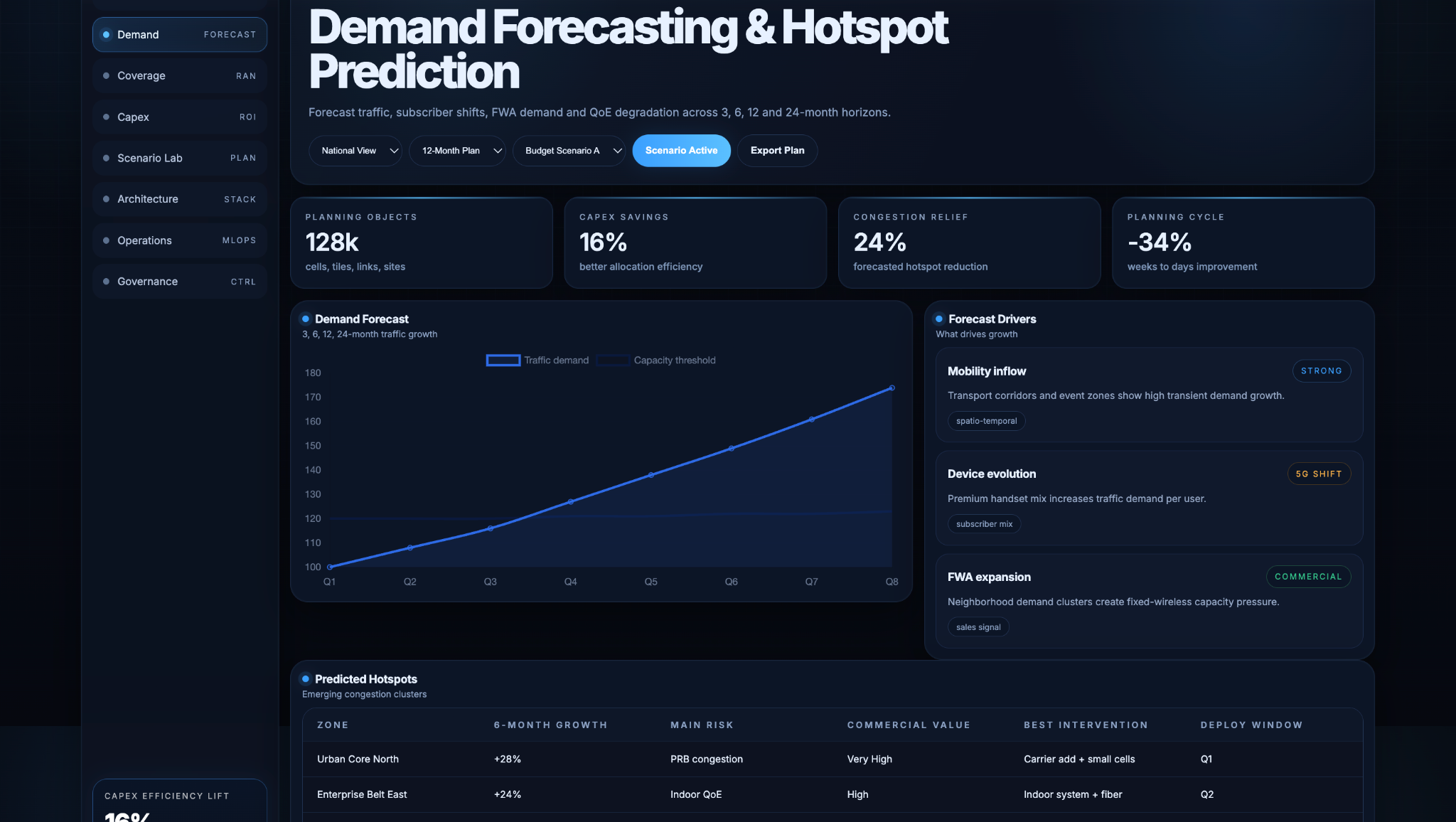
This dashboard provides a geo-level view of predicted demand, highlighting high-growth zones, seasonal traffic patterns, and areas at risk of congestion. It enables planners to proactively prepare infrastructure upgrades rather than reacting to performance degradation.
Coverage and Capacity Optimization
Building on forecasting outputs, the platform evaluates current network performance and identifies coverage gaps, weak-signal zones, and capacity bottlenecks. It incorporates geospatial data, terrain models, building density, and network topology to simulate signal propagation and service quality.
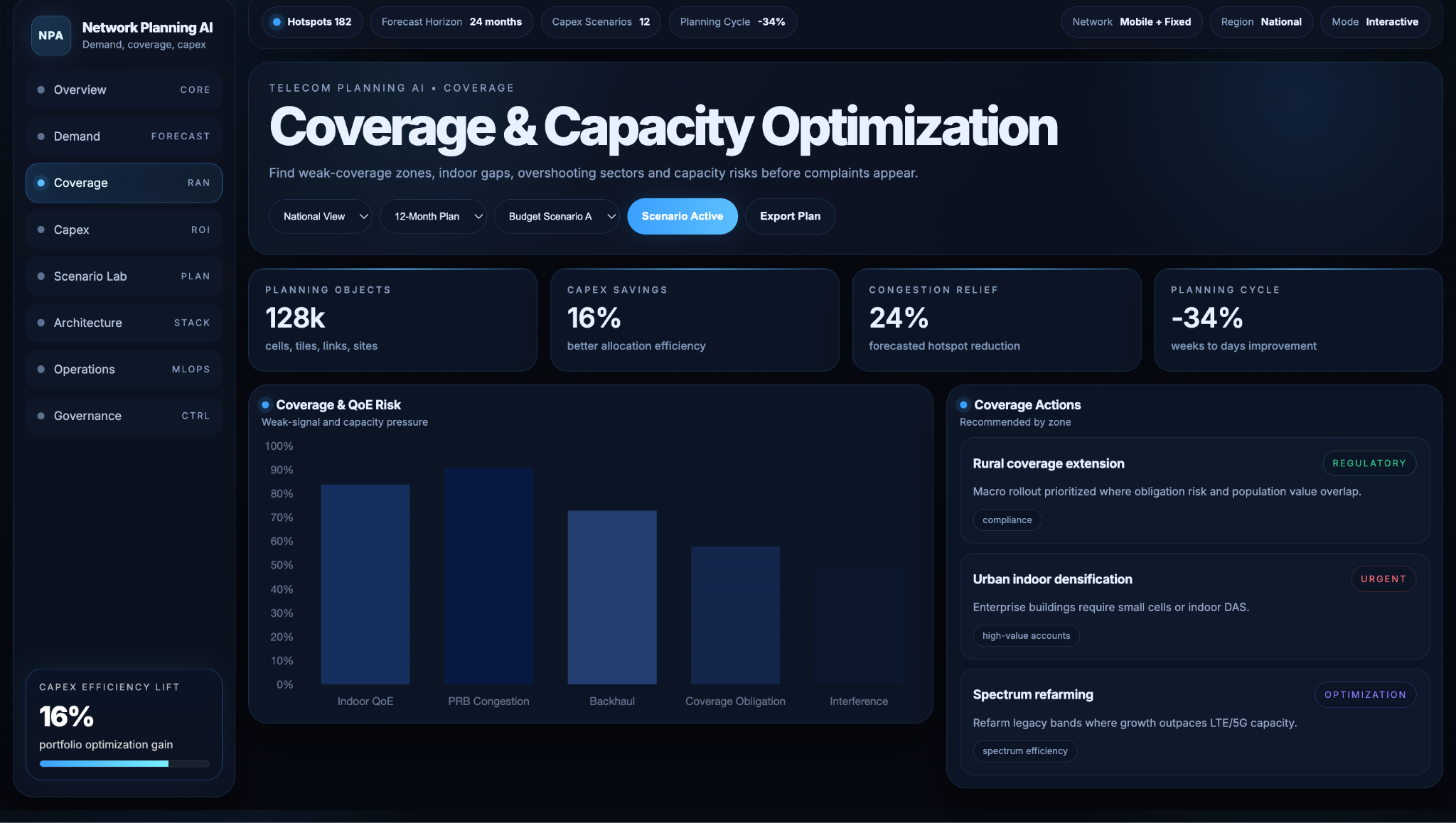
The system generates targeted recommendations such as deploying new macro sites, adding small cells, upgrading antennas, optimizing tilt and azimuth, or enhancing backhaul capacity. Each recommendation is evaluated based on expected QoE improvement, deployment feasibility, and cost efficiency.
Capex Prioritization Engine
One of the most critical components of the platform is the ability to prioritize investments. Instead of relying on static budgeting or fragmented inputs, the system evaluates all potential interventions using multi-dimensional scoring.
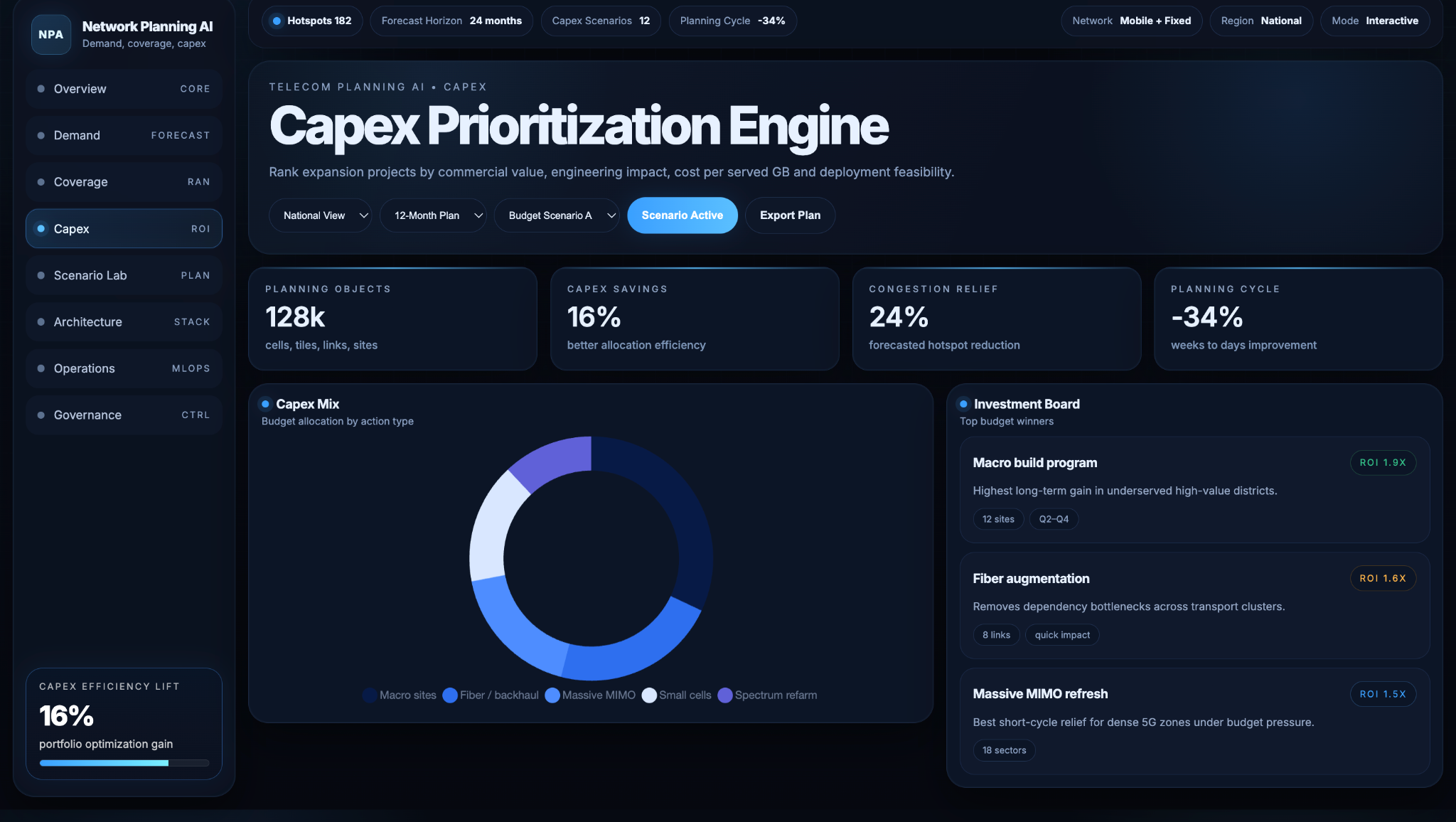
Each investment option is ranked based on projected traffic relief, revenue impact, cost per served GB, time to deploy, and strategic importance. This ensures that capital is allocated to initiatives that deliver the highest business and technical value.
Scenario Simulation and Planning
To support strategic decision-making, the platform provides advanced scenario simulation capabilities. Planners can model different rollout strategies under varying budget constraints, timelines, and demand assumptions.
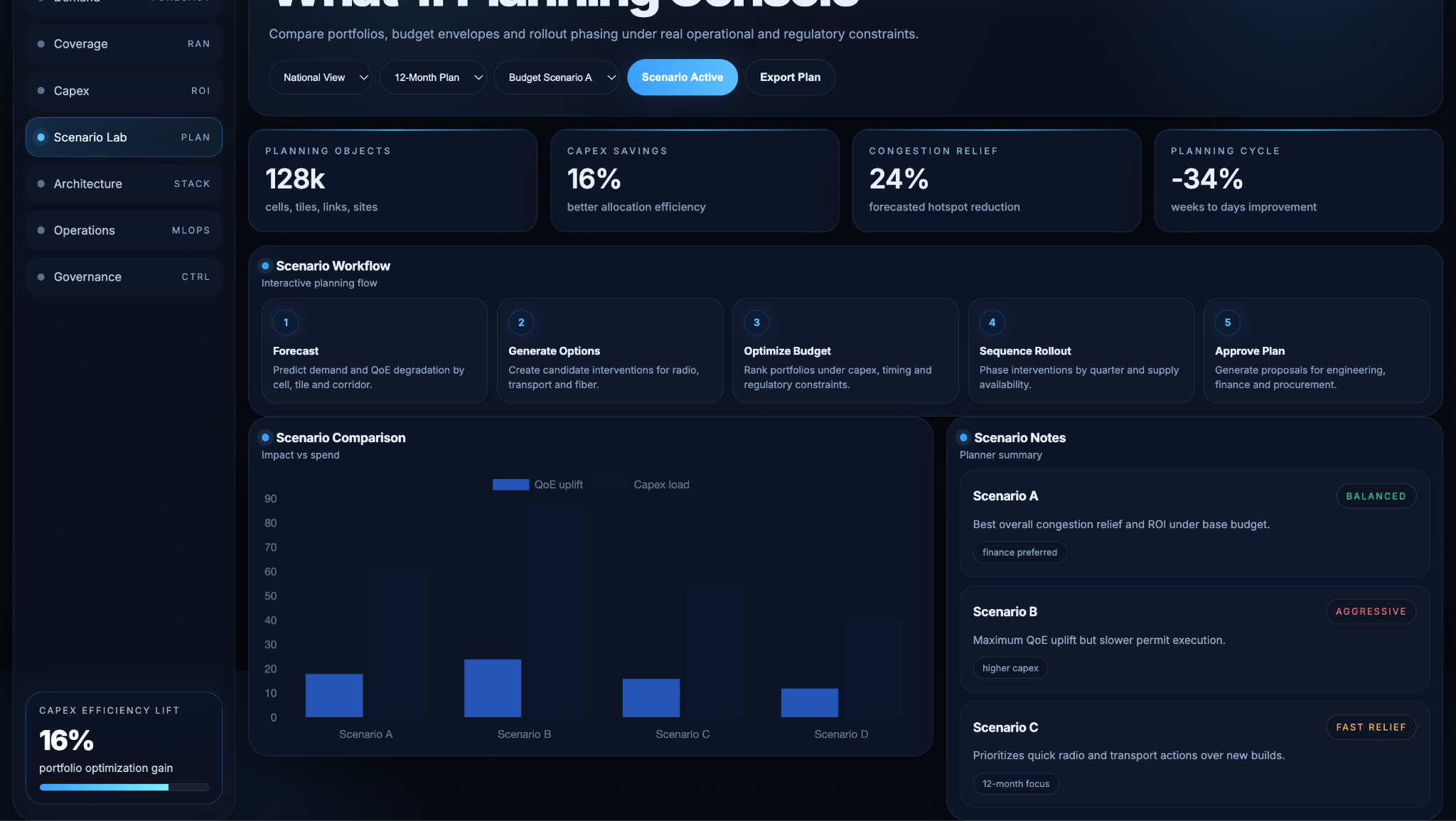
The system evaluates each scenario by simulating network evolution and estimating its impact on performance metrics, costs, and customer experience. This allows decision-makers to compare alternatives and select the most optimal deployment plan with a clear understanding of trade-offs.
Cross-Domain Intelligence and Data Fusion
A key strength of the solution is its ability to integrate data from multiple domains into a unified analytical layer. It combines OSS performance metrics, BSS commercial data, geospatial information, and external datasets such as population density and mobility patterns. This holistic view ensures that planning decisions are aligned with both engineering constraints and business objectives.
Continuous Learning and Adaptive Planning
The platform is not limited to one-time planning cycles. It continuously learns from new data, rollout outcomes, and changing network conditions. Forecasts are updated dynamically, and recommendations evolve as new patterns emerge. This enables a shift from periodic planning to continuous optimization.
Automated Planning Workflows
Beyond analytics, the system supports operational execution by generating planning proposals, build lists, and engineering tasks. It can integrate with planning tools, procurement systems, and rollout workflows, ensuring that recommendations are translated into actionable steps.
Together, these capabilities create a closed-loop planning system where forecasting, optimization, and execution are tightly integrated. The result is a more agile, accurate, and scalable approach to telecom network planning, enabling the client to maximize network performance while optimizing capital investments.
Technology Architecture (Tools List)
- Data Sources: OSS, BSS/CRM, GIS (QGIS/ArcGIS), RF planning tools, external data
- Data Ingestion: Apache Kafka, Apache NiFi, Apache Spark
- Processing: Apache Spark, Apache Flink
- Storage: Amazon S3, Delta Lake, PostgreSQL/PostGIS, Neo4j
- Feature Store: Feast, Redis
- AI/ML: Kubernetes, TensorFlow, PyTorch, XGBoost, LightGBM, LSTM
- Optimization & Graph: Neo4j, PyTorch Geometric, OR-Tools, Gurobi
- Serving & Integration: TensorFlow Serving, ONNX Runtime, REST APIs, gRPC
- Visualization: Mapbox / Kepler.gl, Superset / custom dashboards
- Monitoring: Prometheus, Grafana, OpenTelemetry, MLflow
Results and Impact
Measurable Gains in Network
Performance and Capex Efficiency
The implementation of the AI-driven network planning platform enabled the client to fundamentally transform how network expansion and investment decisions are made. The planning process evolved from static, periodic analysis to a continuous, data-driven workflow where demand, performance, and investment priorities are evaluated in near real time. This shift allowed the operator to move from reactive capacity management to proactive network evolution.
The introduction of predictive demand forecasting significantly improved planning accuracy. The platform identifies high-growth zones and emerging congestion hotspots months in advance, enabling timely interventions such as capacity upgrades, densification, or transport enhancements. As a result, the client was able to prevent service degradation before it affected end users, leading to more stable network performance and improved quality of experience.
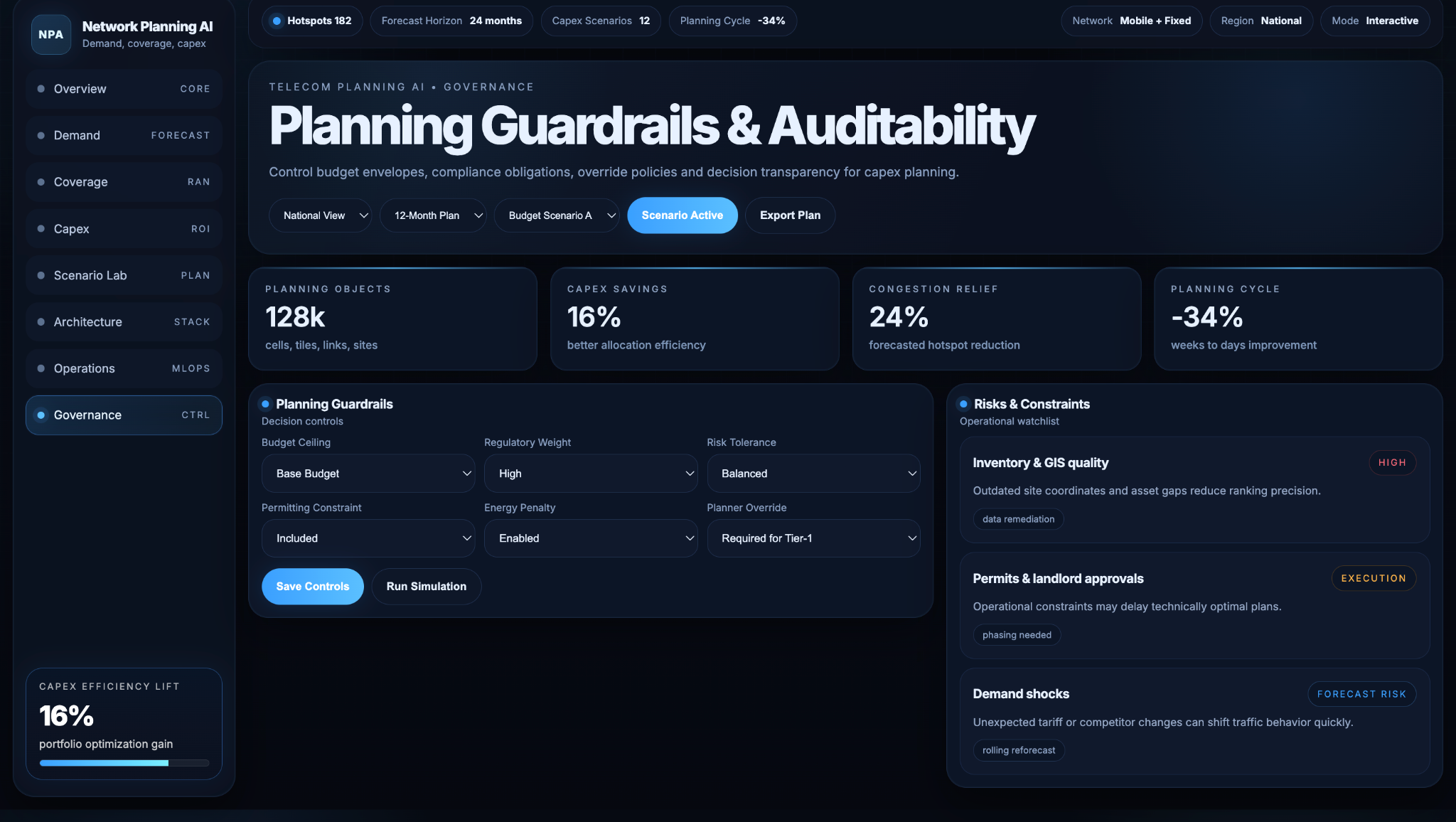
Capex allocation became more precise and transparent. Instead of relying on fragmented inputs and manual prioritization, the platform ranks investment opportunities based on expected traffic relief, QoE improvement, cost efficiency, and commercial impact. This ensures that capital is directed toward initiatives with the highest return, reducing waste and increasing overall investment efficiency.
Operational efficiency improved across planning teams. Automated data processing, scenario simulation, and recommendation generation reduced the time required to evaluate planning options. What previously required weeks of analysis can now be completed in hours or days, enabling faster decision-making and more agile responses to market changes.
The platform also improved cross-functional alignment. By providing a unified view of network performance, demand forecasts, and financial impact, it enables engineering, finance, and strategy teams to collaborate using the same data and assumptions. This reduces decision conflicts and accelerates approval cycles for network investments.
Another key outcome is improved utilization of existing infrastructure. By optimizing coverage and capacity before deploying new assets, the client can extract more value from current investments, delaying unnecessary expansions and reducing overall cost per GB.
In addition, the system supports continuous learning and adaptation. As new data becomes available and rollout outcomes are evaluated, models are updated and recommendations refined. This ensures that planning decisions remain accurate and relevant even as network conditions and user behavior evolve.
Overall, the solution delivered measurable improvements across network performance, capital efficiency, and operational agility. It enables the client to scale network planning capabilities, respond proactively to demand, and maintain a competitive advantage in a rapidly changing telecom environment.
Key Results
- 10–20% improvement in capex efficiency by prioritizing high-impact investments
- 15–30% reduction in congestion-related incidents across high-demand zones
- 20–40% faster planning cycles (from weeks → days/hours)
- 3–8% improvement in network utilization across clusters
- 2–5 point increase in NPS in previously congested regions
- 10–25% improvement in average throughput in optimized areas
- 15–25% reduction in dropped sessions and service degradation
- Up to 20% reduction in unnecessary infrastructure investments
- Faster time-to-market for network expansion and rollout decisions
- Improved alignment between engineering, finance, and strategy teams
Conclusion
From Reactive Planning to
Predictive Network Evolution
The implementation of the AI-driven network planning platform enabled the client to transition from reactive, assumption-based planning to predictive and optimization-driven decision-making. Instead of relying on static models and periodic reviews, the operator can now continuously evaluate network performance, forecast demand, and prioritize investments with high precision.
By combining demand forecasting, geospatial intelligence, and advanced optimization algorithms, the solution provides a holistic view of network evolution. It allows planners to identify where capacity constraints will emerge, determine the most effective interventions, and allocate capital in a way that maximizes both technical performance and business value.
This approach not only improves network quality and customer experience but also ensures more efficient use of capital and faster response to changing market conditions. The integration of simulation and scenario analysis further enhances decision-making by providing clear visibility into trade-offs and expected outcomes.
In the long term, the platform establishes a scalable foundation for intelligent network planning. It enables operators to adapt to continuous growth, support new technologies, and maintain a competitive advantage through faster, smarter, and more data-driven decisions.


Our success stories

.png)
.png)
.png)
.png)











































Tell us about your project needs