


The table of content
Introduction
Real-Time Fraud Prevention
Framework Overview
A telecom operator managing high-volume voice, messaging, and data traffic faced increasing pressure from sophisticated fraud schemes that were evolving faster than traditional rule-based systems could handle. With millions of daily transactions across interconnect, roaming, and subscriber activity, even small detection delays resulted in significant financial losses and operational strain. Existing fraud management tools provided limited visibility, generated high false positives, and relied heavily on manual investigation processes.
To address these challenges, a real-time, AI-driven fraud detection and prevention platform was designed and implemented for the client. The solution introduces a multi-layer intelligence framework that combines streaming analytics, behavioral profiling, graph-based fraud detection, and LLM-assisted investigation. This enables the operator to detect, analyze, and respond to fraud in real time, rather than reacting after damage has already occurred.
The platform continuously processes CDR streams, signaling data, and customer behavior patterns to identify anomalies and detect complex fraud scenarios such as IRSF, SIM box activity, subscription fraud, and account takeover. By integrating automated decisioning and enforcement mechanisms, the system not only detects fraud but actively prevents it through real-time actions such as blocking, suspension, and step-up authentication.
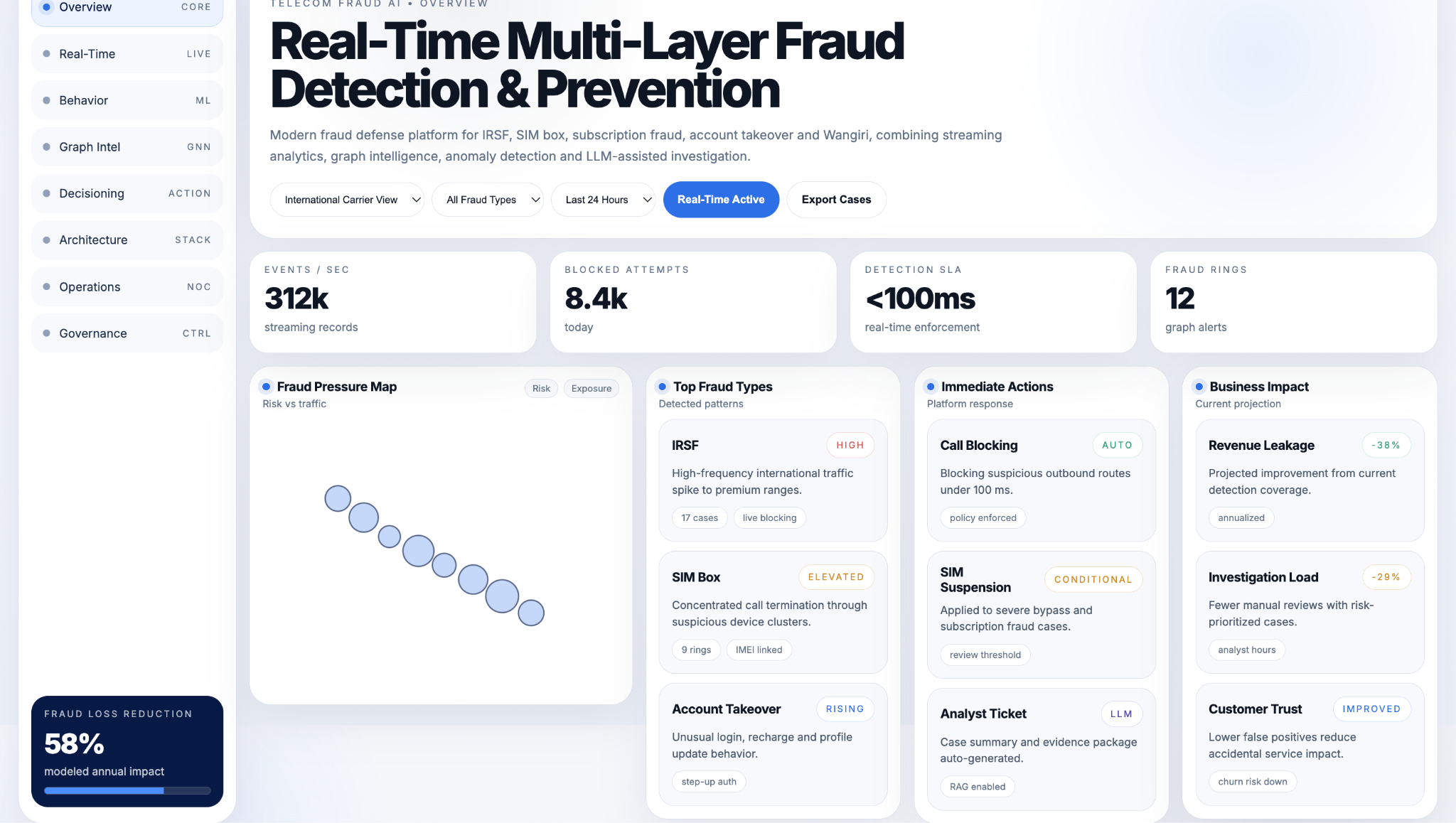
As a result, the client gains full visibility into fraud activity across the network, faster response times, and a scalable foundation for proactive, intelligence-driven fraud management.
Business Challenge
Financial Exposure and
Detection Limitations
The client faced significant financial exposure due to telecom fraud, with revenue leakage estimated at 1–5% of total revenue. Given the scale of operations and transaction volumes, even small inefficiencies in detection translated into substantial monetary losses over time.
The complexity of fraud scenarios further increased the challenge. The operator had to deal with multiple fraud types simultaneously, including IRSF (International Revenue Share Fraud), SIM box bypass fraud, subscription fraud using fake identities, account takeover (ATO), and Wangiri scams. These schemes often overlapped and evolved rapidly, making them difficult to detect using traditional rule-based approaches.
Fraud patterns were dynamic and adaptive, frequently bypassing static rules and thresholds. As a result, existing systems struggled to keep up with new attack vectors and behavioral changes. At the same time, high false positive rates negatively impacted legitimate customers, leading to service disruptions and reduced customer trust.
Another critical issue was detection latency. Fraud was often identified too late, after significant damage had already occurred. This delay increased both direct financial losses and the effort required for investigation and remediation.
Additionally, the client lacked unified visibility across OSS and BSS systems. Data was fragmented across billing, CRM, network signaling, and fraud management tools, making it difficult to correlate events, identify patterns, and respond effectively in real time.
Together, these challenges created a need for a more advanced, integrated, and real-time approach to fraud detection and prevention.
Solution
Multi-Layer AI Fraud Detection
and Prevention System
To address the growing complexity of telecom fraud, a real-time, multi-layer AI platform was designed and implemented for the client. The solution combines detection, intelligence, and automated enforcement into a unified system capable of identifying and preventing fraud as it happens.
At the foundation of the platform is real-time fraud detection, which continuously monitors CDR streams, SMS/data records, and signaling traffic. The system identifies abnormal patterns such as high-frequency international calls, unusual traffic spikes, or suspicious routing behavior.
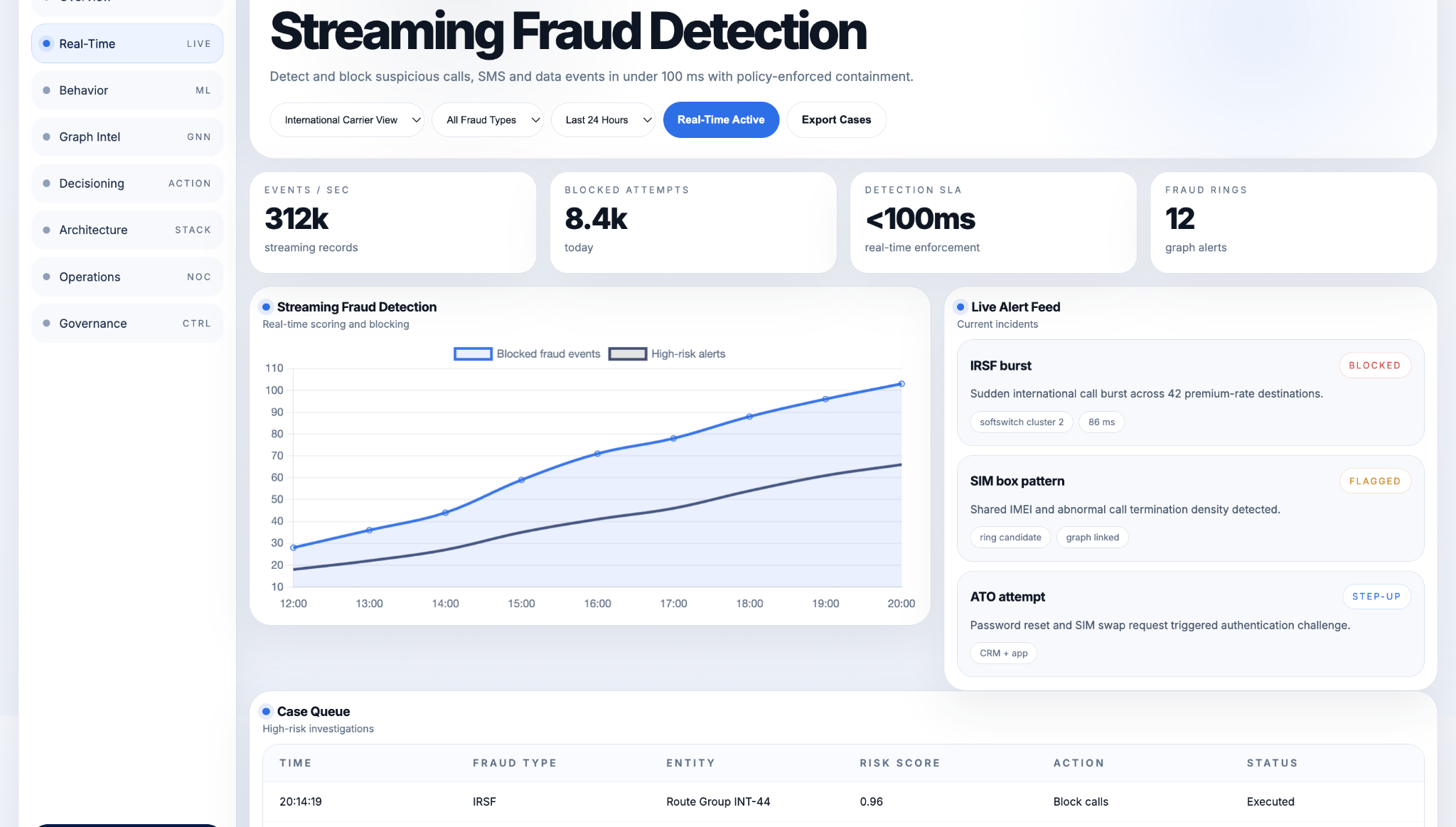
Through high-throughput stream processing and low-latency model inference, the platform performs real-time scoring and decisioning in under 100 milliseconds. This enables immediate blocking of fraudulent activity before it generates significant revenue loss.
Beyond real-time detection, the platform builds dynamic behavioral profiles for subscribers, devices, and enterprise accounts. These profiles evolve continuously based on usage patterns, allowing the system to detect subtle deviations that indicate potential fraud.
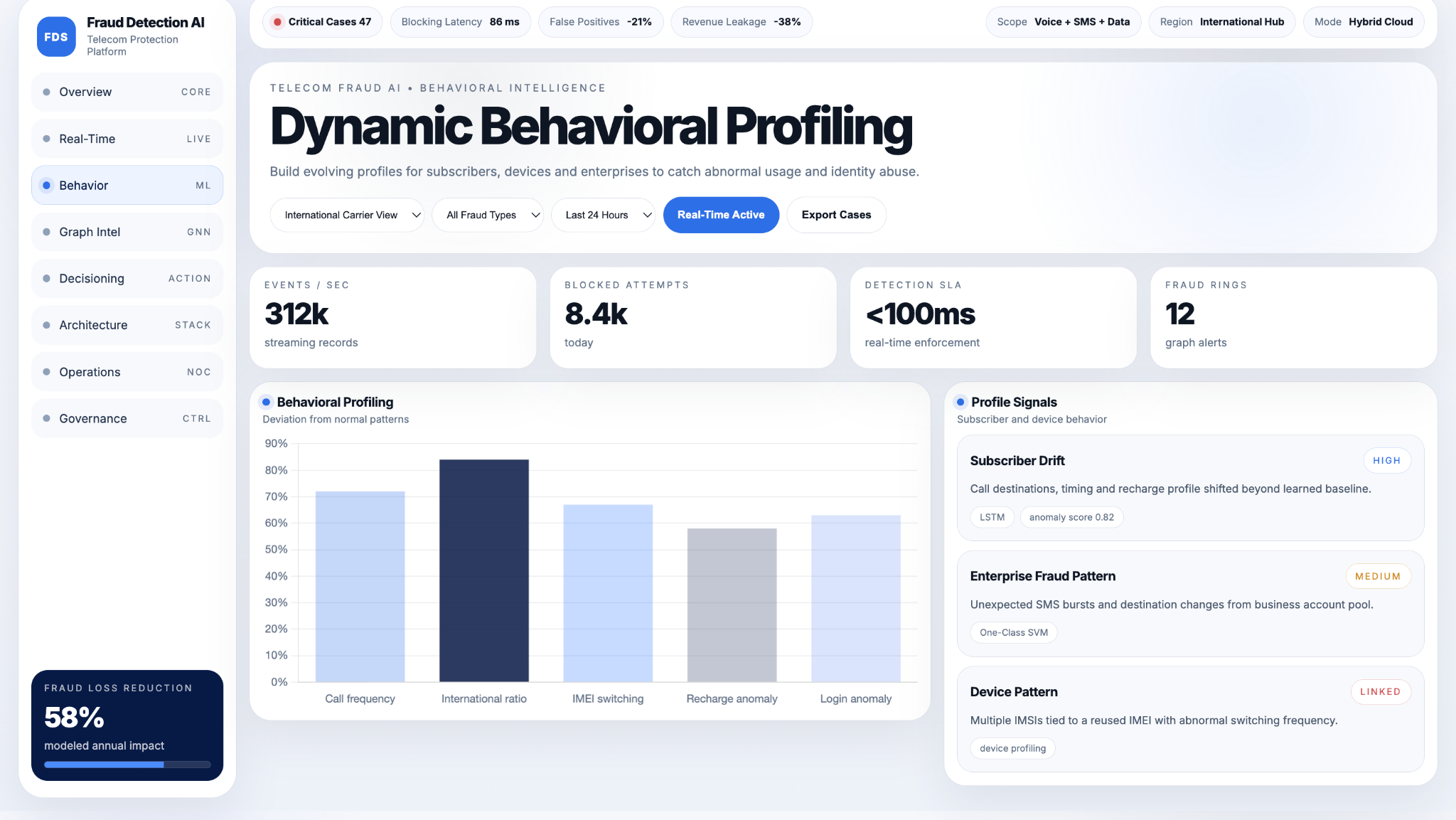
By analyzing deviations from normal behavior — such as changes in call destinations, frequency, device switching, or recharge patterns — the system detects anomalies that would not be visible through static rules.
A key differentiator of the solution is its graph-based fraud detection capability. The platform constructs relationship graphs between entities such as phone numbers, IMEIs, IP addresses, and accounts, enabling the identification of coordinated fraud activity.
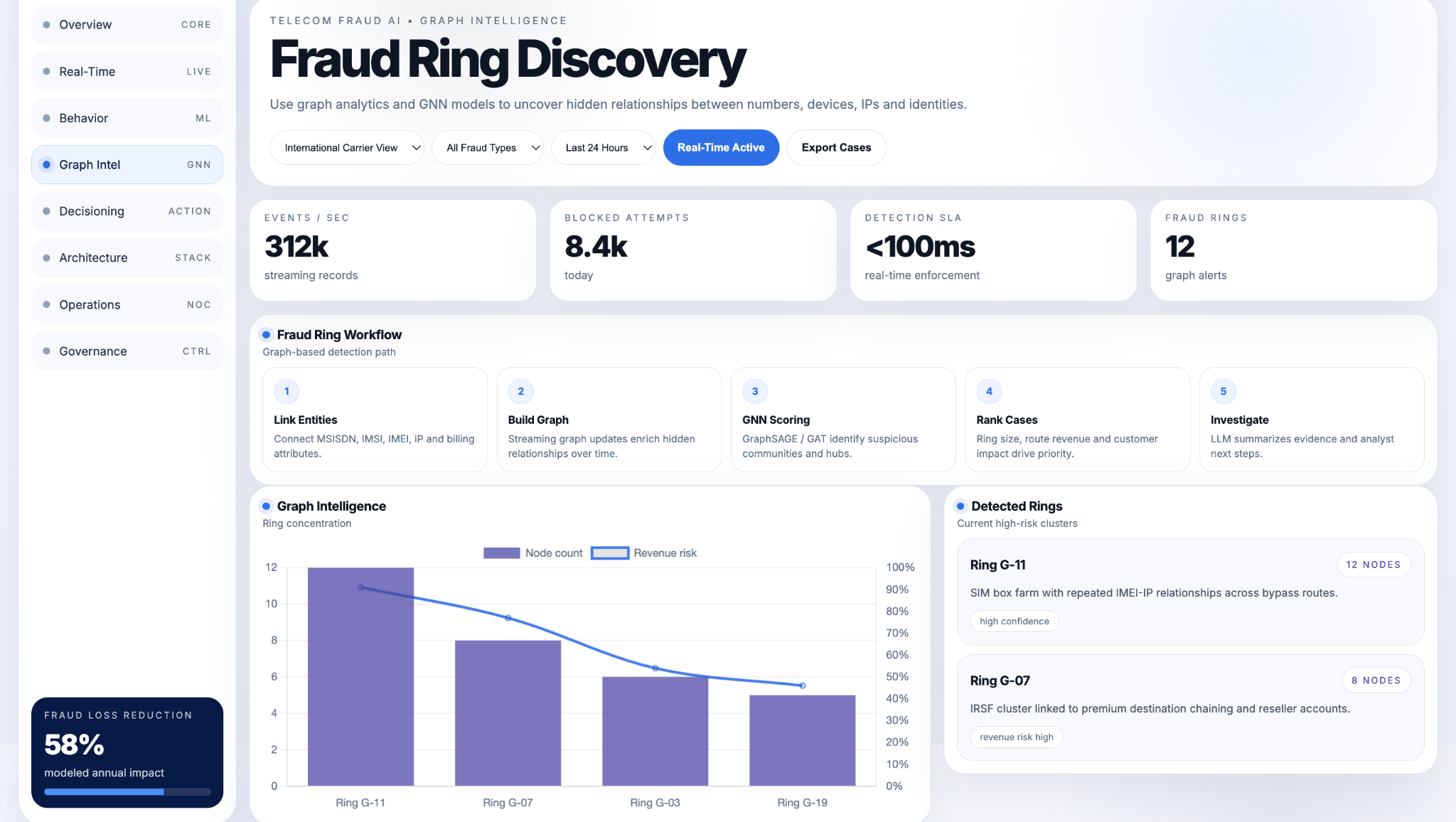
Using graph analytics and GNN models, the system uncovers hidden connections and detects fraud rings such as SIM box clusters or IRSF networks, which are typically invisible to traditional detection methods.
The decisioning layer combines AI model outputs with business rules to determine the most appropriate action in real time.

Based on risk scores and predefined policies, the platform can automatically block calls or SMS, suspend SIM cards, trigger step-up authentication, or escalate cases for investigation. This closed-loop approach ensures that detection is immediately followed by enforcement, minimizing financial impact.
To support fraud analysts, the platform also incorporates LLM-assisted investigation capabilities. It automatically summarizes fraud cases, explains why specific activities were flagged, and enables natural-language queries over logs and historical data. This significantly accelerates investigation workflows and improves decision accuracy.
Overall, the solution transforms fraud management into an intelligent, automated, and real-time system capable of adapting to evolving threats.
Technology Architecture
- Data ingestion (Kafka, NiFi)
- Stream processing (Flink / Spark Streaming)
- Feature store (Redis, Feast)
- Model serving (Kubernetes, TensorFlow Serving, ONNX)
- Graph layer (Neo4j / TigerGraph, GNN models) LLM layer (RAG + vector DB)
- Decision engine (rules + AI fusion)
- Integration (BSS, CRM, network elements)
- Monitoring (Prometheus, OpenTelemetry)
Results and Impact
The implementation of the AI-driven fraud detection platform enabled the client to fundamentally transform their fraud management approach. Instead of relying on delayed, reactive detection, the operator moved to real-time fraud prevention, where suspicious activity is identified and blocked before financial damage occurs.
At the same time, the platform significantly reduced dependence on manual investigation. By introducing AI-driven analysis and LLM-assisted workflows, fraud analysts are now supported with automated insights, case summaries, and prioritized alerts, allowing them to focus on high-impact cases rather than routine checks.
This transformation led to substantial improvements across multiple operational dimensions. Fraud detection speed increased dramatically, with real-time scoring and enforcement enabling response times within milliseconds. This directly contributed to stronger revenue protection by preventing fraud losses before they accumulate.

The governance and compliance layer ensures full transparency and control over fraud detection and enforcement processes, allowing the client to track decisions, audit actions, and align with regulatory requirements.
Operational efficiency improved through automation of detection, decisioning, and response workflows, reducing the workload on fraud teams and minimizing manual intervention. At the same time, the reduction in false positives helped improve customer experience by avoiding unnecessary service disruptions for legitimate users.
Overall, the platform delivered a measurable shift toward a faster, more accurate, and scalable fraud prevention model, strengthening both financial performance and customer trust.
Conclusion
Transition to Autonomous
Fraud Prevention
The implemented platform enabled the client to transition from reactive fraud management to an autonomous, AI-driven fraud prevention model. Instead of detecting fraud after losses occur, the system now identifies and mitigates threats in real time, significantly reducing financial exposure and operational risk.
By combining real-time decisioning with advanced analytics, the solution ensures that suspicious activity is detected and acted upon within milliseconds. The integration of graph intelligence allows the platform to uncover complex fraud networks and hidden relationships, while GenAI-powered investigation enhances analyst capabilities through automated explanations, case summaries, and intuitive interaction with data.
This unified approach transforms fraud management into a continuous, intelligent process that adapts to evolving threats without relying solely on static rules or manual intervention.
In the long term, the solution provides sustainable value by strengthening revenue protection, enabling scalable operations across growing data volumes, and establishing a competitive advantage through faster, smarter, and more reliable fraud prevention.


Our success stories


.png)
.png)
.png)


.png)
































.avif)
























Tell us about your project needs