

The table of content
Introduction
Mobile network operators face growing pressure. SLA penalties are increasing. Energy costs are rising. At the same time, many operations are still reactive.
In Network Operations Centers (NOCs), teams work with fragmented OSS data and large volumes of alarms. These alarms are often not clearly connected. This reduces visibility and slows down response. In many cases, issues are detected only after users are already affected.
Energy optimization is also limited. Most approaches are static and cannot adjust to changing traffic in real time. Operators are forced to choose between cost savings and service quality, which leads to inefficiencies.
A large telecom operator partnered with Infinity Technologies to address these challenges. The goal was to move to a closed-loop operating model.
In response, Infinity Technologies developed NetAssure AI. It is a hybrid platform that combines anomaly detection, traffic forecasting, and reinforcement learning in one system. The platform includes clear decision logic, policy rules, and human approval steps.
NetAssure AI helps operators move from reactive to proactive operations. It improves efficiency and reliability while keeping full control over network decisions.
Under the Hood: The NetAssure AI Technical Architecture
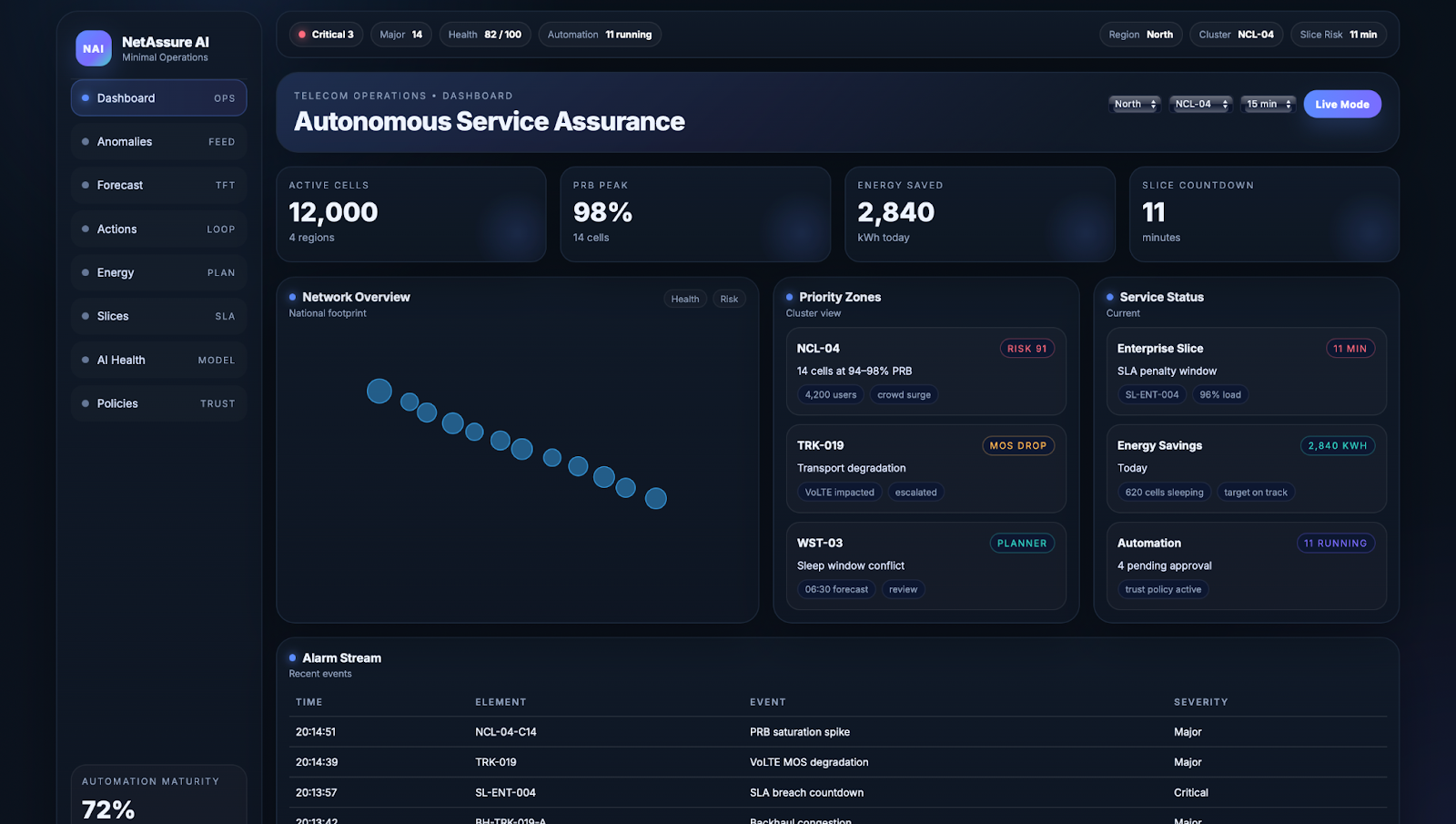
To move from reactive alarms to proactive service assurance, an AI platform must first understand the network as a living, breathing organism. NetAssure AI achieves this through a high-performance ingestion pipeline and a sophisticated, three-layered decision engine.
How the System Sees the Network
NetAssure AI eliminates OSS fragmentation by building a unified, topology-aware, service-impact view spanning the cell, site, cluster, and network-slice levels.
It accomplishes this by ingesting massive, multi-domain datasets in real-time, including live RAN PM counters, transport telemetry, core KPIs, and alarm streams. To provide crucial context, it cross-references network data with external variables like energy meters, local weather feeds, and event calendars.
- Data Velocity: Up to 1.5 million telemetry events processed per second.
- Data Volume: Seamlessly handles 2 to 8 TB of operational data daily.
The Three Decision Layers
NetAssure AI processes this massive data influx through three distinct, interdependent AI layers.
Layer 1: Anomaly Detection
Before an issue triggers a traditional alarm, Layer 1 identifies the underlying symptoms. Using Isolation Forests and Autoencoders, the system performs multivariate detection of PRB saturation, handover failures, VoLTE degradation, packet loss, and power instability. Crucially, it employs graph-based fault propagation for topology-aware root-cause analysis, tracing the degraded service back to its origin rather than just flagging the symptom.
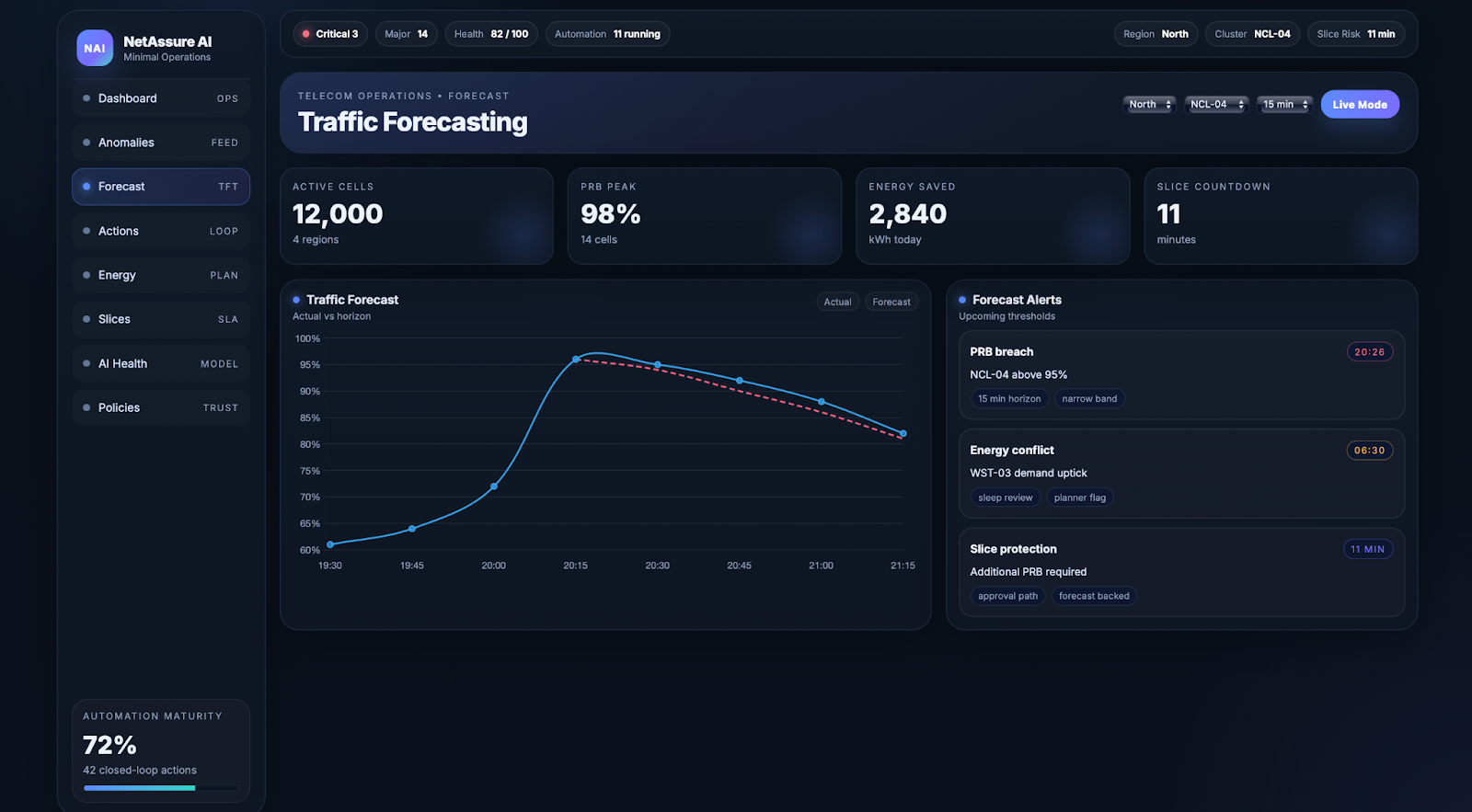
Layer 2: Traffic & Load Forecasting
NetAssure predicts cell-level demand anywhere from 15 minutes to 24 hours in advance. For deep, complex forecasting, it utilizes Temporal Fusion Transformers (TFT) and LSTMs. For highly interpretable baselines, it leverages Prophet and ARIMA models. Forecast alerts proactively surface impending PRB breaches, energy conflicts, and slice protection needs long before the customer experiences a drop in quality.
Layer 3: Optimization & Closed-Loop Action
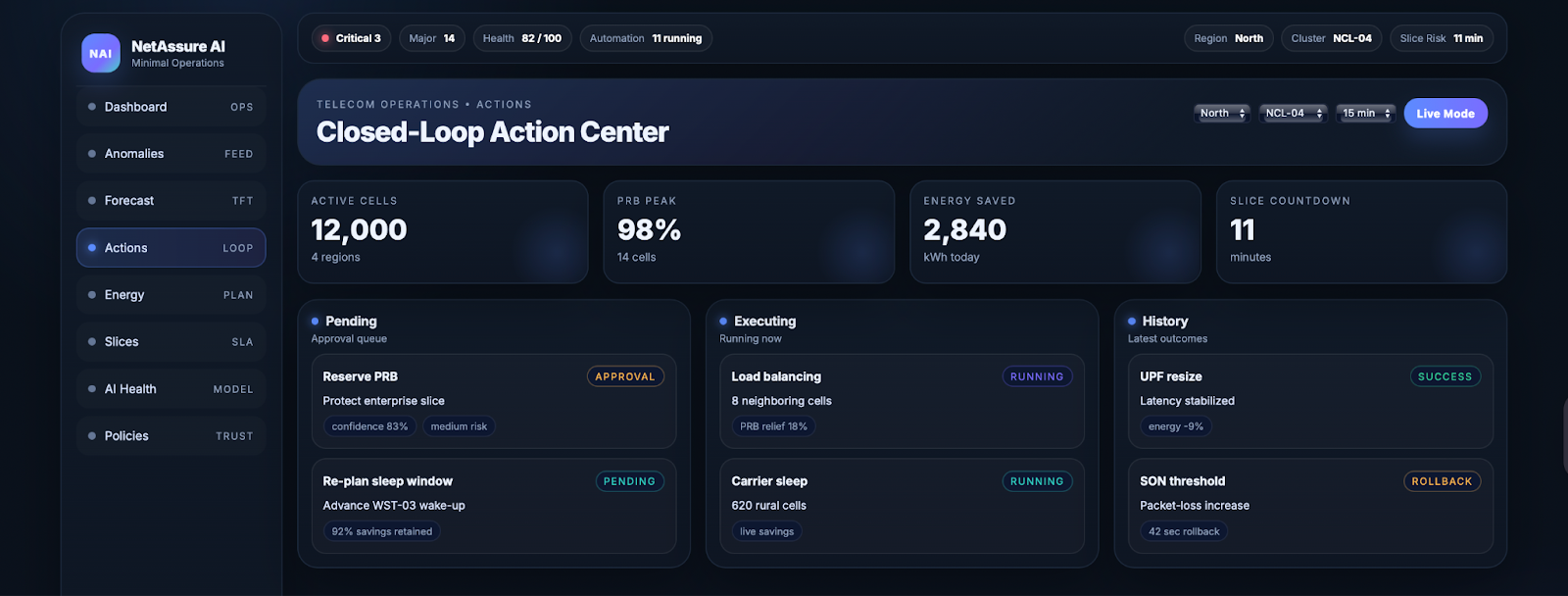
Powered by Proximal Policy Optimization (PPO) and contextual bandit agents, Layer 3 determines the safest and most effective remediation. Actions range from carrier sleep and SON parameter tuning to traffic shifting (load balancing), CNF/VNF resizing, or escalating to field ops.
- Speed to Resolution: Anomaly scoring in 1–5 seconds; root-cause isolation in <30 seconds; closed-loop execution in <1 minute.
- The Trust Paradigm: High-risk configuration changes are automatically queued for human approval. Low-risk actions execute autonomously within strict policy guardrails.
Energy Optimization Planner
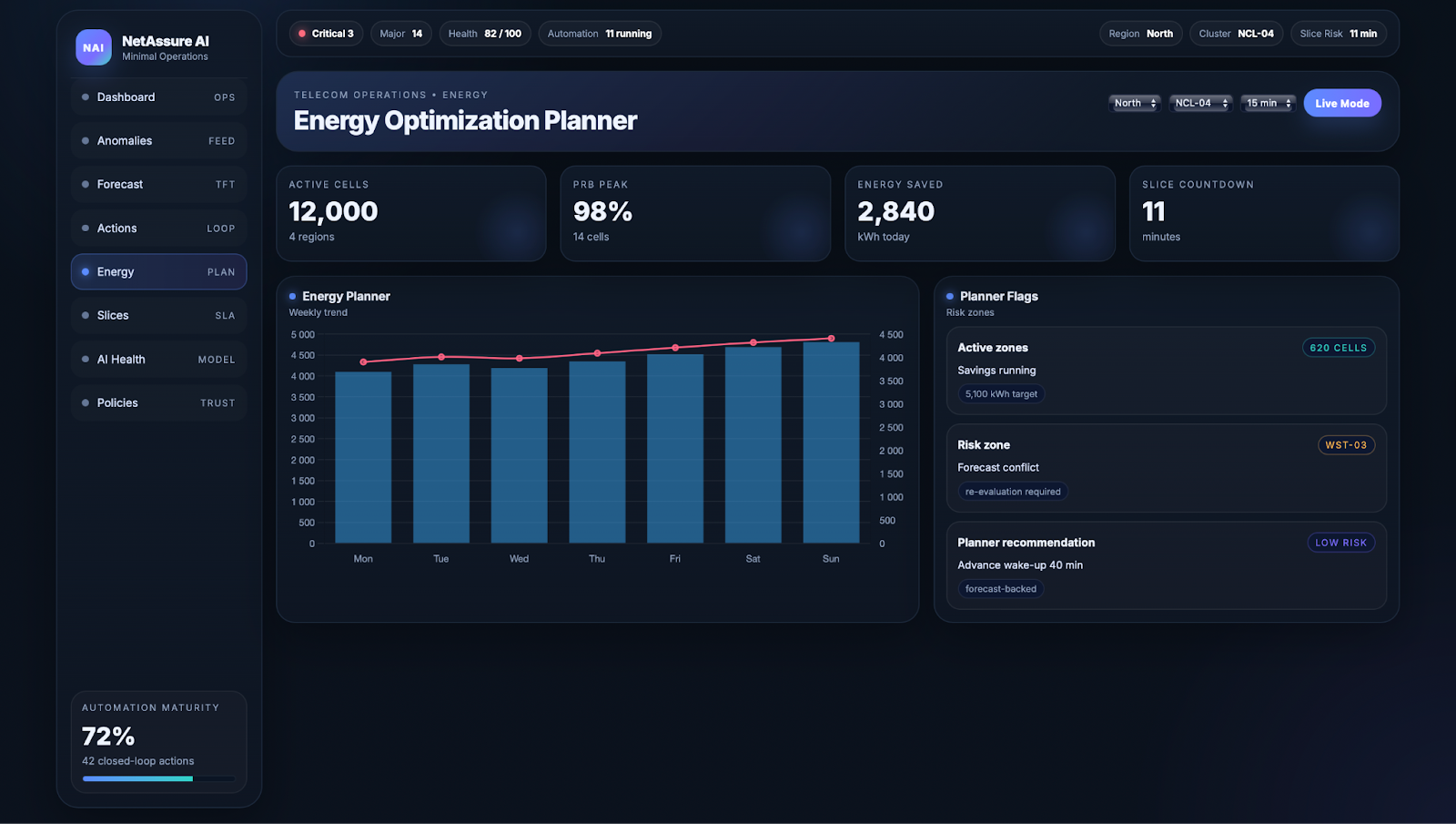
Running on a 15-minute or hourly cadence, the system uses mixed-integer optimization to select optimal carrier sleep windows.
It constantly balances aggressive energy savings against Layer 2's traffic forecasts. If it detects a conflict zone (e.g., an unexpected localized traffic surge in sector WST-03), it flags the area for re-evaluation before committing to sleep mode.
Live Impact: Currently tracking 620 cells sleeping, 2,840 kWh saved today, trending toward a 5,100 kWh weekly target.
Proactive Network Slice Protection
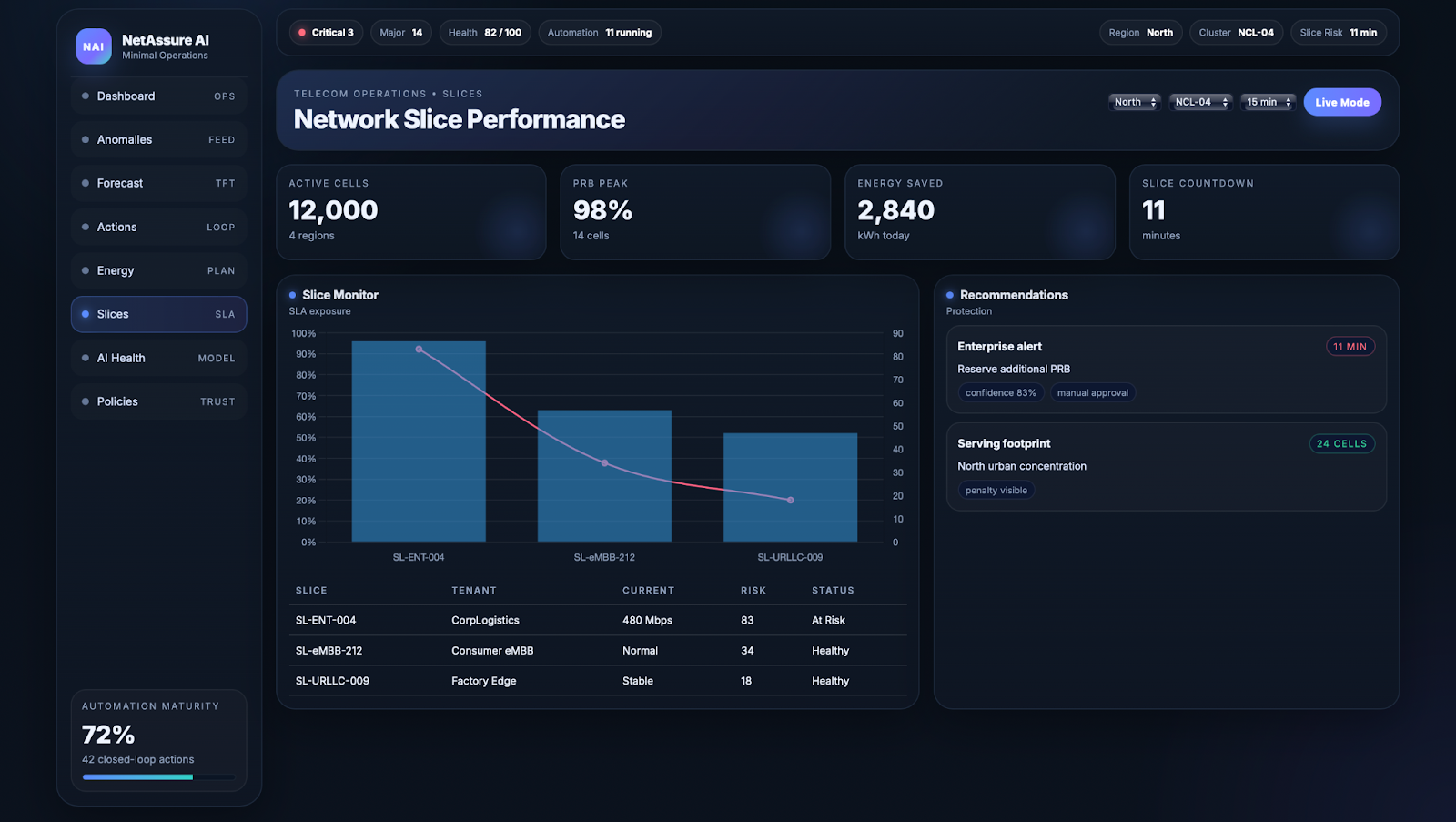
As operators monetize 5G slicing, SLA adherence becomes a strict financial liability. NetAssure AI monitors per-slice SLA exposure in real-time across enterprise (SL-ENT-004), eMBB (SL-eMBB-212), and URLLC (SL-URLLC-009) deployments.
The system proactively reserves PRB for at-risk enterprise slices and surfaces potential SLA penalty visibility before a breach occurs. Every recommendation comes with a transparent confidence score and a clear approval path.
Enterprise-Grade System Architecture
NetAssure is built for the scale and demands of modern Tier-1 operators:
- Ingestion & Processing: Edge/on-premise collectors route data through Kafka into Flink/Spark Structured Streaming, feeding a topology-aware feature store.
- Inference Engine: Fully containerized, Kubernetes-based services utilizing PyTorch, TensorFlow, ONNX Runtime, and NVIDIA Triton.
- O-RAN Ready: Seamless integration via near-RT RIC xApps and non-RT RIC rApps.
- Observability: End-to-end monitoring powered by OpenTelemetry, Prometheus, and Grafana.
Keeping the AI in Check: Health, Governance, and Policy
Operators fear the "black box" taking down the network at 2 a.m. NetAssure AI mitigates this through relentless governance and ironclad policy controls.
Model Health & Drift Monitoring
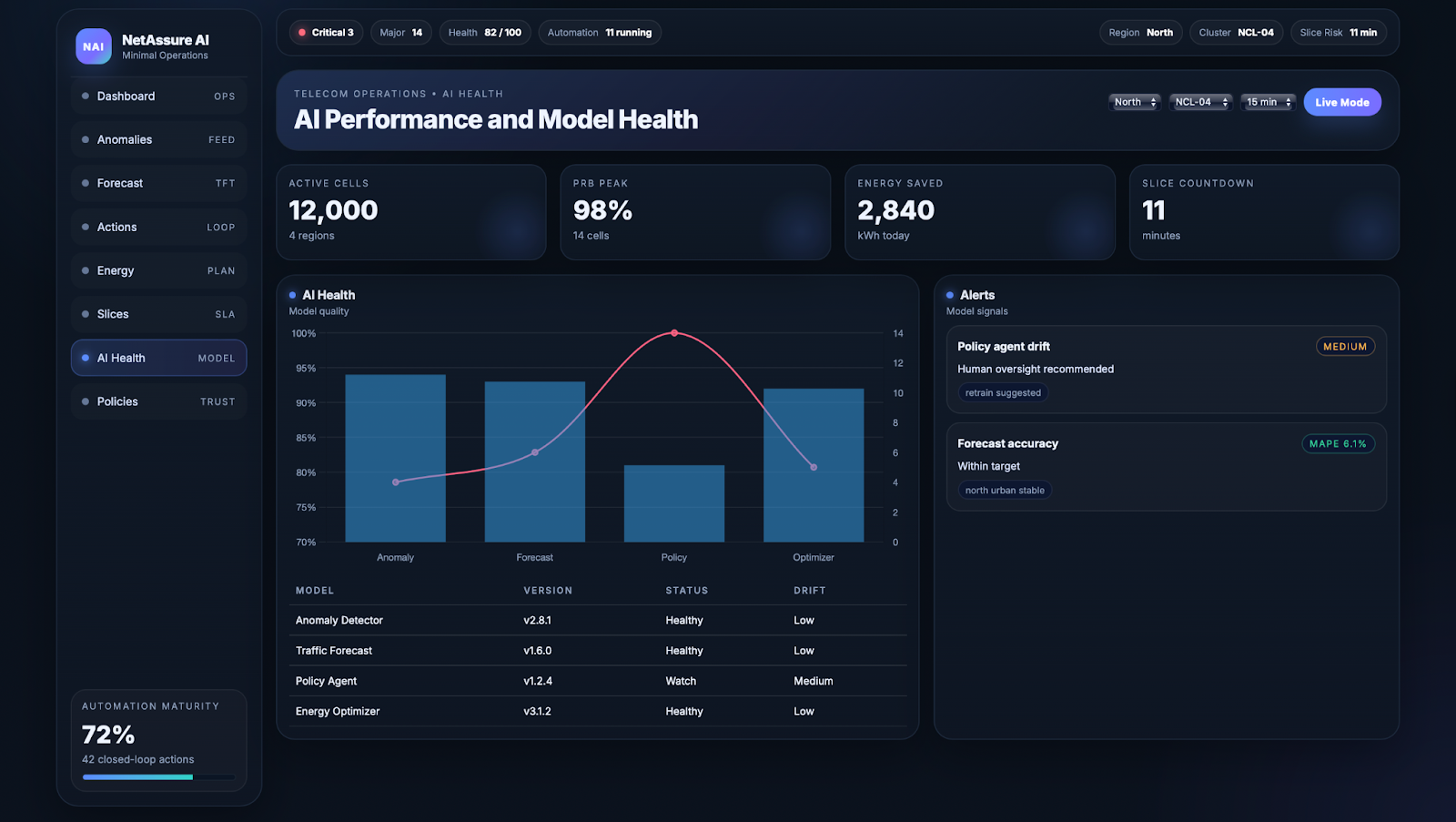
Every AI model is strictly versioned and continuously monitored for data drift, false-positive rates, and action effectiveness.
- Real-world Accuracy: Forecasting models currently operate at an impressive MAPE of 6.1%.
- Automated Oversight: If a policy agent flags for even medium drift, human oversight is triggered automatically before any further actions are taken.
Policy & Guardrail Configuration
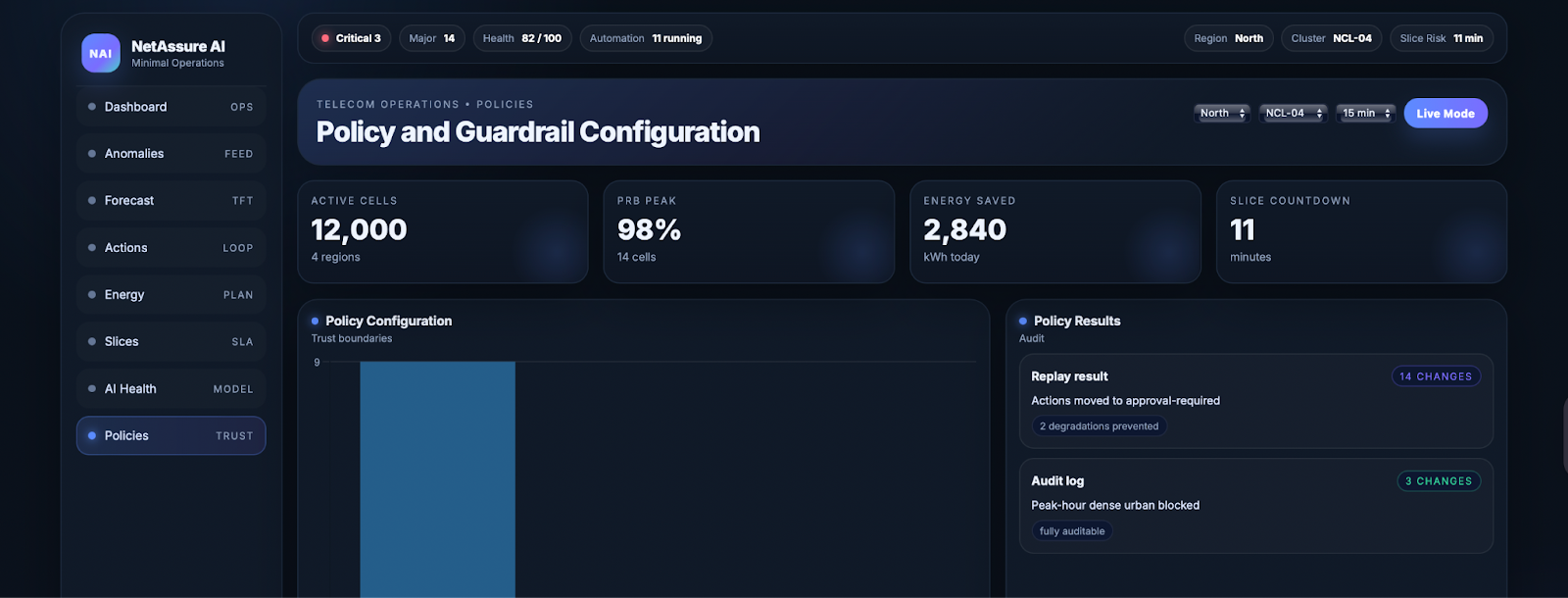
You define the trust boundaries. Peak-hour, dense urban zones can be hard-blocked from autonomous actions entirely. Furthermore, a full, immutable audit log ensures every single AI decision is traceable, replayable, and explainable. For example, if a policy replay highlights potential instability, the system learns and adapts—recently moving 14 specific change types back to "approval-required" status.
Conclusion
This case demonstrates that the shift from reactive to proactive network operations is both achievable and economically justified. By implementing NetAssure AI, the operator addressed core NOC challenges, including alarm overload, limited visibility, and delayed response times. As a result, the network moved toward real-time awareness and predictive control, significantly improving operational stability
The impact is supported by clear, measurable results. The solution delivered a 15–25% reduction in avoidable service degradations, directly protecting user experience. Alarm noise decreased by 20–35% through intelligent correlation, reducing operator fatigue and improving focus. RAN energy consumption dropped by 10–20%, contributing to both OPEX reduction and sustainability targets. At the same time, incident triage became 20–30% faster, leading to a substantial improvement in Mean Time to Resolution (MTTR).
A key success factor of the solution is its balance between automation and control. NetAssure AI enhances operator decision-making rather than replacing it. With transparent logic, policy guardrails, and human approval workflows, the platform ensures that all actions remain explainable and governed. This approach removes the typical risks associated with black-box AI in critical telecom environments.
From a technical perspective, the platform creates a unified, scalable intelligence layer capable of processing up to 1.5 million telemetry events per second and handling 2–8 TB of data daily. It integrates anomaly detection, traffic forecasting, and reinforcement learning into a closed-loop system, enabling faster and more accurate decisions across the network.
From a business standpoint, NetAssure AI delivers dual value. It reduces operational costs while improving service quality—eliminating the traditional trade-off between efficiency and performance. This positions the operator for sustainable growth in increasingly complex and high-demand network environments.
Overall, NetAssure AI establishes a strong foundation for autonomous service assurance. It enables faster decisions, reduces operational load, and improves network reliability, while maintaining full transparency and control.


Our success stories

.png)
.png)
.png)
.png)
























.avif)



















Tell us about your project needs