


The table of content
Client
The client was a fast-growing digital workforce marketplace. The platform connected companies with independent professionals, consultants, and project-based talent, similar in concept to global freelance platforms such as Upwork, but adapted to the needs of enterprises and public-sector organizations in the region.
Because the platform handled personal data, professional profiles, contracts, transaction-related records, identity information, and operational analytics, data residency became a critical requirement. The client needed to demonstrate that sensitive data was stored, processed, backed up, and accessed in line with the expectations of local regulators and enterprise customers.
The company was preparing for a formal data residency and compliance review involving a Big-4 advisory firm and a governmental entity. Infinity Technologies was engaged to support the preparation process, structure the evidence base, validate technical controls, and help the client demonstrate traceability across its cloud infrastructure and operational processes.
Business Context
For digital platforms operating in regulated markets, data residency is not only a technical requirement. It is also a trust requirement.
Enterprise clients and government stakeholders need clear evidence that data is not only hosted in an approved region, but also managed according to defined governance rules. This includes proof of where data is stored, where backups are located, who can access the systems, how access is logged, how data flows across services, and how the organization can demonstrate compliance during an audit.
The client had a working platform and a mature technical team, but the audit introduced a different level of scrutiny. Architecture diagrams, verbal explanations, and cloud provider screenshots were not enough. The company needed a structured, auditable evidence package that could withstand review by external auditors and a governmental body.
The Challenge
The main challenge was to convert the company’s existing technical architecture and operational practices into a clear, traceable, and audit-ready compliance story.
The client needed to answer several critical questions:
- Where exactly is production data stored?
- Where are backups and disaster recovery copies located?
- Which services process personal or sensitive data?
- Are there any cross-border data transfers?
- Who has administrative access to production systems?
- How is privileged access approved, logged, and reviewed?
- Can the company provide evidence of data residency controls, not only policies?
- Can logs, infrastructure records, and operational procedures be connected into one consistent audit trail?
The risk was not only technical non-compliance. The bigger risk was the inability to prove compliance quickly and consistently during the audit.
This is a common problem for fast-growing technology companies. Their systems may be reasonably designed, but their evidence is often fragmented across cloud consoles, DevOps tools, internal documents, ticketing systems, access logs, backup configurations, and informal team knowledge.
Infinity Technologies’ Role
Infinity Technologies supported the client across four major workstreams:
- Data residency verification
- Audit readiness preparation
- Documentation and evidence structuring
- Logs, access control, and traceability validation
Our objective was to help the client demonstrate, in a structured and defensible way, that its platform followed the required data residency model and that the company could prove this through documentation, logs, and operational evidence.
We worked closely with the client’s leadership, engineering team, DevOps specialists, security stakeholders, and external audit representatives to prepare the organization for formal review.
Workstream 1
Data Residency Verification
The first step was to define the actual data residency scope.
Infinity Technologies helped identify the categories of data processed by the platform and map them to infrastructure components. This included production databases, object storage, file storage, backup systems, analytics services, authentication components, application logs, monitoring systems, and third-party integrations.
We supported the creation of a data residency map covering:
- Production hosting regions
- Database locations
- Storage buckets and file repositories
- Backup and disaster recovery locations
- Replication mechanisms
- Administrative access points
- Monitoring and logging destinations
- Third-party systems involved in data processing
- Data flows between application components
The goal was to establish a single source of truth for where data was stored, processed, replicated, and accessed.
This mapping helped separate assumptions from verifiable facts. It also allowed the client to identify which systems were in scope for audit and which systems did not process regulated or sensitive data.
Workstream 2
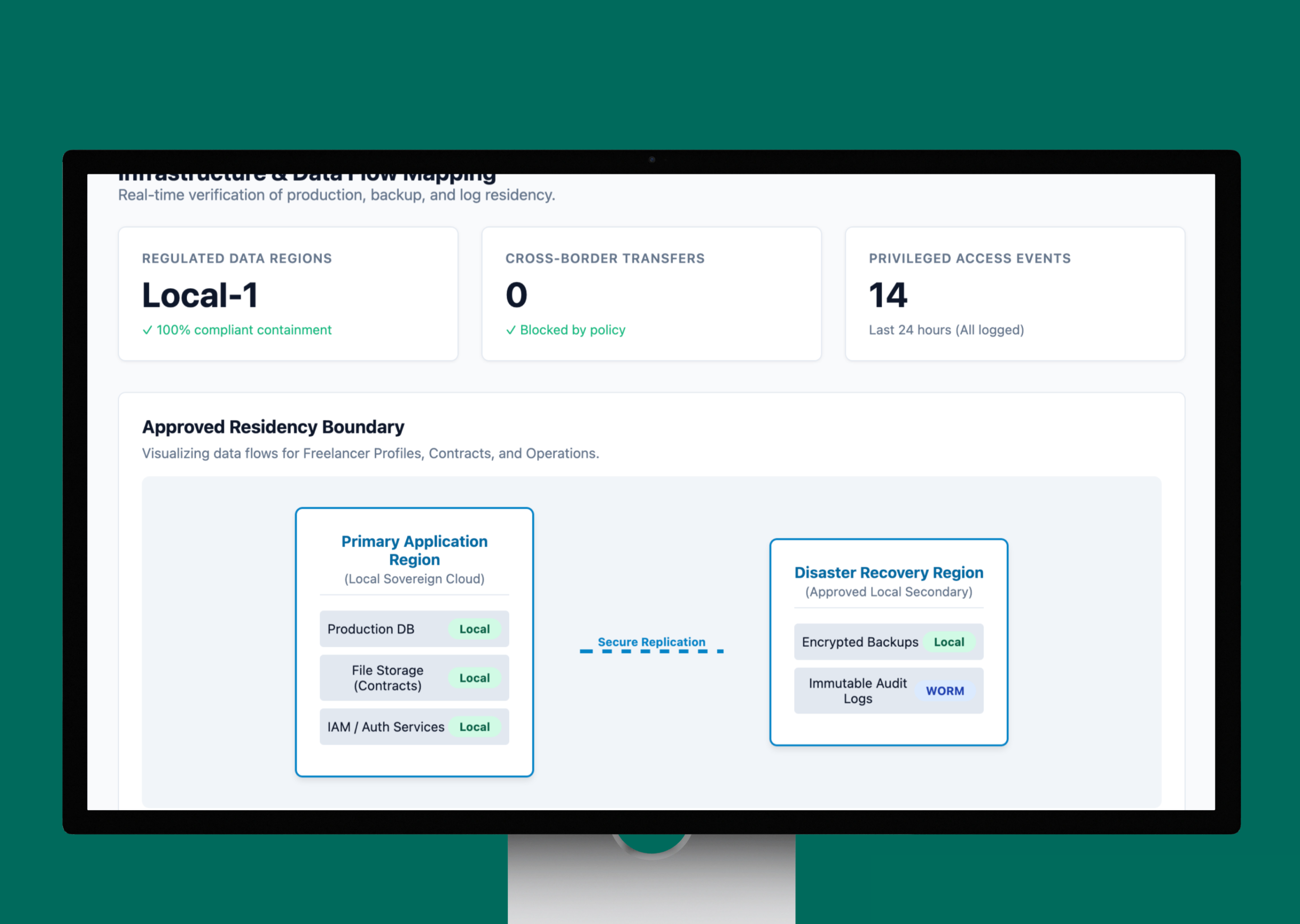
Infrastructure and Data Flow Mapping
After defining the residency scope, Infinity Technologies helped prepare a structured infrastructure and data flow package.
This included diagrams and supporting explanations showing how data moved through the platform from user interaction to backend processing, storage, backup, monitoring, and reporting.
The documentation covered:
- User registration and profile data flows
- Client and professional onboarding flows
- Contract and engagement-related data flows
- File upload and document storage flows
- Payment-related data boundaries
- System logging and monitoring flows
- Backup and recovery flows
- Administrative access flows
Particular attention was given to the difference between application data, metadata, logs, and operational telemetry. In many audits, companies focus only on database residency and overlook logs, backups, and monitoring tools. Infinity Technologies helped the client include these areas in the evidence package because they are often critical in data residency assessments.
Workstream 3
Audit Documentation Preparation
Infinity Technologies helped prepare and organize the documentation required to support the data residency review.
The documentation package included:
- Data Residency Statement
- Data Flow Diagrams
- Infrastructure Architecture Overview
- Data Classification Matrix
- Access Control Procedure
- Privileged Access Management Procedure
- Backup and Disaster Recovery Description
- Logging and Monitoring Description
- Vendor and Sub-Processor Register
- Incident Response Procedure
- Change Management Evidence
- Production Access Review Evidence
- Data Retention and Deletion Notes
- Audit Evidence Index
The purpose was not to create documentation for the sake of documentation. Each document had to support a specific audit question.
For example, the Data Residency Statement explained the intended residency model. The infrastructure evidence demonstrated that the model was implemented. The logs and access records showed that operational activity could be traced. The vendor register helped clarify whether any third-party tools could create residency exposure.
This structure made the audit process more efficient because auditors could request evidence and receive it in a consistent format.
Workstream 4
Logs and Traceability
One of the most important parts of the engagement was traceability.
Infinity Technologies helped the client prepare logs and evidence showing how infrastructure access, administrative actions, backups, and system changes could be traced.
The review included:
- Administrative login records
- Cloud account access logs
- Role and permission assignments
- Production access records
- Database access logs
- Backup job logs
- Storage access records
- Deployment records
- Change management tickets
- Monitoring and alerting records
- Incident response records, where applicable
The objective was to connect technical events with accountable users, approved processes, and timestamps.
This was important because data residency audits are not limited to the question of where infrastructure is hosted. Auditors may also ask whether unauthorized or uncontrolled access could undermine the residency model. For example, even if data is stored in an approved region, uncontrolled administrative access, unmanaged exports, or undocumented backup replication can create compliance concerns.
Infinity Technologies helped the client demonstrate that access was controlled, logged, and reviewable.
Workstream 5
Evidence Repository and Audit Trail
A key deliverable was the creation of an organized evidence repository.
Infinity Technologies helped structure audit evidence into clear categories so that the client could quickly respond to questions from the Big-4 audit team and the governmental entity.
The evidence repository included:
- Architecture evidence
- Data location evidence
- Backup location evidence
- Access control evidence
- Logging and monitoring evidence
- Vendor and third-party evidence
- Policy and procedure evidence
- Operational review evidence
- Remediation evidence
Each item was linked to an audit topic and, where possible, to a specific control objective.
This approach reduced confusion during the audit and helped the client avoid inconsistent answers from different teams. It also created a reusable compliance asset that could support future enterprise client due diligence, public-sector tenders, and regulatory reviews.
Workstream 6
Pre-Audit Readiness Review
Before the formal review, Infinity Technologies supported a pre-audit readiness assessment.
The assessment simulated typical auditor questions, including:
- Show where production data is stored.
- Show where backups are stored.
- Show who has access to production systems.
- Show how access is approved and revoked.
- Show whether any logs or telemetry leave the approved region.
- Show how changes to infrastructure are controlled.
- Show how the company can detect unauthorized access.
- Show how incidents would be handled.
- Show how third-party vendors are assessed.
This exercise helped identify gaps before the formal review started. Some gaps were technical, while others were documentation or evidence-related.
Where issues were found, Infinity Technologies helped the client define practical remediation actions, clarify responsibilities, and prepare updated documentation.
Examples of Improvements Introduced
During the engagement, Infinity Technologies helped the client improve several areas of audit readiness.
These improvements included:
- Clearer documentation of data residency boundaries
- Better separation between in-scope and out-of-scope systems
- More complete mapping of backup and recovery locations
- Improved evidence of administrative access control
- Better traceability between infrastructure activity and responsible users
- Structured audit evidence index
- More consistent explanation of data flows and third-party dependencies
- Improved readiness to answer auditor questions with evidence rather than verbal explanations
The result was a more mature compliance posture and a clearer operating model for data residency governance.
Support During the Audit
Infinity Technologies supported the client during the external audit process by helping prepare responses, organize evidence, and explain technical controls in a form understandable to auditors and non-technical stakeholders.
This included support for:
- Big-4 audit requests
- Governmental entity questions
- Evidence preparation
- Technical clarification sessions
- Follow-up explanations
- Minor remediation tracking
Our role was to help bridge the gap between engineering reality and audit expectations.
Technical teams often describe systems in implementation terms. Auditors usually need evidence organized around risks, controls, and accountability. Infinity Technologies helped translate the client’s technical architecture into a structured control narrative supported by logs and documentation.
Outcome
The client successfully passed the data residency verification process involving the Big-4 audit team and the governmental entity.
The review confirmed that the company had a defensible data residency model, supported by appropriate documentation, traceability, and operational evidence.
The successful audit helped the client:
- Demonstrate compliance with data residency expectations
- Strengthen trust with government and enterprise stakeholders
- Reduce risk in regulated-market operations
- Improve internal governance over data flows and access controls
- Create a reusable evidence base for future audits and customer due diligence
- Improve confidence in backup, logging, and operational traceability processes
For the client, this was not only a compliance milestone. It became a commercial enabler. Passing the review allowed the company to continue scaling its platform in a regulated market and gave enterprise and government customers greater confidence in the platform’s ability to manage sensitive data responsibly.
Key Deliverables
Infinity Technologies delivered a structured audit readiness package that included:
- Data Residency Verification Framework
- Data Flow and Infrastructure Mapping
- Data Residency Statement
- Data Classification Matrix
- Backup and Disaster Recovery Evidence
- Access Control and Privileged Access Documentation
- Logging and Traceability Evidence
- Vendor and Sub-Processor Register
- Audit Evidence Repository
- Pre-Audit Readiness Assessment
- Support During Big-4 and Governmental Review
Technologies and Control Areas
The engagement covered the following areas:
- Cloud infrastructure review
- Regional hosting verification
- Database and storage residency
- Backup and disaster recovery residency
- Identity and access management
- Privileged access control
- Logging and monitoring
- Change management
- Vendor and third-party dependency review
- Data flow documentation
- Audit evidence preparation
The specific infrastructure and tooling details are confidential, but the approach is applicable to cloud, hybrid, and sovereign infrastructure environments.
Why This Case Matters
Data residency is becoming a strategic requirement for digital platforms operating in regulated markets. It is especially important for companies working with public-sector organizations, financial institutions, healthcare providers, critical infrastructure entities, and large enterprises.
However, many companies underestimate what data residency verification requires. It is not enough to say that a system is hosted in a specific region. Companies must be able to prove where data is stored, how it moves, who can access it, where backups are located, and how operational activity is logged.
Infinity Technologies helped the client move from informal confidence to structured proof.
That shift was critical for passing the audit.
Infinity Technologies’ Value
Infinity Technologies brought together technical, compliance, and operational expertise.
Our value was in combining:
- Cloud and infrastructure understanding
- Software engineering experience
- Security and compliance documentation
- Audit preparation
- Data flow analysis
- Practical evidence collection
- Ability to work with both engineers and auditors
This allowed the client to prepare not only a set of documents, but a coherent and evidence-backed compliance position.


Our success stories
.png)
.png)
.png)























.avif)
















Tell us about your project needs





.png)
.png)