

The table of content
Overview
The Client is a Fortune 200 integrated oil & gas operator headquartered in Texas, with roughly 27,000 employees spanning corporate, midstream operations, refining, and upstream field sites, and around 3,400 new hires each year. Onboarding at this scale had grown into a fragmented, high-risk process: twelve disjointed tools, more than forty manual handoffs, an average time-to-badge of 14 calendar days, mandatory HSE safety training tracked across three separate learning systems, and day-30 new-hire satisfaction stuck at 6.1 out of 10.
To replace this, the Client deployed Project ONIX — an AI-driven onboarding solution that uses Google Gemini Enterprise as the intelligent orchestration layer between Workday (the system of record for HR), Microsoft Teams (the enterprise collaboration platform), and a portfolio of upstream and downstream HR, IT, learning, and Health, Safety & Environment systems. The result is a single conversational, proactive onboarding companion that lives inside the new hire's Teams client and manages the experience from the moment an offer is signed through the full 90-day onboarding window.
The agent is event-driven, bi-directional, and observable. It treats Workday as the source of truth, consuming structured events at every state change — offer accepted, background check cleared, I-9 verified, badge issued, training assigned — and deciding the next best action for both the new hire and the manager. It answers grounded, source-cited questions from either side, nudges managers through structured 30-60-90-day rituals, and continuously measures sentiment to flag at-risk joiners for HR intervention. Every prompt, response, citation, and action is logged for analytics and audit, giving HR real-time visibility where reporting was once a weekly spreadsheet exercise stitched together from five sources.
Business Challenge
Before Project ONIX, the Client's onboarding combined twelve disjointed tools, more than forty distinct manual handoffs, and an average time-to-badge of 14 calendar days. The experience was fragmented from the first day: new hires received an average of 17 separate emails in their first three days, from at least seven different sender domains, often carrying conflicting instructions and broken links. Behind the scenes, the path from offer accepted to badge issuance depended on manual ticket creation, manual account provisioning, manual mailbox setup, and manual entitlement requests across multiple operational systems — a chain of human steps where any single delay stalled the whole process.
Manual Handoffs and No Visibility
The reliance on manual coordination left the process slow, inconsistent, and opaque. Manager engagement varied widely — only 41% held a documented 30-day check-in and just 22% a 60-day check-in — because no structured ritual cadence existed to prompt them. HR leadership, meanwhile, had no real-time view of where any individual new hire stood in their onboarding flow; reporting was a weekly Excel exercise stitched together from five sources, always describing the past rather than the present. The absence of a single orchestration layer meant no one could see the whole journey, let alone intervene in time.
Fragmented HSE Training and Compliance Risk
For a heavily regulated oil & gas operator, the greatest exposure was safety. Mandatory HSE curriculum — H2S Awareness, HAZWOPER, SafeGulf, and site-specific orientations — was split across Cornerstone OnDemand for corporate, Veriforce for contractor and field, and a legacy in-house LMS for refinery operations, with no unified tracking. The consequences were concrete: an FY2024 internal audit found that 7.3% of new field employees had been granted access to operational sites before completing one or more mandatory HSE prerequisites, primarily because manual tracking gaps let people through. In an environment governed by OSHA, EPA, PHMSA, BSEE, and TWIC, that gap represented real physical and regulatory risk, not just administrative friction.
Solution
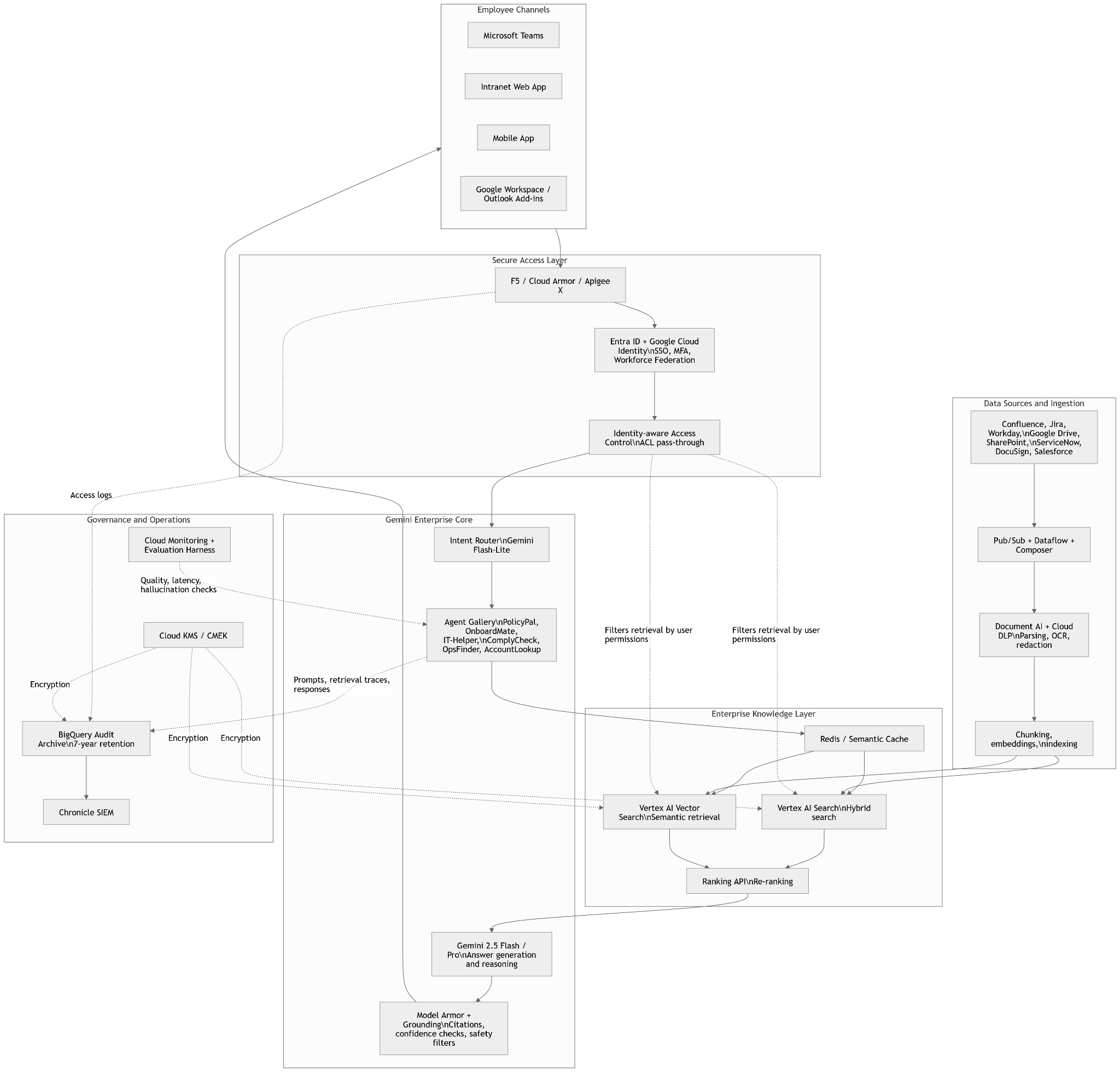
Project ONIX delivers a proactive, conversational onboarding companion that sits inside the new hire's Microsoft Teams client from day one, built on Google Gemini Enterprise with Vertex AI Agent Builder, Gemini 2.5 Pro for reasoning, and Gemini 2.5 Flash for high-volume routine inference. The agent is grounded against the Client's HR knowledge base, HSE policies, Code of Conduct, IT service catalog, and benefits documentation through Vertex AI Search, so it answers from the company's own authoritative content rather than from open-ended generation. Architecturally, the solution is organised into seven clean layers — from the Teams experience surface through agent orchestration, workflow and events, integration, data, security, and observability — a separation that let the team deliver incrementally and swap underlying systems, such as an LMS, without rewriting the agent itself.
Event-Driven Orchestration Across Systems
The agent treats Workday as the source of truth. Every meaningful state change in the hire-to-start-date process — offer accepted, pre-hire created, background check cleared, I-9 verified, work eligibility confirmed, badge issued, training assigned — emits a structured event that Gemini Enterprise consumes through a Pub/Sub and Eventarc backbone, with Cloud Workflows managing the long-running 90-day journey and Cloud Tasks and Scheduler driving timed nudges and reminders. From each event the agent decides the next best action for both the new hire and the manager, then orchestrates downstream work — provisioning tickets, training assignments, calendar rituals — through Apigee X and Google Cloud Application Integration connectors rather than the manual handoffs it replaced. This turns a sequential chain of human steps into an automated, self-healing flow with built-in retries and SLA tracking.
Grounded, Bi-Directional, and Governed
The agent is genuinely two-way and safe by design. A new hire can ask how to enrol in benefits or what PPE will be issued at their site and receive a grounded, source-cited answer; a manager can ask who on their team is onboarding this week and receive a synthesised briefing. Every response passes through Model Armor for prompt-injection and PII filtering, with confidence thresholds and human-in-the-loop write confirmation guarding consequential actions. The whole platform runs inside a VPC Service Controls perimeter with CMEK encryption, keyless workload-identity access to data, and a firm commitment that no prompts, completions, or grounding sources are used for model training — and every prompt, response, citation, and action is logged to BigQuery for Looker dashboards and to immutable Cloud Logging for Internal Audit.
Results
Six months into production, Project ONIX had cleared every target it was set, backed by measured before-and-after data rather than projections. The impact registered across speed, manager behaviour, safety compliance, experience, and cost — and the financial return closed a decisive business case.
Speed, Compliance, and Experience
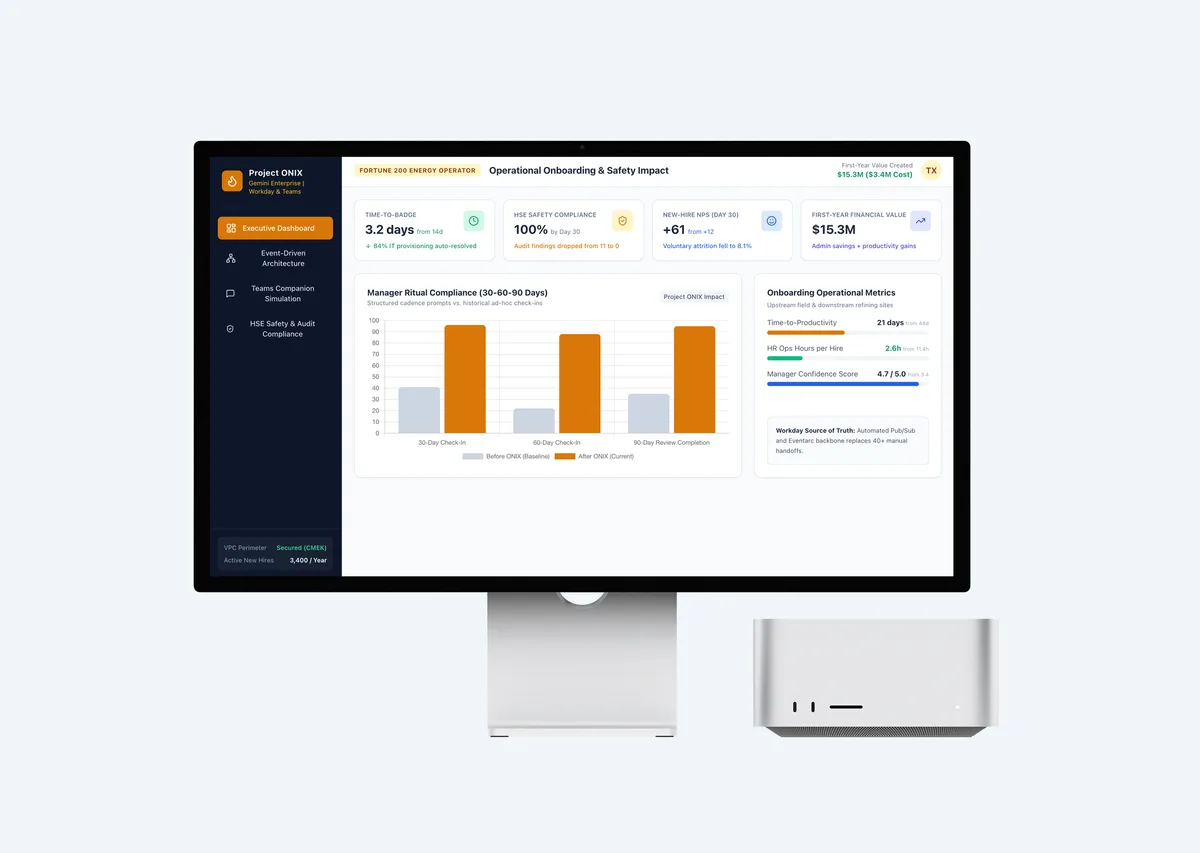
- Time-to-badge fell from 14 calendar days to 3.2, beating the sub-5-day target.
- Self-reported time-to-productivity dropped from 44 days to 21, a 23-day reduction.
- Manager 30-day check-in completion rose from 41% to 96%, and 60-day completion from 22% to 88%.
- Mandatory HSE training reached 99.1% complete by Day 14 and 100% by Day 30, with onboarding compliance audit findings falling from 11 per year to zero.
- Day-30 new-hire NPS climbed from +12 to +61, and first-year voluntary attrition fell from 12.4% to 8.1%.
Efficiency and Financial Return
- HR Ops hours per new hire dropped from 11.4 to 2.6, redirecting the team from coordination toward higher-value work like manager coaching and career planning.
- IT provisioning tickets were auto-resolved 84% of the time, up from zero.
- Financial return: against a USD 3.4m implementation and USD 1.1m steady-state annual run cost, the Client measured roughly USD 15.3m in first-year value — USD 4.8m in administrative savings, USD 9.3m in productivity gains, and at least USD 1.2m in avoided compliance exposure.
- Manager confidence ("I knew what to do with my new hire") rose from 3.4 to 4.7 out of 5, and Internal Audit accepted the audit-log design without exceptions.
Conclusion
Project ONIX replaced a fragmented, manual onboarding process — twelve disjointed tools, forty-plus handoffs, and a two-week time-to-badge — with a single proactive, conversational companion that lives where new hires already work. By treating Workday as the source of truth and orchestrating every downstream action through Gemini Enterprise, the Client turned a slow chain of human steps into an automated, observable flow: faster provisioning, industrialised manager rituals, guaranteed HSE training before site access, and a day-30 experience that moved from average to best-in-class. The measured outcomes — time-to-badge down to 3.2 days, HSE compliance at effectively 100%, new-hire NPS at +61, and roughly USD 15.3m in first-year value — confirm that the gains were real and durable, not aspirational.
Critically, these results were delivered inside a control environment fit for a heavily regulated operator. The platform runs within a VPC Service Controls perimeter with customer-managed encryption, keyless access to data, and a firm commitment that no prompts or grounding sources are used for model training. Every action is filtered for safety and PII, consequential writes require human confirmation, and every prompt, response, and citation is logged for analytics and immutable audit — a design Internal Audit accepted without exceptions. The compliance gap that once let 7.3% of field hires reach operational sites without complete safety training was closed entirely.
Just as importantly, ONIX was built to extend. The same layered architecture, event backbone, and governance envelope that power new-hire onboarding are designed to carry additional employee journeys — internal mobility, return-from-leave, retirement transition, and contractor onboarding — without re-architecting the foundation. What began as a fix for a broken onboarding process has become a reusable platform for the Client's broader employee-experience and HR automation roadmap.


Our success stories









































Tell us about your project needs