

The table of content
Digital Transformation in Modern Warehouse Operations: A Strategic Imperative
The modern warehouse operates at the intersection of multiple technological frontiers—artificial intelligence, real-time data processing, cloud infrastructure, and advanced automation. For organizations seeking to remain competitive, the question is no longer whether to digitize, but how to do so effectively and efficiently.
Warehouse automation requires more than just implementing new technology. It requires a partner who understands the entire process: the initial discovery phase where business goals align with technical possibilities, the architectural decisions that support growth, the development methods that deliver results on schedule and within budget, and the ongoing support that keeps systems running smoothly. Making the wrong technology choices or failing to align the project correctly can damage years of investment.
This is where working with the right digitization partner becomes crucial. Organizations in agriculture, logistics, healthcare, e-commerce, IoT, and financial services have learned that successful digital transformation depends on three things: real industry experience, strong technical knowledge, and a clear process for executing projects. Companies need partners who combine proven methods with modern technology, balance innovation with smart risk management, and focus on delivering real business results.
Infinity Technologies has spent over two decades building solutions that transform warehouse and inventory operations. Their approach uses agile development practices, comprehensive service solutions, and proven strategies to manage risk. This guide explores how organizations can approach warehouse automation strategically, choose the right technology, and work with experienced teams to achieve measurable results.
Optimizing Warehouse Operations with a Consignment Model
Key client requirements:
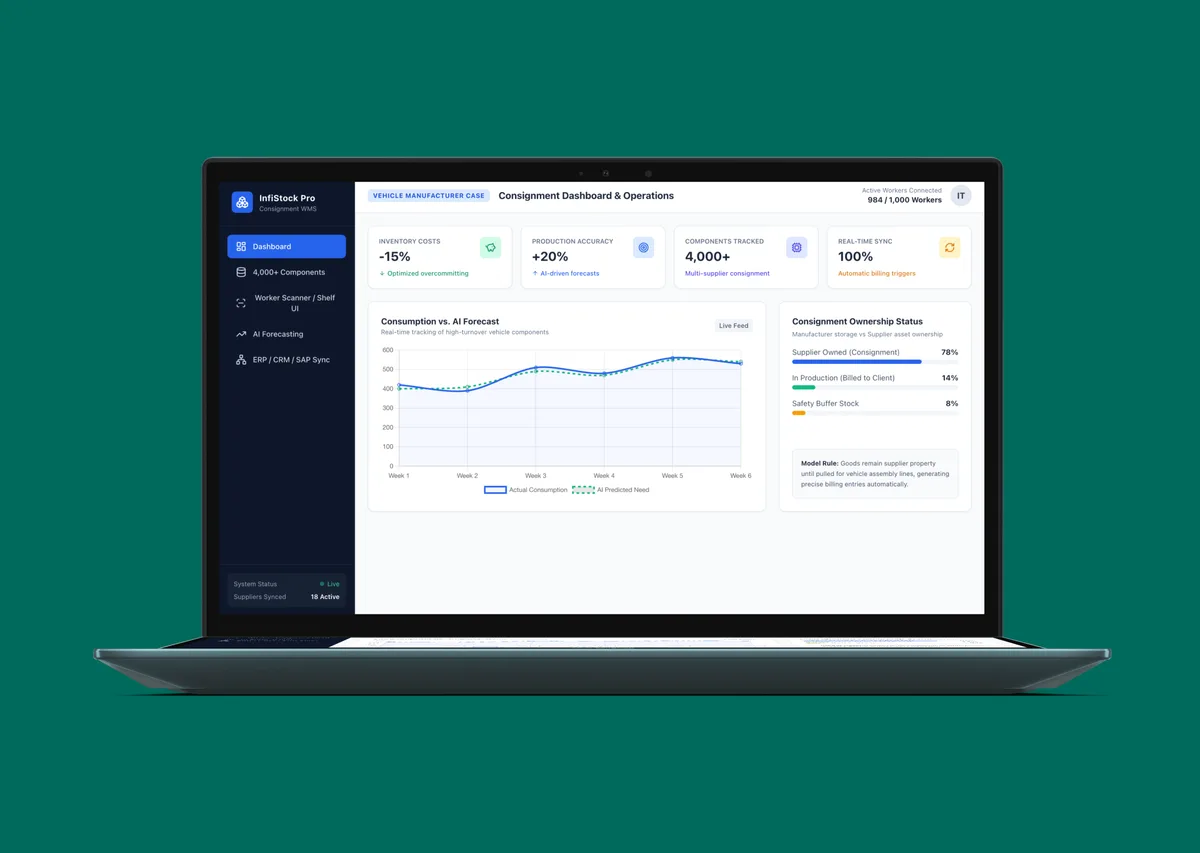
Our client, a vehicle manufacturer, needed to improve managing a large warehouse containing over 4,000 different components sourced from multiple suppliers. The manual tracking system didn't give enough possibilities to make accurate forecasts of component needs simply and fast, resulting in overcommitting to suppliers and extra expenses.
We proposed a consignment warehouse model with a digital solution to provide real-time inventory visibility, track component usage, and enhance production and expense forecasting. In a consignment warehouse, the owner manages the storage, but the suppliers retain ownership of the inventory.
The key client requirements included:
- AI-driven predictive analytics to forecast component consumption and optimize supply chain operations.
- A solution scalable to accommodate a growing number of components and warehouse workers.
- Real-time inventory tracking and automated data collection for over 4,000 unique components.
- Storing, verification, refreshing information about the warehouse capacity and transfer of the current information to the goods owner.
- Integration with the client's and suppliers' CRM, ERP, or WMS systems to streamline reporting and management.
Challenge
The main challenges of the project included:
01 Data Synchronization and Ownership Tracking
Since the warehouse owner doesn't own the goods, it's crucial to track the movement of every item, mark it as "sold" when used, and monitor items taken to generate accurate bills at the end of the accounting period. Both the supplier and the warehouse owner need real-time access to up-to-date inventory information.
02 Inventory management at scale.
Managing a complex warehouse with more than 3,000 different components sourced from different suppliers, required a solution that could track and record every item's movement in real time without overwhelming the workforce.
03 Scalability
The system had to be future-proof, scalable to manage a growing number of components, workers, and potential expansion of warehouse facilities.
04 User-friendly system for workers.
The solution needed to be intuitive for about 1,000 warehouse workers to track inventory efficiently without disrupting their workflow.
05 Real-time data synchronization.
Ensuring that data on component usage is instantly available to both the client and its suppliers. This required seamless integration with existing client and supplier systems, allowing for real-time reporting and data synchronization.
06 Data integration with external systems
The warehouse management solution required integration with both off-the-shelf and custom CRMs, ERPs, and WMSs to allow data flow between the client's systems and suppliers' systems. The solution had to generate real-time reports, visual analytics, and enable AI-driven forecasts.
Solution
Dual-Approach Solution for Real-Time Inventory Tracking and Data Integration
We developed two strategies of creating a digital solution to meet the client's requirements, incorporating real-time inventory tracking, AI analytics, and extensive integration capabilities. The solution was designed with two approaches for the client's warehouse workers. The client chooses desired option based on their comfort, budgeting, and present warehouse management tools.
Mobile and QR/Barcode Scanners
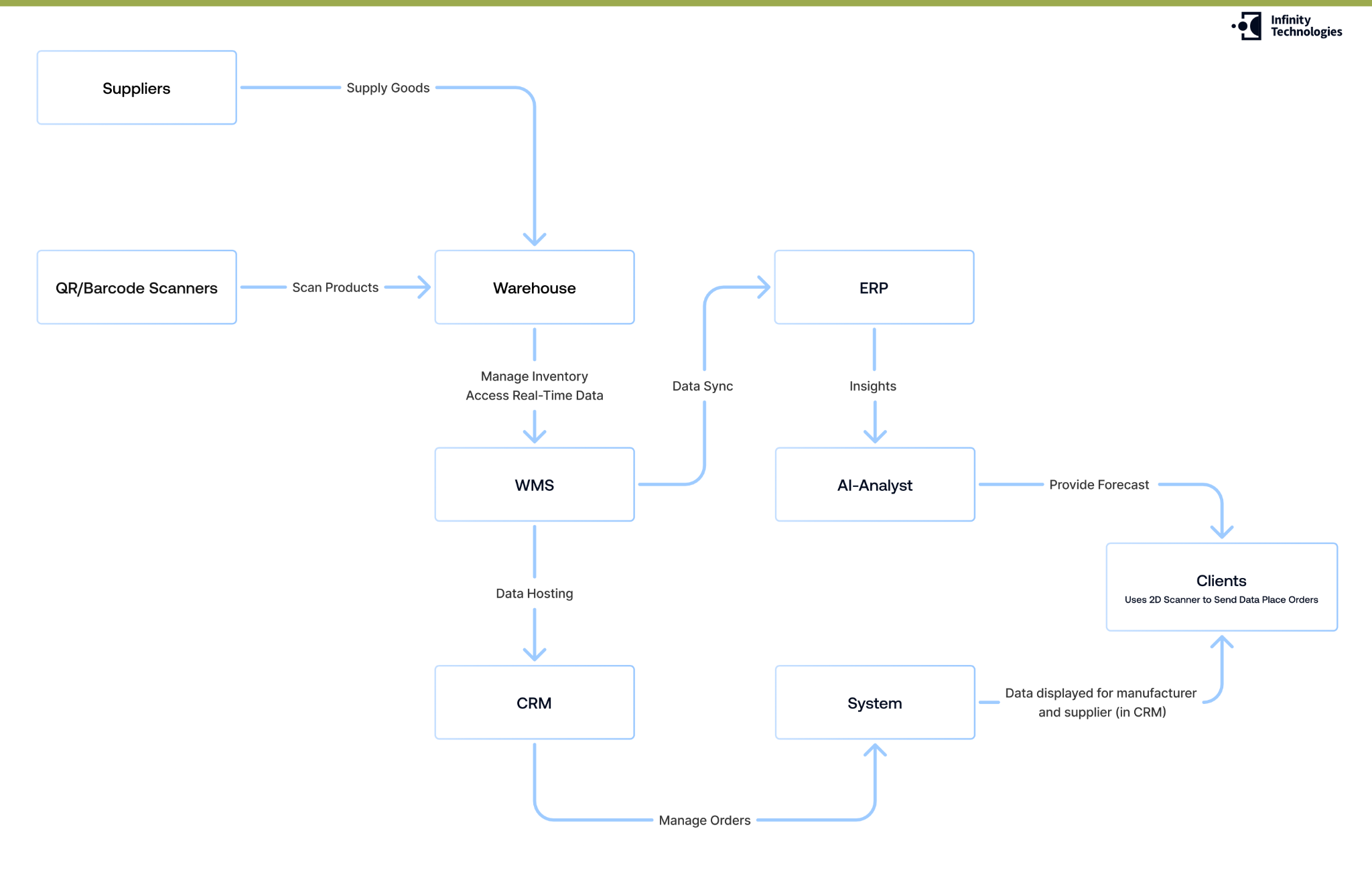
By this approach, warehouse workers are equipped with 2D scanners: either QR or barcode, as standalone devices or mobile apps, to scan components as they were used and send information into the system, which is immediately displayed in the CRM or SAP of the manufacturer and supplier. This allows for real-time tracking of every item leaving the warehouse shelves, feeding data directly into the centralized system.
Tablet-Based Interface on Shelves
Managing a complex warehouse with more than 3,000 different components sourced from different suppliers, required a solution that could track and record every item's movement in real time without overwhelming the workforce.
Integration Capabilities
The solution was built with integration capabilities for popular CRM, ERP, and WMS systems, as well as custom solutions used by both the client and suppliers.
The system automatically generated reports, charts, and performance metrics based on real-time inventory movement and allowed suppliers to predict demand and optimize manufacturing cycles.
Data from the warehouse system was shared between the client and suppliers through a secure centralized server. Suppliers had two options: either use the solution's admin interface to monitor inventory levels or integrate a plugin to sync data with their existing systems.
Solution Architecture
AI-Powered Analytics
The integrated AI analyzed inventory data to predict future component consumption, enabling more accurate forecasting for both the client and suppliers. This predictive model improved production planning, reducing over-ordering, and minimizing excess stock.
Results
For the Suppliers
The implemented solution transformed the client's warehouse management operations. The AI-powered analytics provided valuable predictions on future component needs, reducing unnecessary stockpiling and saving costs. As a result, the company experienced a 15% reduction in inventory costs and improved production planning accuracy by 20%.
For the Client
Suppliers benefited from the system's real-time data sharing, allowing them to monitor product consumption directly. This improved their ability to forecast manufacturing requirements and logistics planning. Suppliers could now predict sales and adjust production cycles based on real demand, resulting in more efficient manufacturing processes and reduced lead times.
Team and Duration
Building the Right Team for Success
Successful warehouse automation requires a carefully assembled team of professionals, each bringing specialized expertise to the project. The composition outlined below represents the core roles necessary to deliver a comprehensive digital transformation solution, though the specific makeup may adapt based on project complexity and requirements.
Project Leadership and Strategy
At the helm of any successful digitization project is a Project Manager who oversees all aspects of execution, manages timelines rigorously, and ensures seamless communication between all stakeholders. Working alongside the Project Manager, a Business Analyst serves as the bridge between client needs and technical execution, gathering requirements from stakeholders and defining the project scope with precision. These foundational roles are complemented by a Solution Architect who designs the overall architecture of the system, ensuring that both hardware and software components work in harmony to deliver the intended solution.
The Development Team
The technical implementation falls to a dedicated software development team. Frontend Developers focus on creating intuitive user interfaces and delivering exceptional user experience, while Backend Developers build the server-side logic and manage database interactions that power the system. A UX/UI Designer works closely with both teams to ensure that every touchpoint is intuitive and user-friendly, particularly important in a warehouse environment where usability directly impacts workforce efficiency.
Quality Assurance and Infrastructure
To ensure the solution meets the highest standards, QA/Test Engineers conduct rigorous testing through various methodologies before deployment. A DevOps Engineer manages the deployment process, oversees CI/CD pipelines, and maintains system stability in production environments. These roles are critical to delivering a solution that not only works correctly but performs reliably under real-world conditions.
Implementation and Continuous Improvement
Implementation Engineers handle the physical installation of automation systems and equipment, bridging the gap between software and hardware deployment. Finally, a Data Analyst continuously examines data from warehouse operations, identifying opportunities for improvement and ensuring the system delivers measurable business value over time.
Team Flexibility and Complexity
It's important to note that the composition of the team may vary significantly based on the complexity of the project. In cases where the project exhibits a higher degree of complexity, additional resources or specialized expertise may be necessary to ensure successful execution. Our commitment is to adapt and assemble a team that aligns seamlessly with both the client's initial preferences and the evolving demands of the project as it progresses.
Project Timeline
The entire process can take anywhere from 6 months to over a year, depending on the scale and complexity of the automation solution. This timeline encompasses everything from initial discovery and architectural design through development, testing, implementation, and deployment. Please note that this represents a high-level overview and actual durations can vary considerably. It's always best to tailor both the team composition and project timeline to the specific needs and constraints of your project, ensuring that resources are allocated efficiently while maintaining quality standards throughout the engagement.
Application
The priority tech direction in modern warehouses is managing inventory and unit counts. It provides an up-to-the-minute method of tracking stock levels, so it is vital for both staff and clients. The solution is applicable to industries such as automotive, manufacturing, retail, logistics, and healthcare, where real-time inventory tracking, supply chain optimization, and predictive analytics are essential.
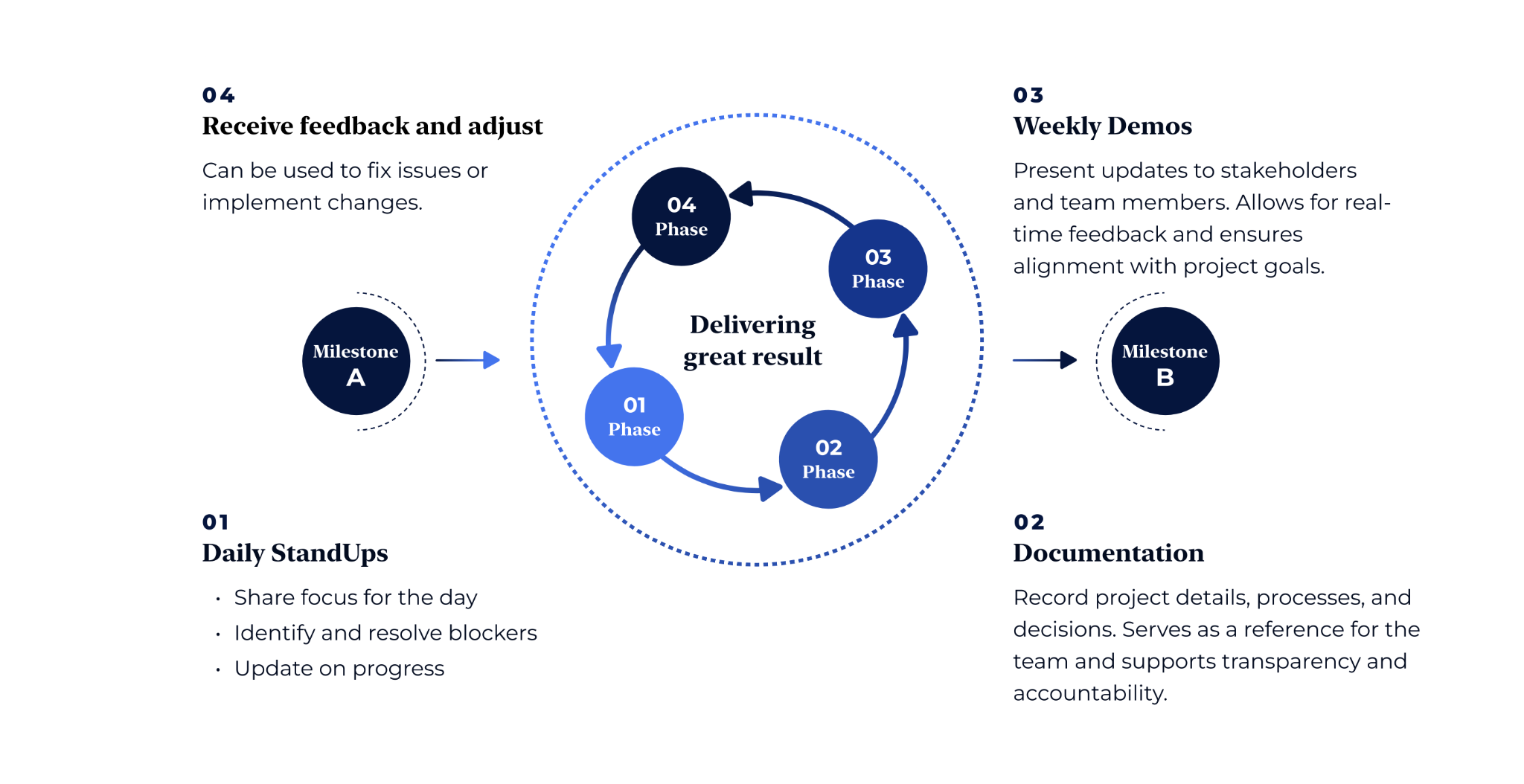
Delivering great result
Mitigating Potential Risks
Successful warehouse automation requires proactive risk management. By anticipating common challenges and establishing clear mitigation strategies, organizations can ensure smoother execution and better outcomes.
Managing Scope Creep
Scope creep is common in automation projects as new requirements emerge during execution. To manage this, add a contingency reserve to budget and timeline from the start. Use a structured backlog and Scrum board to evaluate new requests systematically, preventing reactive changes that derail schedules.
Controlling Budget and Time
Budget overruns often result from unclear requirements and slow decision-making. Designate a single point of contact from the customer side who is empowered to make business decisions. Finalize the product backlog and requirements upfront to ensure clarity before development begins, preventing costly rework later.
Addressing Code Base Clarity
When integrating with existing systems, lack of access to the original code base poses significant risks. Ensure the Research and Development team has full access to existing code and documentation from project inception. Conduct a comprehensive analysis of existing applications at the outset to identify potential complexities early.
Preventing Delivery Delays
Delays in feedback and acceptance can cause slippage. Establish clear escalation processes for any deviations outside the stated deliverables schedule. This allows issues to be flagged and resolved quickly before they impact subsequent phases.
Accepting Continuous Discovery
Knowledge gaps cannot always be resolved in the discovery phase alone. Recognize that discovery is continuous, and client teams will address gaps throughout delivery. This approach fosters collaboration and positions ongoing learning as part of successful transformation.
Conclusion
Digital transformation in warehouse operations is essential for organizations seeking competitive advantage. As demonstrated through the consignment warehouse case study, implementing AI-powered inventory tracking, real-time data synchronization, and predictive analytics delivers measurable results: 15% reductions in inventory costs and 20% improvements in production planning accuracy. Success requires experienced teams who understand the complete ecosystem—from business discovery through implementation and ongoing support—combined with proactive risk management and flexibility to adapt as requirements evolve.
Whether your organization operates in automotive, manufacturing, retail, logistics, or healthcare, the principles remain constant: real-time visibility drives better decisions, predictive analytics optimize operations, and integrated systems create efficiency across the value chain. With the right partner and a structured approach to implementation, warehouse automation becomes a strategic advantage that drives business growth and operational excellence. The time to act is now.


Our success stories




















































Tell us about your project needs