

The table of content
Overview
The client is a European insurance and pensions group of roughly 28,000 employees operating across several Continental European and Nordic markets. Its entire talent suite — Recruiting Management, Employee Central, Compensation, Career Development Planning, Onboarding, and Performance & Goals — runs on SAP SuccessFactors as the single authoritative system of record. As with most enterprises of its size, the real constraint on hiring was not the tracking system but the hiring manager's time: every requisition demanded that a manager author job descriptions, assemble requirements, reason about pay, apply country-specific compliance wording, and later write up interview notes — work that varied widely in quality and consumed hours before a role ever reached a candidate.
The Assistant is the client's answer: an AI-native recruiting assistant that lives inside the natural flow of SuccessFactors rather than beside it as a separate application. This is the defining design principle, enforced architecturally rather than merely encouraged — the hiring manager never leaves SuccessFactors. Triggered by a SuccessFactors event the moment a requisition is created, the Assistant reads the surrounding context, generates a set of drafted artifacts, and writes each back to the correct field. The manager edits inline, the recruiter publishes, and the candidate experiences a single coherent process — no separate app, no chat to open, no new tool to adopt.
Under the hood, the Assistant is a six-agent system built on a conductor pattern running on Google Cloud's Vertex AI Agent Engine, part of the Gemini Enterprise platform. A lightweight conductor orchestrates and routes work; five specialists handle job-description composition, compensation intelligence, time-to-hire prediction, interview-kit generation, and candidate experience; and a sixth synthesizes post-interview scorecards from live transcripts. Because recruiting is one of the most regulated domains in the employee experience, the system was designed from day one as an EU AI Act high-risk system operating under GDPR, national equal-treatment law, and a co-designed Works Council agreement — with human oversight and the firm principle that its outputs are decision support, never decisions.
The result turns recruiting from a sequence of manual authoring tasks into an event-driven, agent-orchestrated workflow embedded in tools people already use — reclaiming leadership time, compressing time-to-fill, and raising the consistency and inclusivity of every role, while keeping a human unambiguously in control of every decision.
Business Challenge
The hiring manager was the bottleneck. In the client's operating model, managers were expected to author or curate role descriptions, requirements, compensation context, location-specific rules, compliance wording, and recruiting inputs — all directly inside SuccessFactors. Because that burden fell on individuals with wildly different writing skills, market knowledge, and available time, the quality and completeness of requisitions varied significantly by manager, by country, by role family, and by business unit. That single point of variability rippled outward into a set of compounding problems across the recruiting lifecycle.
Manual authoring drained time and capacity
Managers spent hours per requisition drafting job descriptions, role requirements, interview criteria, and approval notes, which pushed roles to market late and stretched time-to-fill on every opening. Downstream, recruiters routinely rewrote, corrected, enriched, or standardized those requisitions before they could be published — a rework loop that quietly consumed capacity that should have gone to sourcing and candidate relationships. The same content was effectively authored twice, and incomplete or inconsistent data at the point of creation degraded everything built on top of it: weak analytics, weak workforce planning, and weak approval-quality signals.
Inconsistency carried real compliance risk
Similar roles were described differently from one country to the next, producing an uneven candidate experience and diluting the employer brand across the group. More seriously, each job description had to reflect local employment law, language expectations, diversity wording, compensation practice, and country-specific recruiting policy. When that responsibility rested on individual managers drafting free-form text, the exposure was tangible — non-compliant phrasing, protected-characteristic language, and localization gaps that carried fines and reputational damage.
Layered on top of all of this was a hard adoption constraint: managers already worked inside SuccessFactors and would not adopt a separate AI application with its own login and interface. Any bolt-on assistant was destined for low adoption and change fatigue no matter how capable it was. This ruled out the obvious approach outright and defined the brief precisely — lift the authoring burden off managers, standardize quality and compliance across every market, and return capacity to recruiters, without introducing a single new surface for anyone to log into, and without ever letting an automated system make a hiring decision.
Solution
The client built the Assistant as a smart helper that works right inside SuccessFactors — the same system managers already use every day. It quietly does the writing work managers used to do by hand, then hands the draft back to a person to check, tweak, and approve. One rule sits at the center of the whole design: the Assistant only suggests, it never decides — and the manager never has to leave SuccessFactors.
It starts on its own, the moment a role opens
There's no new app to open and nothing to learn. A manager creates a job opening in SuccessFactors and fills in just a few basics — the project, the start date, the location, who's hiring, and the type and level of role. That simple save quietly sets everything in motion behind the scenes. Within about a minute, the Assistant has read the surrounding details, written up the first drafts, and placed them right back into the job record. The manager just gets a Microsoft Teams message: "Your job posting has been drafted — review and edit in SuccessFactors." All of this happens over a private, secure connection; nothing travels across the open internet.

One "conductor" directs a team of specialists
Instead of a tangle of tools all talking to each other, the Assistant works like an orchestra: a single "conductor" directs everything, and each specialist does one job well. This keeps things simple, reliable, and easy to trace later. Each specialist has a clear focus — one writes the job description and checks it for fair, inclusive wording; one recommends a sensible pay range using both company and market data; one estimates how long the role will take to fill and why; one builds the interview questions and scoring guides; one answers candidate questions on the careers site in 14 languages; and one turns interview conversations into a first-draft scorecard. That last one, which works from live interview recordings, is treated as the most sensitive of all — it's only used after a full ethics review and only with the candidate's clear consent.
A person always stays in charge
Because hiring is a sensitive, heavily regulated area, everything the Assistant produces can be edited, and nothing moves forward without a person choosing to move it. The manager rewrites parts of the job description, adjusts the suggested pay, and reads the timing estimate — but the Assistant never posts the role, locks in a salary, or decides who gets hired. Every draft, every suggestion, and every human approval is recorded and kept for ten years, so the company can always show that a real person made each decision.

Technology Stack
The Assistant runs entirely on Google Cloud, hosted in the EU, with SAP SuccessFactors as the system of record and a few Microsoft and Google Workspace surfaces plugged in around the edges.
Core AI models
- Gemini Enterprise — the platform that hosts the Assistant and its team of specialist agents
- Gemini 2.5 Pro — the heavy-reasoning model behind job descriptions, pay recommendations, interview kits, and scorecard synthesis
- Gemini 2.5 Flash — the lighter, faster model for the inclusive-language checker and the candidate chat assistant
- Gemini 2.5 Flash-Lite — the "conductor" that routes work to the right specialist
- Gemini Live — captures interview conversations in real time inside Google Meet
Orchestration and data
- Vertex AI Agent Engine — the runtime that hosts the conductor and all six agents
- Vertex AI Search — retrieves job-description libraries, the competency catalog, and candidate FAQs
- Vertex AI Vector Search — finds similar past job descriptions and résumés
- Vertex AI AutoML Tables — the model that predicts time-to-hire
- Vertex AI Model Monitoring — watches the prediction model for drift over time
- Document AI — parses résumés, including European CV formats
- Cloud Workflows — drives the multi-step, long-running orchestration
- Pub/Sub — carries SuccessFactors events in and fans work out to the agents
- BigQuery — the historical-hiring warehouse and the immutable audit log
- Cloud Spanner — holds live scorecard and calibration data
- Looker — powers KPI dashboards for talent-acquisition leadership
Integration
- Apigee X — a single, swappable gateway to external market-pay vendors
- SAP Integration Suite (CPI) — the bridge that carries SuccessFactors events to Google Cloud
- Microsoft Teams — delivers notification cards to managers
- Google Workspace (Meet, Calendar, Drive) — the interview, scheduling, and transcript surfaces
Security and governance
- Cloud KMS (HSM-backed CMEK) — customer-managed encryption keys, held in the EU
- VPC Service Controls — a closed perimeter around the whole system, with no public internet exposure
- Cloud DLP — strips personal data from transcripts before they're stored
- Model Armor — blocks prompt-injection and jailbreak attempts on public-facing surfaces
- Chronicle SIEM — continuous security monitoring and threat detection
- Access Transparency — logs any access by cloud-provider personnel
Results
Every figure below is a real before-and-after measurement from the production rollout. The business case was built on the manager-hours number alone; everything else came as upside.
Time and capacity reclaimed
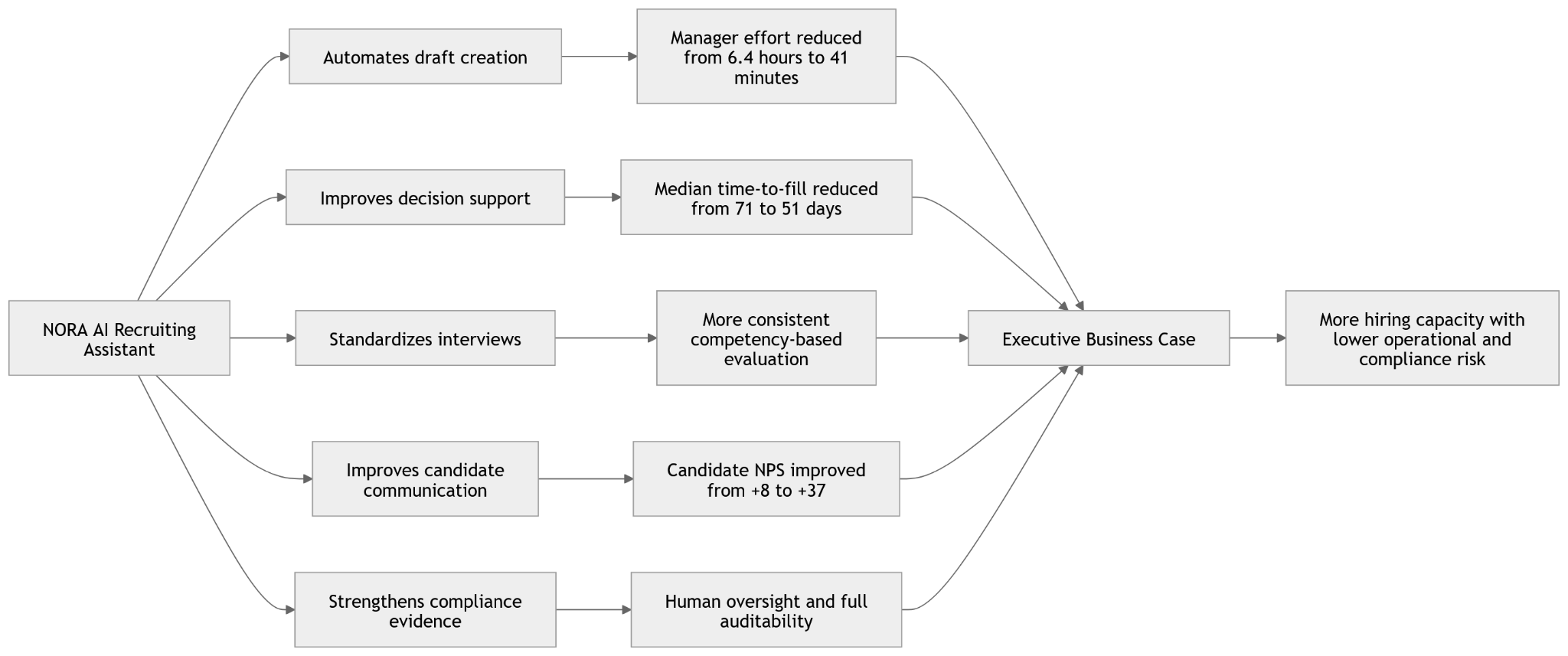
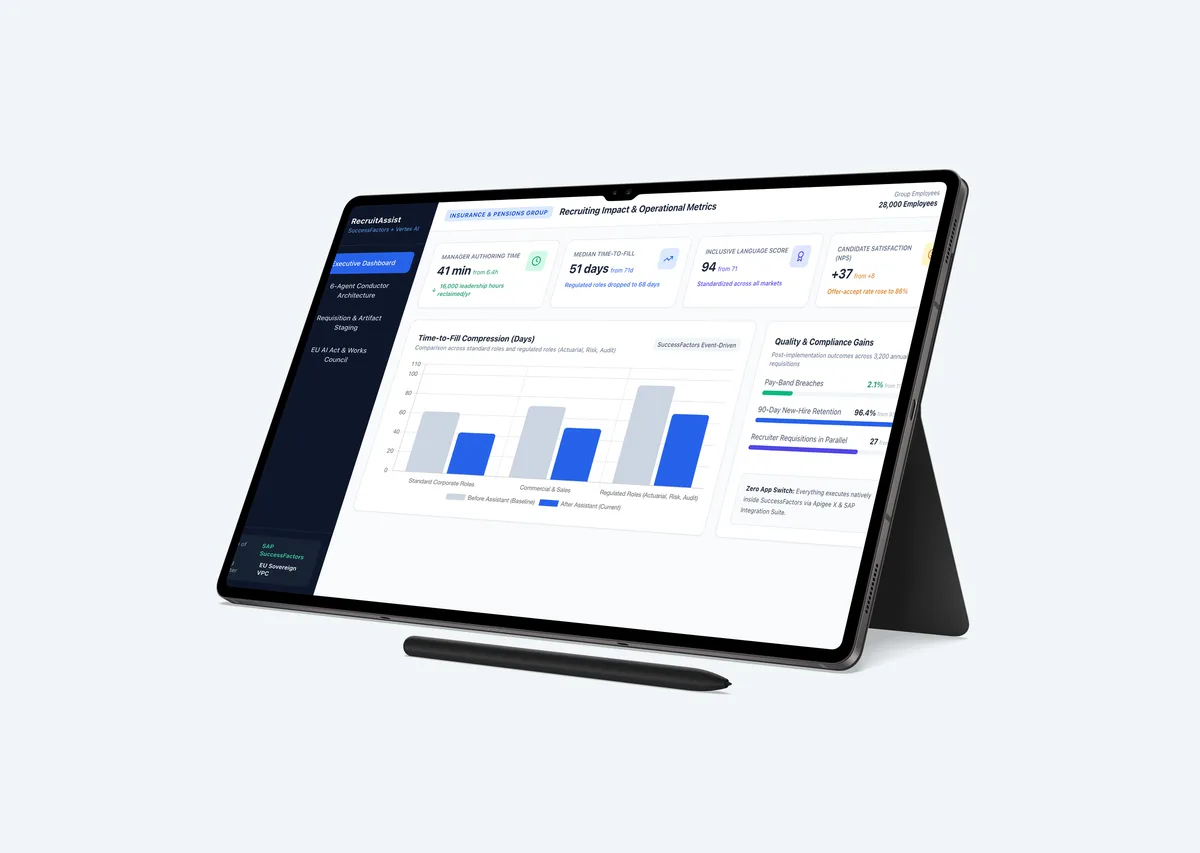
- Hiring-manager work per requisition dropped from a measured 6.4 hours to 41 minutes of review-and-edit
- Across roughly 3,200 requisitions a year, that adds up to about 16,000 hours of leadership time reclaimed annually — worth around €2.4M
- Recruiters now manage more openings at once — up from 18 to 27 requisitions in parallel
Faster hiring
- Median time-to-fill fell from 71 days to 51 days across all roles
- For hard-to-fill regulated roles (actuarial, risk, audit), it dropped from 94 days to 68 days
- The time-to-hire prediction model lands within about 9.3 days of the actual outcome, comfortably under its 12-day target
Better quality and fairness
- The inclusive-language score on published job descriptions climbed from 71 to 94 out of 100
- Offers falling outside the approved pay band dropped from 11.4% to 2.1%
Stronger candidate and hiring outcomes
- Candidate satisfaction (post-interview NPS) improved from +8 to +37
- Offer-accept rate rose from 78% to 86%
- 90-day new-hire retention improved from 93.1% to 96.4%
Compliance and trust, built in
- Registered and operating as an EU AI Act high-risk system, with the required controls in place and evidenced
- GDPR-compliant through human-in-the-loop decisioning — a person approves every step
- A signed Works Council agreement in force, plus a full audit trail retained for ten years
Conclusion
The Assistant turns recruiting from a sequence of manual, one-person-at-a-time authoring tasks into a smooth, automated workflow that lives inside the tools people already use. The change managers feel is immediate and concrete: instead of spending the better part of a day writing a job description, assembling interview questions, justifying a pay range, and typing up notes, they open a role, fill in a few fields, and come back to a finished first draft they can shape in minutes. The recruiter spends less time rewriting and more time building relationships with candidates. And the candidate moves through a process that feels coherent, well-prepared, and consistent no matter which country or manager they encounter — answered in their own language and treated the same as everyone else.
What makes the approach durable is that speed never came at the cost of control. The Assistant only ever suggests; a person decides. Every draft is editable, every step forward requires a deliberate human action, and every prompt, recommendation, and approval is recorded and kept for years. That design is what let the client deploy advanced AI into one of the most heavily regulated corners of the business — employment decisions — with the compliance function, the data-protection office, and the Works Council all satisfied rather than sidelined. The safeguards aren't bolted on afterward; they're the reason the system was allowed to run at all.
The results make the case plainly. Roughly 16,000 hours of leadership time reclaimed each year, roles filled weeks faster, fairer and more consistent job postings, pay-band breaches cut to a fraction, and candidates who leave the process happier than before — all while a human stays unambiguously in charge of every hiring decision. Just as important, the platform the client built for recruiting isn't a one-off. The same secure foundation, the same governance model, and the same human-in-the-loop pattern extend naturally to onboarding, career development, and beyond — which means this project isn't the finish line so much as the groundwork for the next wave of AI the organization chooses to take on.


Our success stories













































Tell us about your project needs