The table of content
Overview
The Client is a Frankfurt-headquartered universal bank, reporting EUR 420 billion in assets under management and operating across retail banking, corporate banking, private banking and wealth management, and asset management, with licensed entities and branches in fourteen European countries. Its institutional knowledge is spread across thirty-eight disparate enterprise systems — Confluence, Jira, Workday, Google Drive, SharePoint, ServiceNow, DocuSign CLM, Salesforce, an internal policy hub, and many more — accumulated across decades of growth, mergers, and country expansion.
To consolidate that landscape into a single conversational interface, the Client commissioned Project MERIDA, an internal AI knowledge and onboarding assistant built on Gemini Enterprise as its core reasoning and orchestration platform. Now in production across all 1,200 branches and 38,000 employees, MERIDA answers natural-language questions — from "How do I request vacation under the new German collective agreement?" to "Who owns the relationship with a given client account?" — by retrieving grounded, source-cited answers from more than two dozen systems and delivering them through Microsoft Teams, the corporate intranet, a mobile app, and inline within Google Workspace and Microsoft 365.
Operating inside a demanding regulatory perimeter — ECB, BaFin, FCA/PRA, FINMA, the EU AI Act, DORA, and GDPR — MERIDA is engineered so that every answer is grounded in a current, verifiable source, retrieval respects each user's existing native permissions, and every prompt and response is logged in a tamper-evident archive. The result is a single, identity-aware, citation-grounded front door to the bank's knowledge, built to satisfy the auditability and data-residency obligations of a significant European financial institution.
Business Challenge
Before Project MERIDA, the Client operated a knowledge environment scattered across thirty-eight enterprise systems accumulated over decades of growth and expansion. A discovery run by the CTO's office inventoried a vast and fractured surface area — 240,000 Confluence pages, 3.8 million Jira issues, 6,400 HR policy documents in Workday, 6.2 million files in Google Drive, 1.8 million SharePoint items, 22,000 ServiceNow knowledge articles, 11,200 regulatory policy PDFs, and more. Authoritative content for any single process was routinely spread across several of these systems, with no consistent way to find the current, correct version.
Lost Time and Deflected Support
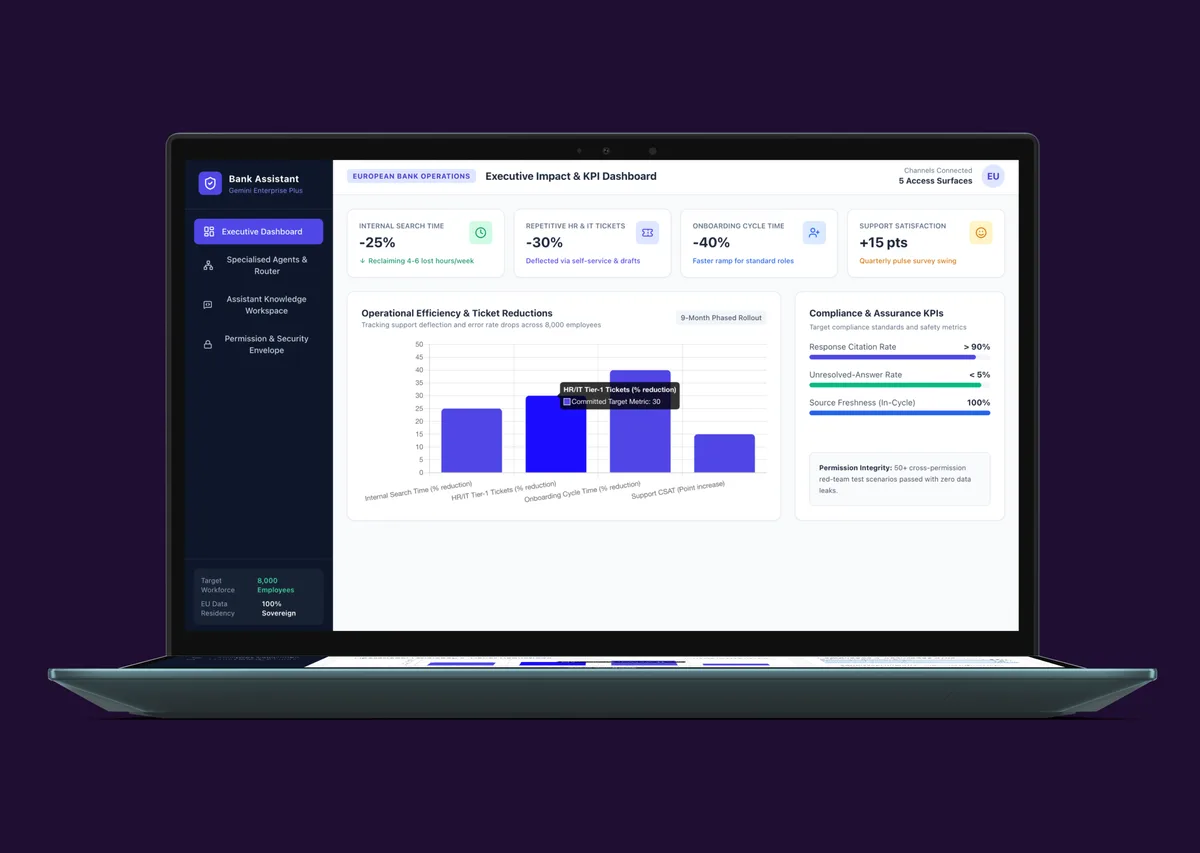
A 2025 time-and-motion study across 1,800 employees quantified the cost precisely. Employees spent an average of eight hours and fourteen minutes per week searching for information across internal systems — more than a full working day lost every week, at scale, across a 38,000-person workforce. The support burden compounded the problem: 71% of HR ticket volume consisted of repeat questions already answered in the policy hub, tying up service teams with work that self-service should have absorbed. Confluence search satisfaction, meanwhile, sat at a benchmark-low 2.3 out of 5, signalling that employees had effectively lost confidence in the tools meant to help them.
Onboarding Drag and Compliance Exposure
The same fragmentation slowed every new hire. Time-to-productivity averaged 90 working days for client-facing roles, and 67% of new joiners named "finding information" as their top frustration in 30-day surveys — a direct drag on exactly the talent-competitive positions where ramp speed matters most. More seriously, the disorder created regulatory risk: Group Internal Audit finding A-2024-117 identified citation drift, with 14% of sampled customer communications referencing superseded policy versions. In a heavily regulated institution answering to the ECB, BaFin, FCA, and FINMA, acting on outdated policy is not merely inefficient — it is a compliance exposure with audit and reputational consequences.
Solution
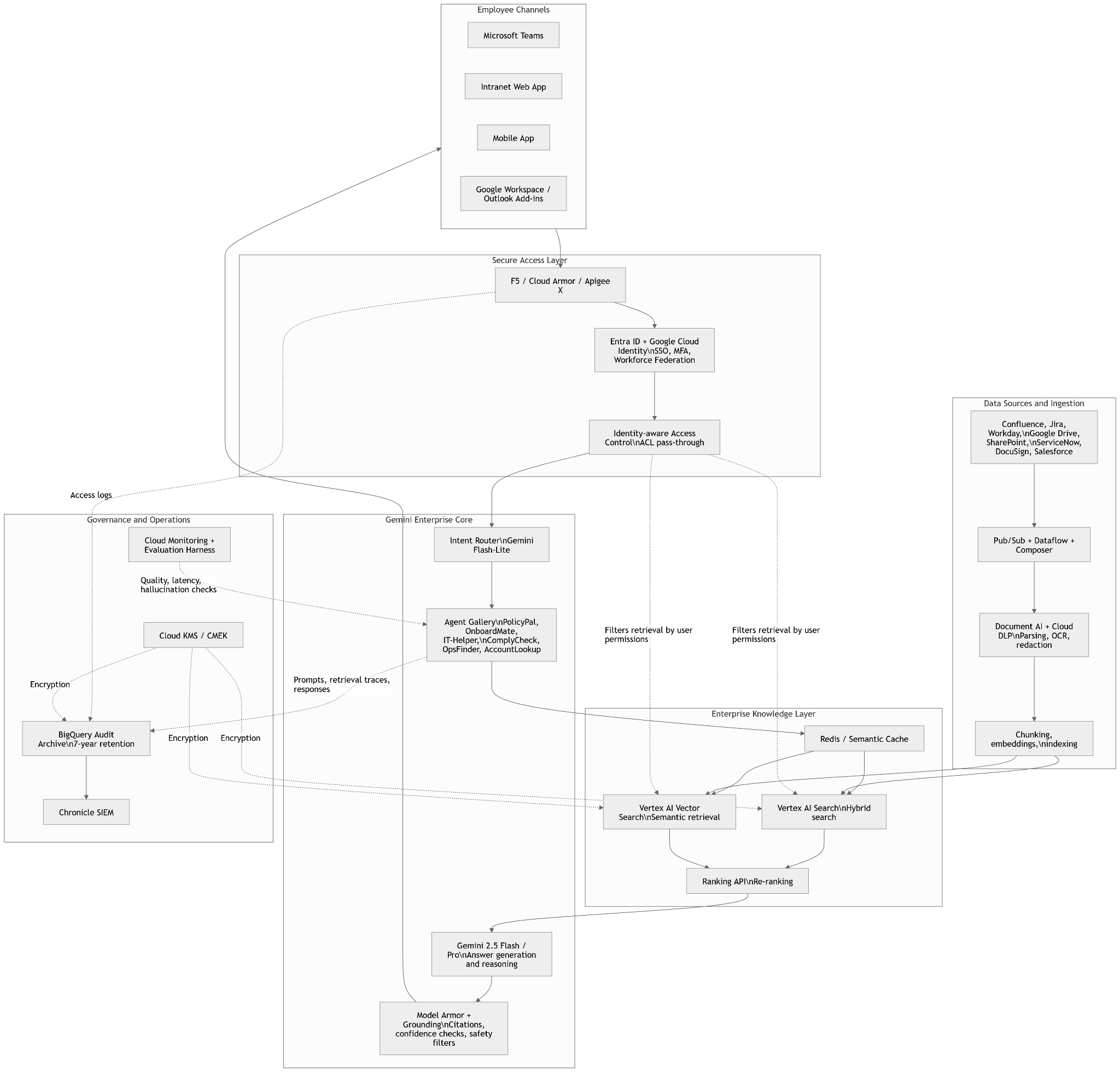
MERIDA is delivered as a multi-agent enterprise assistant built on Gemini Enterprise, which serves three architectural roles: a reasoning engine, an agent platform, and a knowledge fabric that ingests, vectorizes, and serves the bank's primary corpora with enforced permission pass-through. Around this core, the Client built a defense-in-depth envelope of Google Cloud and on-prem services to meet banking-grade compliance, observability, and resilience requirements. The reference architecture is organised as seven horizontal layers, from the source systems and ingestion pipeline through retrieval and reasoning up to the user experience, all hosted inside the bank's own Google Cloud organisation.
Model Routing and the Agent Gallery
MERIDA does not rely on a single model. A lightweight Gemini 2.5 Flash-Lite classifier inspects each incoming prompt and routes it across three tiers by complexity: Flash-Lite for intent detection and routing, Gemini 2.5 Flash for FAQ and single-source lookups, and Gemini 2.5 Pro for multi-document synthesis and compliance Q&A, with an on-prem Gemma 3 fallback for disaster-recovery and air-gapped audit replays. This tiering keeps latency and cost proportionate to the task rather than paying premium reasoning cost for a simple lookup.
The Gemini Enterprise Agent Gallery hosts seven purpose-built agents — including PolicyPal for HR, OnboardMate for new joiners, OpsFinder for runbooks and templates, ComplyCheck for compliance questions, and AccountLookup for client ownership — alongside three verified marketplace agents for ServiceNow, Workday, and Salesforce. Each agent is defined declaratively in YAML, version-controlled in Git, CI-deployed, and pinned to a specific model version, and agents hand off to one another through the Agent2Agent protocol so a single question can move cleanly from one specialist to the next.
Identity-Aware Retrieval and
Grounding Discipline
Retrieval is bound to the user's existing permissions. The entire platform runs inside a VPC Service Controls perimeter with no public ingress, reaching on-prem source systems over Private Service Connect and a redundant Dedicated Interconnect, and every query inherits the user's native source-system access so no one can retrieve a document they could not already open. Every answer must also satisfy a strict grounding contract: a minimum of two citations for any compliance, HR, or policy answer, each carrying document title, version, timestamp, and a deep link, with stale sources flagged by a warning banner. A separate groundedness-judge call scores each response, and anything below threshold triggers an explicit "I am not confident in this answer" fallback rather than a fabricated one — with the full retrieval set persisted for audit.
Results
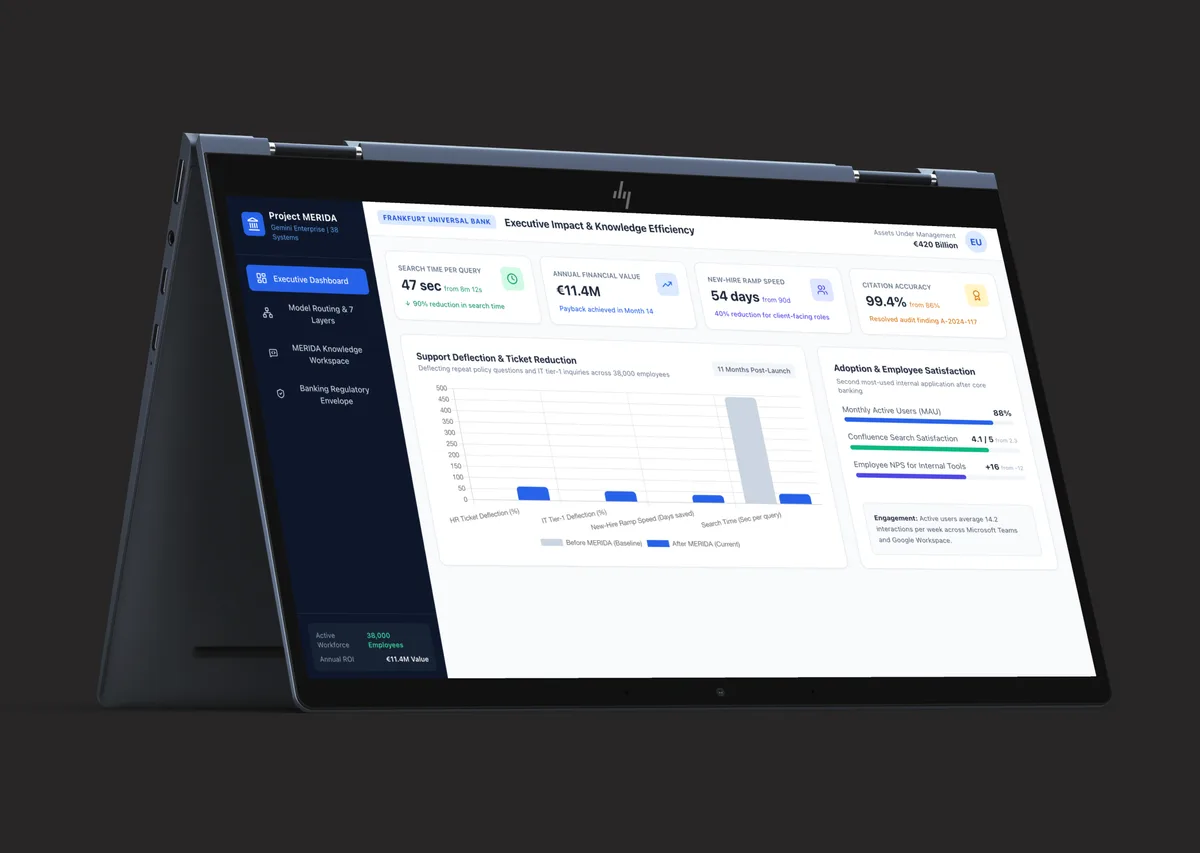
Eleven months after launch, MERIDA had moved every headline metric past its target, backed by measured before-and-after data rather than projections. Its impact spans productivity, support deflection, compliance, and adoption — and the financial return closed a clear business case.
Productivity, Adoption, and Financial Return
- New-hire time-to-productivity fell from 90 to 54 working days for client-facing roles, a 40% reduction.
- Average search-and-find time dropped from 8 minutes 12 seconds to 47 seconds per query, a 90% reduction.
- HR ticket deflection reached 62% and IT Tier-1 deflection 47%, both exceeding target.
- Adoption hit 88% monthly active users at 14.2 interactions per active user per week, making MERIDA the second most-used internal application after the core banking workstation.
- Financial return: against a EUR 4.2m year-one investment and a EUR 2.1m steady-state run-rate, Finance conservatively quantified benefits at EUR 11.4m per year — a 2.7x in-period ROI, 5.4x annualized at steady state, with payback in month 14.
Compliance and Employee Confidence
- Compliance citation accuracy rose from 86% to 99.4%, resolving audit finding A-2024-117 on citation drift.
- Confluence search satisfaction improved from 2.3 to 4.1 out of 5 org-wide.
- Employee NPS for internal tools swung from −12 to +16, a 28-point improvement.
- Grounding safeguards — mandatory citations, groundedness scoring, and an "I don't know" fallback — kept superseded-policy exposure controlled while preserving the tamper-evident, seven-year audit trail required by regulators.
Conclusion
Project MERIDA turned the Client's fragmented knowledge landscape — thirty-eight systems, millions of documents, and more than eight lost hours per employee each week — into a single, identity-aware, citation-grounded conversational front door. Employees no longer need to know which of dozens of systems holds the answer; they ask once, receive a grounded response with verifiable sources, and act on it, whether they are requesting leave under a country-specific agreement, locating the current delivery template, or onboarding in their first week. The measured outcomes confirm the thesis: faster onboarding, dramatically reduced search time, high ticket deflection, near-perfect citation accuracy, and adoption that made MERIDA the bank's second most-used internal application.
Critically, these gains were delivered inside the control envelope a significant European bank requires. The platform runs entirely within an EU data-residency perimeter, enforces native source-system permissions on every retrieval, grounds every compliance answer in at least two verifiable citations, and logs every prompt and response in a tamper-evident seven-year archive — satisfying ECB, BaFin, FCA, FINMA, EU AI Act, DORA, and GDPR obligations rather than working around them. Residual risks such as hallucination, stale citations, vendor lock-in, and third-party-provider availability are each met with specific, tested mitigations, from groundedness scoring and nightly stale-removal jobs to a portable agent definition format and a Gemma 3 fallback path.
MERIDA is therefore not an endpoint but a foundation. The same architecture, governance, and security envelope now underpins a forward roadmap — voice-first branch experiences, proactive policy notifications, expanded deal support, and broader multilingual coverage — that the Client can build on without re-architecting the platform. What began as a fix for knowledge fragmentation has become the durable substrate for the bank's next wave of enterprise AI.


Our success stories














































Tell us about your project needs