The table of content
Overview
Client operates a national US telemedicine business spanning virtual primary care, urgent care, behavioral health, chronic-care management, mail-order pharmacy, remote patient monitoring, and a subscription wellness service. Its contact center handles a high daily volume of outbound care-coordination and inbound member service calls, each touching protected health information, commercial data, and pharmacy logistics at once.
To modernize this environment, Client is implementing a Gemini Enterprise–powered Call Center Assistant that supports operators before, during, and after every patient call.
The assistant is a clinically aware, compliance-first care and service assistant — not a sales engine. It prepares a governed patient brief before the call, coaches the operator in real time, and produces a structured post-call summary, keeping care and commercial actions in clearly separated, authorized channels.
The solution runs on Google Cloud using Gemini Enterprise and the Agent Development Kit, grounded in Client's existing systems through a single governed integration fabric. All ePHI processing occurs under executed Business Associate Agreements, with encryption, access control, and data residency enforced throughout.
The strongest value proposition is patient experience, safer care coordination, lower operator workload, and stronger HIPAA governance — with revenue uplift treated as a controlled byproduct, never the primary objective.
Business Challenge
Client's contact center operators work across a fragmented system landscape, moving between as many as eight disconnected systems during a single conversation. The result is long pre-call preparation, patients repeating their story, missed follow-up opportunities, inconsistent complaint recovery, and recurring compliance risk around what may be offered to whom under which authorization. The cost is measurable in handle time, repeat contacts, complaint escalation, and member churn.
Context for a single call is scattered across the CRM, EHR, telemedicine platform, billing, pharmacy, e-commerce, ticketing, and marketing automation systems. Operators spend significant time searching for context before they can help, and recommendations are sometimes made without sufficient clinical or compliance grounding.
The fragmentation drives longer handle time, lower first-call resolution, weaker complaint recovery, and unnecessary regulatory exposure — particularly around the line between care coordination and marketing.
The pain is concrete and measurable across seven areas:
- Pre-call preparation currently runs four to seven minutes per outbound call, targeted for a 60% reduction.
- Average handle time carries a long tail on complex cases, targeted down 15%.
- First-call resolution is inconsistent across call types today, targeted for a 20% improvement.
- Complaint follow-up often sees tasks dropped or delayed, targeted up 25%.
- Inappropriate offers, episodic but recurring, are to be driven materially toward zero.
- Operator onboarding ramp of six to eight weeks is targeted for a 30% reduction.
- QA coverage moves from low-coverage manual sampling to a 100% automated screen.
Solution
Client's Call Center Assistant is a multi-agent system orchestrated by Gemini Enterprise on Google Cloud. It supports the operator across the full arc of a call — assembling a governed brief beforehand, coaching in real time during the conversation, and producing a defensible record afterward — all inside a hardened security perimeter with compliance enforced at every step.
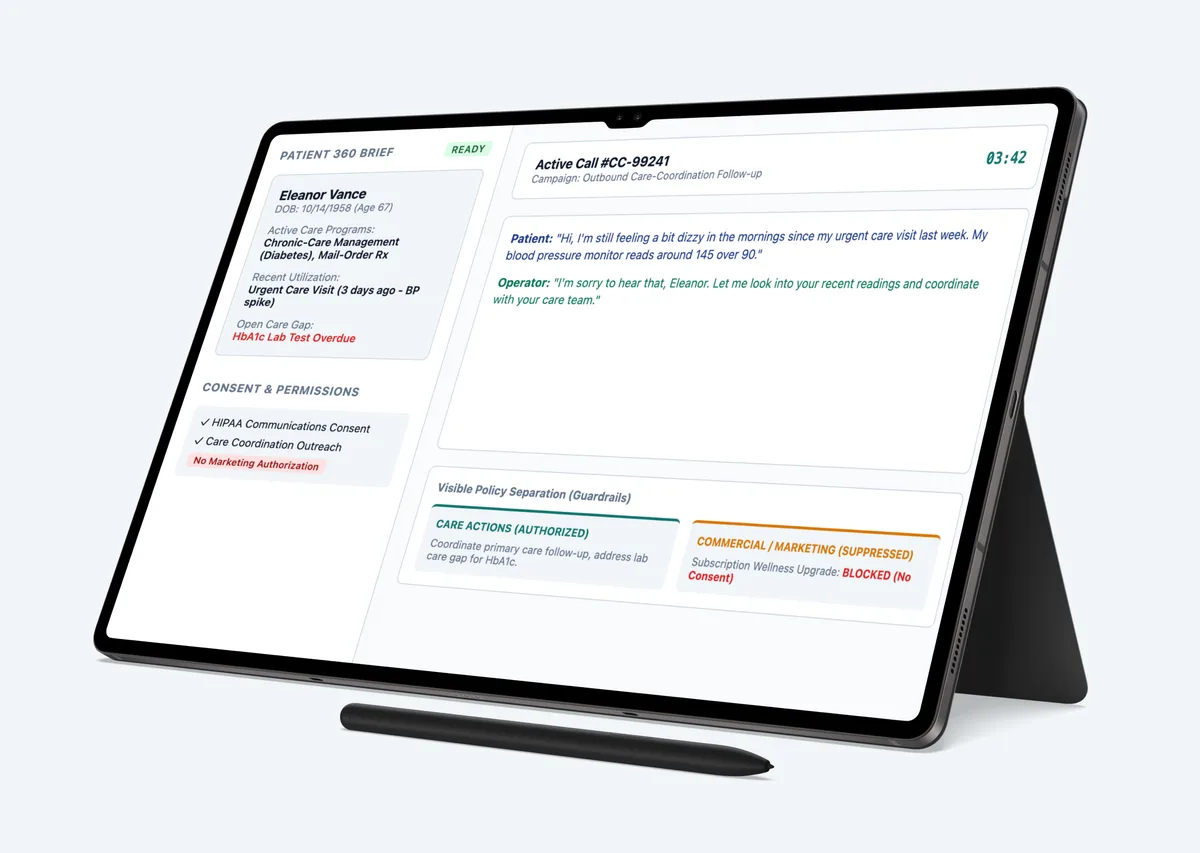
Before the call, Gemini Enterprise assembles a structured patient brief drawn from the CRM, EHR, telemedicine, billing, pharmacy, and support systems, filtered by the operator's role, the campaign type, and the patient's consent record. During the call, the assistant listens to the live transcript, surfaces relevant context and suggested phrasing, and tracks conversation progress. After the call, it generates a structured summary routed to the CRM and, where clinically appropriate, staged for the EHR.
The system is composed of nine specialized agents, each with a narrow scope, an explicit data contract, and deterministic policy guardrails. No agent calls a downstream system directly — every request passes through a single governed integration surface, and every recommendation is checked against policy before it reaches the operator.
Every recommendation is classified into a category — treatment, payment, healthcare operations, care coordination, marketing, or third-party promotion — and the interface enforces visible separation between care and commercial actions. Anything classified as marketing requires a specific, current authorization on file; third-party promotions are out of scope entirely. Hard-stop rules trigger immediate clinical escalation on symptoms and suppress commercial recommendations when safety is in question.
The assistant is built on Gemini Enterprise and the Agent Development Kit, with Gemini 2.0 Pro for reasoning and Gemini 2.0 Flash for low-latency coaching. It integrates with Client's existing systems — Genesys, Salesforce Health Cloud, Epic via the Cloud Healthcare API, Stripe, and OneTrust — through Apigee X, with all ePHI processing protected by CMEK, VPC Service Controls, and a federated identity model.
The assistant does not make clinical decisions, does not initiate outbound contact on its own, does not surface marketing offers without current authorization, and does not export ePHI outside the governed perimeter. A human operator owns every contact and remains accountable for every action.
Results
The assistant is measured against operational, clinical, and compliance targets, with baselines established at pilot start and outcomes tracked over a twelve-month window. Success is defined not by sales uplift but by faster, safer, more compliant service.
The program targets a 15% reduction in average handle time, a 20% improvement in first-call resolution, and a 60% cut in pre-call preparation time. Complaint follow-up completion is targeted up 25%, repeat contacts within seven days down 15%, and operator onboarding ramp reduced by 30%.
On the patient side, the assistant targets a 15% lift in CSAT after service recovery, a 10-point gain in NPS for care-coordination outreach, and a 20% improvement in care-gap closure among consented members. On safety, clinically appropriate escalation is targeted above 95% and the sampled missed-symptom rate held under 0.5%.
The compliance targets are absolute: zero inappropriate offers surfaced without authorization, zero consent-mismatch incidents, 100% audit log completeness, and no recommendation overrides without supervisor approval. Policy violations are to be detected within 24 hours, with the QA defect rate declining quarter on quarter.
The Phase 3 pilot is accepted only when all success conditions hold over a continuous 30-day production window — including the brief delivered before connect on at least 99.5% of calls, real-time coaching latency under 1.5 seconds, measurable handle-time and first-call-resolution gains with no CSAT degradation, and no significant security incident attributable to the platform.
The value drivers are lower cost-to-serve, higher member retention, improved care-gap closure, greater operator productivity, and reduced compliance risk — on top of a reusable governed-AI platform that lowers the marginal cost of the next use case. The target is payback within 18 months of enterprise rollout, with compliance risk reduction recognized as a non-financial benefit.
Conclusion
The Call Center Assistant gives Client's operators a governed patient 360 brief, complaint context, and compliant next-best-care recommendations before and during calls — and a structured, defensible record after. Its strongest value is not incremental sales but better patient experience, faster complaint resolution, safer care coordination, lower operator workload, stronger retention, and robust HIPAA governance.
Delivery runs in four phases over 9 to 12 months, each with formal stage gates and steering-committee go/no-go reviews. Oversight sits with a cross-functional governance structure, and every prompt, policy, and agent contract is version-controlled with dual approval, shadow deployment, and pre-staged rollbacks. Key risks — from excess PHI exposure to non-consented offers and prompt-injection attacks — are each met with specific, layered mitigations.
Client commits to deploying the assistant under these guardrails: where the operator and the system disagree, the operator decides; where the operator and patient interest diverge, the patient interest prevails; and where the system is uncertain, it asks for help.


Our success stories














































Tell us about your project needs