The table of content
Overview
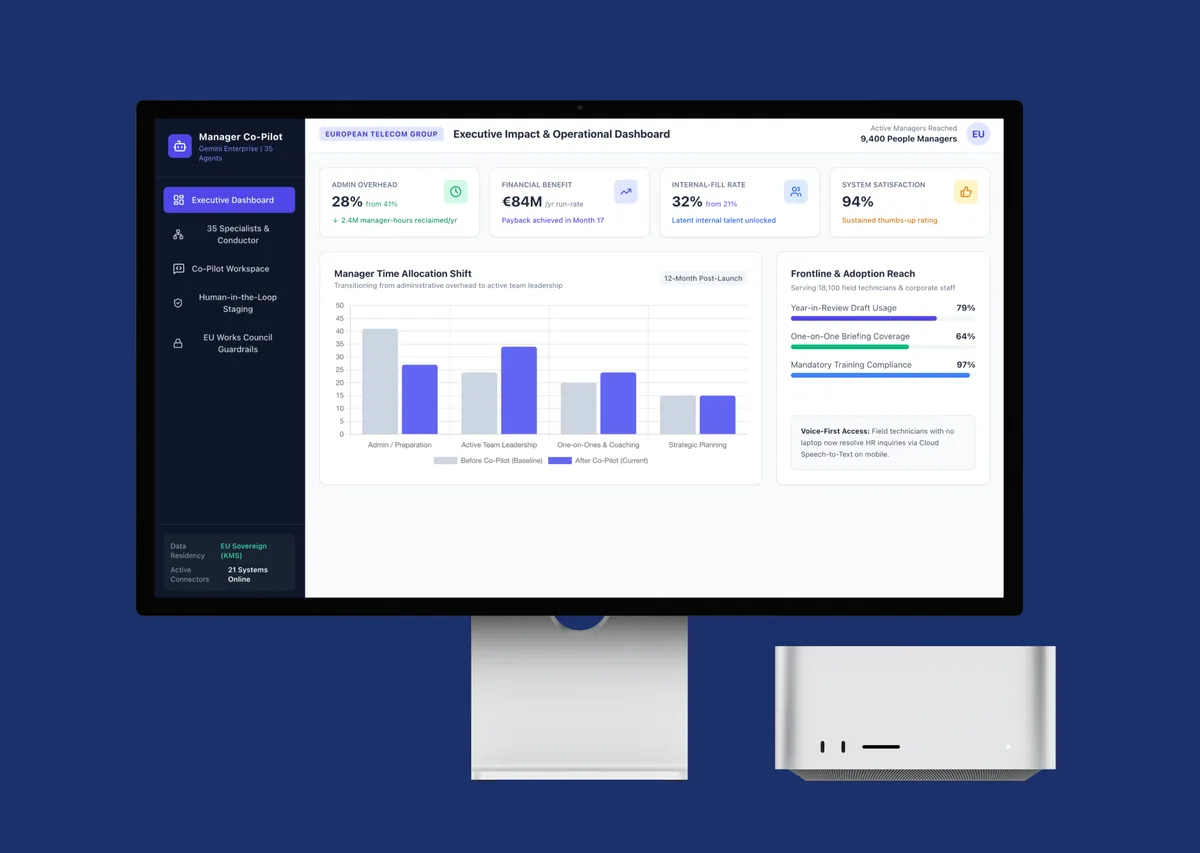
The client is a large European telecommunications group with around 78,000 employees across eleven markets. Within it sits a population that quietly carries much of the organization's success: roughly 9,400 people managers. A group-wide study found these managers were spending about 41% of their week not on leading their teams, but on the admin around it — preparing for one-on-ones, writing reviews, handling pay conversations, and answering the same recurring questions. That overhead crowded out real management and varied so much between countries that engagement scores differed by nearly 20 points across units running the same model.
The Co-Pilot is the client's response: an AI assistant that gives every manager, on demand, a capable helper for the hard and time-consuming parts of the job. Rather than a single chatbot, it's a coordinated system of 35 specialists — each focused on one task, like prepping a one-on-one, coaching a manager through a difficult conversation, drafting a year-in-review, or answering an HR question by voice for a field technician with no laptop. These assistants draw on the 21 business systems the group already runs, so answers are grounded in real, current information rather than guesswork.
Built on Gemini Enterprise on Google Cloud, the Co-Pilot meets people where they already work — Microsoft Teams, Google Workspace, a web app, and a voice-first mobile app — surfacing the right information at the right moment and handing back drafts a manager can shape. Crucially, it only ever suggests: anything that would actually affect an employee, such as a rating, a pay change, or a training record, is staged and cannot happen until a person approves it.
Because much of this work touches sensitive, regulated territory, the system was designed with strict guardrails from the start: all data stays in the EU, a manager only sees their own direct reports' data, wellbeing conversations stay private from the employer, and every step is logged. Twelve national works councils and a European works council helped shape and co-sign the framework it runs under — making this an assistant that gives managers their time back while remaining something employees, regulators, and unions can all trust.
Business Challenge
Before the Co-Pilot, a group-wide efficiency study across 1,200 managers established a stark baseline: the people meant to be leading teams were spending most of their energy on paperwork instead. The problem wasn't a lack of effort or capability — it was that the administrative weight of modern management had quietly grown until it crowded out the job itself, and it did so unevenly across a very large, very diverse organization.
Managers were buried in administrative overhead
Managers spent 41% of their working week on people-management admin — one-on-one prep, performance documentation, compensation conversations, calibration, recognition, approvals, and recurring policy questions — well above the 28–32% seen at peer companies. The annual performance cycle alone consumed about 130 hours per manager. The result was predictable: 45% of managers admitted to skipping or shortening a one-on-one in the previous quarter simply because the preparation was too much. When leading people becomes the thing that gets squeezed out, the whole organization feels it.
Inconsistency and hidden capability were dragging on performance
Because manager capability varied so widely, engagement scores differed by up to 18 points between country units running the same operating model — a gap traceable largely to how well individual managers led. At the same time, the group struggled to see the talent it already had: only 21% of open roles were filled internally, against a peer benchmark of 31–38%, because skills and internal candidates were scattered across systems and effectively invisible. Latent capability the company had already paid for went unused, and roles were filled expensively from outside instead.
Two further pressures sharpened the brief. Mandatory training compliance had slipped to 87% — below the 95% regulatory minimum in two markets — largely because generic 45-minute videos felt irrelevant to many roles. And a large frontline population of roughly 18,100 field technicians and retail staff was effectively unserved by HR self-service: with no laptop and little desk time, they generated HR support tickets at more than four times the per-person rate of corporate staff. The group's operating committee approved the programme with an explicit target: cut manager admin overhead by at least 25% while measurably improving engagement and internal mobility — all within strict EU data-residency and works-council constraints.
Solution
The client built the Co-Pilot to do the heavy, repetitive parts of management for the manager — and then hand the result back for a person to review and approve. It doesn't ask managers to change how they work or learn a new app. Instead, it shows up inside the tools they already use, at the moment they need it, with answers grounded in the company's real data.
Help that arrives at the right moment, in the right place
The Co-Pilot meets managers in Microsoft Teams, Google Workspace, a web app, and a voice-first mobile app for frontline staff. Much of its value comes from good timing rather than being asked. For example, about 15 minutes before a manager's next one-on-one, it quietly assembles a briefing — recent goals, shipped work, peer recognition, learning progress, and a gentle flag if something needs attention — and delivers it as a card the manager can open with one click. The same pattern powers dozens of everyday tasks: drafting a year-in-review from a year's worth of scattered notes, rehearsing a difficult conversation with a realistic AI partner, coaching a pay discussion, spotting skills the company already has but can't find, or letting a field technician check their leave balance hands-free by voice.
A coordinated team of specialists, always grounded and always human-approved
Rather than one all-purpose bot, the Co-Pilot is 35 specialist assistants organized around nine areas of management, from learning and career growth to performance, wellbeing, and people analytics. When a question spans several of them, a lightweight coordinator breaks it apart, sends the pieces to the right specialists at the same time, and stitches the answers back together — showing which specialist contributed which fact. Every answer is bound by strict rules: sensitive outputs about performance or pay must cite at least three real source records; if the system isn't confident enough, it says so rather than guessing; and anything that would actually change an employee's record is staged and cannot happen until a person clicks to approve it. On top of that, a manager only ever sees their own direct reports' data — the system never widens their view beyond what the underlying systems already allow — and the most sensitive uses, like wellbeing support, are kept private from the employer entirely. The result is speed with a firm brake: a human stays unambiguously in control of every decision that matters.
Technology Stack
Everything runs on Google Cloud, hosted only in the EU, with Gemini Enterprise as the reasoning and orchestration layer and connectors reaching into the 21 systems the group already uses.
Core AI platform
- Gemini Enterprise — the platform hosting the 35 specialist agents and the conversational surface
- Gemini 2.5 Pro — heavy reasoning: year-in-review synthesis, calibration, analytics, and long-context work (up to a 1M-token context window)
- Gemini 2.5 Flash — faster tasks and the "judge" models that check tone and groundedness
- Gemini 2.5 Flash-Lite — the lightweight router that sends each request to the right model
- Gemini Live — real-time voice for role-play coaching, skill assessments, and meeting capture
Agents, retrieval, and data
- Vertex AI Agent Engine — hosts the conductor and all 35 agents (defined as versioned YAML, deployed via CI/CD)
- Vertex AI Search + Vector Search + Ranking API — three-stage hybrid retrieval (keyword, semantic, re-rank) over company knowledge
- Vertex AI AutoML Tables — predictive models for attrition insight and workforce planning
- Document AI — parses PDFs, scanned forms, and photos (e.g. receipts)
- BigQuery — the immutable 7-year audit log plus analytics
- Cloud Spanner — glossary, token maps, and the hardened, separately-keyed store for private wellbeing sessions
- Memorystore for Redis — fast prompt caching
- Cloud Dataflow / Composer / Pub/Sub / Workflows — the ingestion pipelines, orchestration, and event backbone
Integration and delivery surfaces
- Apigee X — a single API gateway serving both Teams and Workspace clients
- 21 enterprise connectors — including Workday, SAP SuccessFactors, Cornerstone LMS, Salesforce, Jira/Confluence/GitLab, ServiceNow, Microsoft Viva, Genesys and NICE, and Mercer
- Microsoft Teams, Google Workspace, a React web app, and a Flutter mobile app — the four ways managers reach the Co-Pilot
- Cloud Speech-to-Text + Cloud Translation — voice-first, multilingual access for frontline staff
Security, identity, and governance
- Cloud KMS (HSM-backed CMEK) — customer-managed encryption keys held in the EU
- VPC Service Controls, Private Service Connect, Cloud Armor, Secure Web Proxy, Cloud IDS — a closed perimeter with no public access to the system
- Workforce Identity Federation (Microsoft Entra ID) — single sign-on with MFA and step-up approval for any write-back
- Cloud DLP — redacts personal and telecom-specific identifiers before data is stored
- Model Armor — blocks prompt-injection and jailbreak attempts
- Chronicle SecOps + Microsoft Sentinel + Access Transparency — continuous security monitoring and full access logging
Results
The figures below are measured twelve months after launch, across the Phase 1 and Phase 2 population. The business case was approved on the manager-time saving alone; the rest came as upside.
Time and capacity reclaimed
- Manager admin overhead fell from 41% of the working week toward the sub-28% target, clearing the mandated 25% reduction
- Roughly 2.4 million manager-hours reclaimed per year across the group — the single largest source of value
- The one-on-one prep assistant now covers 64% of all scheduled one-on-ones, with each briefing ready in under 4 seconds for a few cents
Engagement and internal mobility
- Employee engagement (eNPS proxy) is tracking toward the +8-point, 24-month target, with explicit focus on narrowing the gap between country units
- Internal-fill rate targeted to rise from 21% to 32% by surfacing skills and candidates the group already had but couldn't find
- Latent capability — people with hands-on experience in priority technologies but not assigned to them — is now discoverable and feeds internal mobility
Reach and service quality
- Frontline field and retail staff — previously generating HR tickets at 4.2× the corporate per-person rate — now get self-service by voice and mobile
- 79% of eligible employees used the AI-drafted year-in-review as a starting point in the latest performance cycle
- Sustained 94% thumbs-up rate across the most-used assistants
Financial outcome
- Year-one investment of about €19.6M; realized benefits conservatively valued by Group Finance at €84M/year at steady state
- Payback in month 17, with a forecast steady-state run-rate of about €11.8M/year
Compliance and trust, built in
- Operating under the EU AI Act high-risk framework for its sensitive capabilities, registered in the EU AI database, with human approval required for every decision that affects an employee
- All data resident in the EU, a full 7-year audit trail, and wellbeing conversations kept private from the employer
- A Group Framework Agreement co-signed by twelve national works councils and the European works council, with quarterly usage reporting
Conclusion
The Co-Pilot changes what it means to be a manager at the client by quietly removing the administrative weight that had come to define the role. Instead of losing 41% of the week to preparation, documentation, and recurring questions, managers get that time back — and get it back in the form that matters most: more and better conversations with the people they lead. A one-on-one that used to be skipped for lack of prep now arrives with a thoughtful briefing already waiting. A blank-page year-in-review becomes a draft to shape rather than a chore to dread. A nervous first-time manager can rehearse a hard conversation before having it for real. And a field technician with no laptop can finally get an answer just by asking out loud. The technology is sophisticated, but the experience is simple: the right help, in the tools people already use, at the moment they need it.
What makes the approach durable is that convenience never came at the cost of control or trust. The Co-Pilot only ever suggests; a person approves anything that touches an employee's rating, pay, or record. Managers see only their own team's data, wellbeing conversations stay private from the employer, and every step is logged so the organization can always prove a human made each decision. Those safeguards weren't added at the end to satisfy auditors — they were designed in from the start and co-signed by twelve national works councils and the European works council, which is precisely why a system this capable was allowed to operate in territory as sensitive as performance, pay, and workforce planning across eleven countries.
The outcomes make the case on their own terms: roughly 2.4 million manager-hours reclaimed a year, more consistent leadership across very different markets, hidden internal talent finally made visible, frontline staff genuinely served for the first time, and benefits that pay back the investment inside a year and a half. Just as important, the platform underneath isn't a single-purpose tool. The same secure, EU-resident foundation, the same human-in-the-loop pattern, and the same governance model now extend naturally toward new frontiers — from retail and network-operations coaching to a cross-group skills marketplace — which means this isn't the end of the programme so much as the groundwork for whatever the organization chooses to build next.


Our success stories









































Tell us about your project needs