The table of content
Overview
Digital banks compete on speed — open an account in minutes from your phone. For a UK-regulated bank, that promise collides with reality at the worst moment: right when a customer is most willing to sign up, the app demands an ID photo, a selfie, a liveness check, and proof of address. This is KYC, a legal step that can't be skipped, and it's exactly where sign-up quietly falls apart. Every customer who abandons here is one the bank already paid to acquire, now walking away — usually not because they don't want the account, but because the app makes the step harder than necessary and offers no help along the way.
This document lays out a better way: a real-time assisted KYC platform built on Google Cloud, Gemini Enterprise, and Gemini Live. A fast, multimodal assistant sits inside the process, explains each step, coaches the customer through capturing their documents, and catches common mistakes before they ever reach the verification partner. One rule sits above everything else: this is not about automating compliance. The regulated decision stays with the bank and its verification partner — Gemini guides, explains, and prepares the evidence; it never approves, rejects, or overrides.
Business Challenge
The Regulatory Squeeze
A UK-regulated digital bank's onboarding has to satisfy several rulebooks in the same few minutes a customer photographs a document and takes a selfie. The Money Laundering Regulations require Customer Due Diligence on every applicant, Enhanced Due Diligence for higher risk, sanctions/PEP screening, and ongoing monitoring. UK GDPR governs the data — selfies and liveness checks are biometric data under Article 9, so the bank needs a legal basis and a documented opt-out. Consumer Duty requires clear, timely information and extra care for vulnerable customers. No version of onboarding can skip any of these.
Where Applicants Drop Off
Identity verification is the bottleneck in an otherwise strong funnel, with abandonment concentrated at four moments: ID photo, selfie, liveness, address proof. The causes are human, not technical: customers asked for a selfie with no explanation feel it's invasive and quit; bad lighting produces blurred or glare-washed photos that get rejected and trigger frustrated retries or exits; fixed liveness guidance can't adapt to what the camera sees; people upload screenshots because no one flagged that originals were required; those wary of biometrics get no alternative; and applicants sent to manual review hear nothing, generating support calls and complaints. A rigid app can accept or reject — it can't explain or coach, and a rejection here is costly.
Who Bears the Cost
The applicants most defeated by a rigid flow — older customers, people with disabilities, anyone stressed or rushed — are exactly who Consumer Duty obliges the bank to support, making this a regulatory exposure, not just a design flaw. The cost lands in three places: lost lifetime value as a few-minute process stretches to ten or twelve and applicants give up; manual-review workload that scales with volume rather than actual risk; and the complaints and conduct risk that follow an experience customers couldn't finish or understand.
Solution
The Core Principle — Assisted, Not Automated
The platform assists a regulated process rather than automating it. An AI never judges identities, approves accounts, or makes calls the law reserves for the bank — the verification partner still analyzes documents and biometrics, and the bank's rules engine still decides. What changes is that a real-time assistant sits with the customer: explaining why each step exists, coaching capture as it happens, catching mistakes before they reach the verification partner, and handing downstream systems a clean, structured evidence trail. The customer is no longer alone with a silent camera and a list of instructions.
The Customer Journey
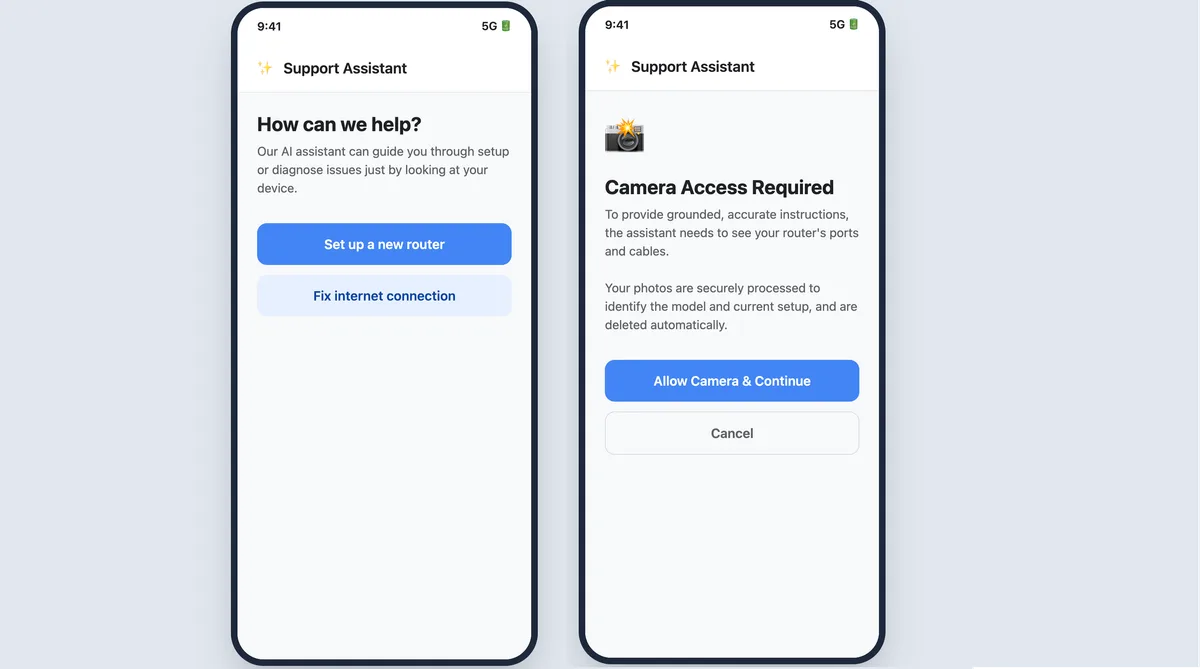
The customer enters basic details, which creates a temporary KYC session set to the right verification level for their product. Gemini Live opens and explains, in pre-approved wording, why verification is needed, what data is used, and what alternatives exist — then captures explicit consent as a permanent event before any biometric processing starts.
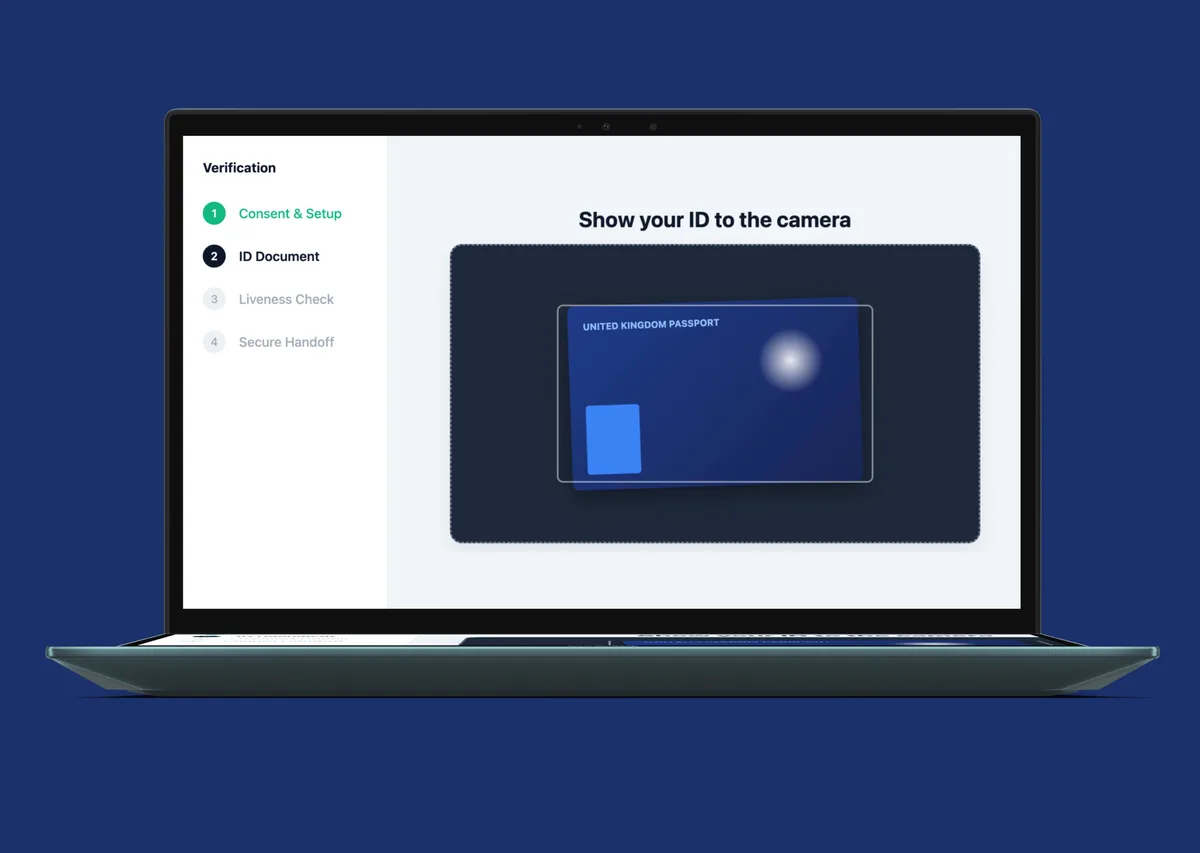
From there, the assistant coaches in real time: framing the ID shot, clearing glare, catching cropped edges or screenshots, guiding the selfie and liveness check, and verifying address via credit-bureau match first, with document upload as fallback. If Enhanced Due Diligence triggers, it asks an approved question set. At the end, the outcome is explained in neutral, controlled language, with clear next steps if the case goes to manual review:
Customer: "Why do you need a selfie? I already uploaded my passport."
Assistant: "We ask for a selfie to check that the person opening the account matches the person in the document — it helps protect you from someone using your ID without permission. If you'd rather not, I can show you the other verification options."
Guardrails — Architecture and Edge Cases
The assistant prepares evidence but never decides — it cannot rule on KYC, AML, fraud, sanctions, or biometrics, won't reveal risk thresholds or bypass methods, always offers an accessible alternative, and hands off to a human when confidence is low or the customer seems distressed. All explanations come from compliance-approved wording, never free-form generation.
Behind this sits a fixed roster of single-purpose agents, each with a strict output format and access only to the tools it needs: a Journey Conductor running the sequence, a Consent agent for privacy explanations, a Document Capture Coach, a Liveness Preparation agent, a Risk-Based Question agent for EDD, a Vulnerable Customer Support agent, a Compliance Handoff agent building analyst review packs, a Fraud Safe-Response agent blocking bypass attempts, and a QA/Analytics agent improving prompts over time from anonymised sessions.
This architecture is built for hard cases: biometric refusal is treated as a legitimate choice, offering video verification or in-person Post Office checks with no penalty; any text or QR code in a submitted image is treated as untrusted data, never as instruction; and least privilege is strict throughout — the Consent agent can't reach KYC decisions, the Risk-Based Question agent can't touch raw biometric images.
Technology Architecture
The architecture follows a single discipline: one canonical implementation per concern, with no parallel or competing technology choices. All real-time multimodal interaction runs through Gemini Live; all non-real-time reasoning runs through Gemini on Vertex AI. External traffic terminates at Apigee X, so backend services are never directly exposed. Customer data is resident in the United Kingdom by default, and all inter-service traffic runs inside a VPC Service Controls perimeter. The stack below is organised as layers, each naming the components that deliver it.
- Channel layer (iOS/Android app, web onboarding, contact-centre co-pilot, accessible voice/text/large-font routes)
- Real-time assistant (Gemini Live over WebSocket, Cloud Run session broker)
- Agent orchestration (Gemini Enterprise, ADK on Vertex AI Agent Engine)
- Reasoning layer (Gemini 2.5 Pro via Vertex AI, RAG over compliance data stores)
- Edge and gateway (Cloud Load Balancing, Cloud Armor WAF, Apigee X — OAuth, mTLS, quotas)
- Orchestration and eventing (Cloud Workflows, Pub/Sub, Cloud Tasks)
- KYC and screening partners (Onfido — document/face/liveness; ComplyAdvantage — sanctions/PEP/adverse media; in-house fraud platform)
- Data and storage (Cloud Storage UK + CMEK with lifecycle purge, BigQuery, Secret Manager, Cloud KMS)
- Security and governance (VPC Service Controls, Cloud DLP, Model Armor, IAM, Chronicle, Cloud Audit Logs)
- Systems of record (core banking, CRM, Salesforce Service Cloud)
- Observability and delivery (Cloud Monitoring/Logging, Cloud Build, Binary Authorization signed-image-only)
- Visualisation (Looker — product, compliance, and operations dashboards)
A point worth making explicit: the verification partner boundary is firm. Document authenticity, face match, and liveness decisions live with Onfido, not with the AI. The assistant prepares and submits; the partner analyses and returns a result; the bank's rules engine decides.
The same discipline governs data. Compliance and data-handling controls are designed in, not bolted on:
- UK data residency by default; no cross-border transfer without an approved Transfer Impact Assessment.
- CMEK encryption at rest; TLS 1.2+ in transit; Model Armor screening every customer-facing input and output.
- Retention discipline: five-year KYC evidence retention under the Money Laundering Regulations; raw capture images purged immediately after partner submission; no internal storage of biometric templates; Gemini transcripts redacted of PII and biometric references before analytics.
- DPIA completed before each major change; Article 9 condition documented, with explicit consent and a documented alternative route for customers who decline biometrics.
Results
What Moves, and By How Much
The platform earns its place by moving business metrics, not by adding a conversational veneer. Abandonment falls as the assistant removes friction — explaining the selfie, fixing the photo, offering alternatives instead of dead ends. First-pass document acceptance rises as poor captures get corrected before reaching the verification partner. Manual review volume drops as fewer ambiguous cases reach analysts, freeing their time for genuine risk. Onboarding time contracts from 8–12 minutes to 4–7. Complaints decline as customers stop being left in silence at the most sensitive moment. And every case reaching a human arrives with a complete evidence pack instead of a thin one.
Target KPIs (12 months post-rollout):
- KYC abandonment: −20% to −40%
- First-pass document acceptance: +15% to +30%
- Manual review volume: −10% to −25%
- Average onboarding time: 8–12 min → 4–7 min
- Gemini-assisted recovery rate: 0 → ≥40%
- Consent-refusal alternative-route completion: ≥60%
- Onboarding-linked complaints: −25%
- Compliance evidence completeness: 100% structured
In the bank's terms: each recovered onboarding is recovered Customer Lifetime Value, lower review load is operating cost removed, and a consistent evidence trail is reduced conduct risk on every session.
The Headline Metric, and How It's Proven
One measure sits above the rest: the Gemini-assisted recovery rate — customers who failed first capture but completed KYC after guidance, divided by all customers who failed first capture. It isolates the assistant's entire purpose: rescuing onboardings the old flow would have lost. A platform that adds conversation without moving this number hasn't delivered the business case. It's owned by the Product Owner and reviewed monthly.
These outcomes are designed to be proven, not asserted. Discovery and compliance design (DPIA, approved-explanation library) come first, then a prototype tested against the Onfido sandbox with synthetic users, then a controlled pilot against a matched control group to isolate causal impact. Only after clearing acceptance gates does the platform roll out to all UK customers, then extend to web onboarding, a contact-centre co-pilot, and business onboarding.
Where the Value Comes From
Three channels of value, each larger per event than the marginal cost of a session: recovered Customer Lifetime Value from saved onboardings, reduced analyst labour from fewer manual reviews, and lower remediation cost from fewer complaints. Set against per-session coaching and verification costs — themselves bounded by on-device pre-checks, session budgeting, and image-lifecycle deletion — the return comes from recovered customers and avoided work, not from the technology itself.
Conclusion
Why this stack
Assisted KYC asks for a combination of capabilities that no single off-the-shelf product delivers on its own: real-time multimodal interaction, governed agent orchestration, connector-based retrieval of compliance content, UK data residency, customer-managed encryption, network isolation, and AI-specific safety controls. The value is in assembling these as one governed system rather than stitching them together from disparate parts.
Gemini Live supplies the low-latency, stateful, multimodal voice-and-visual interaction that makes in-session coaching possible at all. Gemini Enterprise provides centralised control over agents, permissions, policies, Model Armor screening, and connectors — so the bank's bespoke KYC agents run under the same governance as Google-built ones. The Gemini Enterprise data stores turn the bank's own compliance, policy, and support content into a governed, retrievable knowledge base, ensuring every customer-facing response is grounded in approved wording. And UK residency, CMEK, VPC Service Controls, and Access Transparency provide the regulatory posture an FCA-supervised environment requires. The combination is the point.
Final positioning
The strategic value of this platform is not the automation of compliance. It is better completion, better evidence quality, better accessibility, and stronger operational control at the most sensitive moment in the customer journey — the moment a prospective customer becomes a regulated relationship. The assistant guides the customer through identity verification in real time, explains each step clearly, improves capture quality, and reduces abandonment, while the regulated decision stays firmly inside the bank's approved KYC, AML, and compliance systems.
That boundary is what makes the approach durable. It points to a broader pattern for regulated workflows: the near-term opportunity is not autonomous AI that replaces human and regulatory judgment, but assisted AI that makes the right outcome easier to reach and easier to prove — leaving the decision exactly where law and accountability require it to be.


Our success stories




















































Tell us about your project needs