

The table of content
Introduction
Regulatory Requirements and Operational Complexity in Hazardous Materials Management
The transportation and management of hazardous materials is one of the most strictly regulated industries globally. Organizations must comply with complex international standards, national regulations, and government oversight requirements. Companies implementing robust compliance systems and operational transparency gain significant competitive advantages.
A Saudi Arabian logistics company recognized the critical importance of modernizing their hazardous materials management operations. Their existing systems lacked real-time monitoring capabilities, comprehensive compliance visibility, and government agency integration. Manual processes and limited coordination across regulatory bodies created operational inefficiencies and compliance risks. The inability to scale operations limited business growth.
Recognizing that digital transformation was essential, the company engaged Infinity Technologies to architect and implement a comprehensive hazardous materials management platform. The solution provides real-time monitoring and tracking, seamless government integration, centralized compliance management, and scalable architecture to support business growth.
Challenge
Regulatory Complexity and Operational Fragmentation
The company operated in a highly regulated environment overseen by multiple government agencies, each with distinct requirements and approval processes. There was no coordination between these agencies, requiring the company to navigate a fragmented regulatory landscape independently. Each government body required separate applications with different documentation and approval timelines. Information was dispersed across multiple systems, platforms, and paper records, making it difficult to maintain accurate, current data about hazardous materials operations.
Manual Processes and Limited Visibility
Permissions, clearances, and transportation authorization depended heavily on manual, paper-based processes. Approvals took weeks or months. Once approved, staff had to manually re-enter information into internal systems, creating redundancy and increasing error risk. The company lacked real-time monitoring of hazardous materials during transportation and storage. Visibility into material locations and status was limited, creating safety risks and making compliance verification difficult. The company relied on periodic inspections rather than continuous monitoring.
System Integration Gaps and Scalability Constraints
The customer-facing platform did not integrate with the main business system (ERP), creating data silos that hindered efficiency. Information about orders, materials, and shipments existed in separate systems that did not communicate. Staff had to manually transfer information between systems, wasting time and creating errors. Government agencies had no access to company data, requiring information to be provided repeatedly through different channels.
As the company sought to grow and handle more shipments, manual systems and fragmented processes became unmanageable. The company could not reliably scale operations without proportionally increasing administrative staff. These operational constraints limited the company's ability to pursue business expansion and compete with more technologically advanced competitors. Platform modernization was essential to improve efficiency, ensure regulatory compliance, and enable safe business growth.
Objectives
Strategic Goals for Hazardous Materials Management
The platform must accomplish processes streamlining through automation and elimination of complex workflows related to permissions, clearances, and transportation of hazardous materials. The solution must eliminate manual coordination between multiple government agencies and reduce approval timelines significantly. By automating routine processes and centralizing information, the system will accelerate operations and reduce administrative burden on both companies and regulatory bodies, enabling faster transactions without sacrificing compliance.
Safety and compliance enhancement represents a critical objective. The platform must ensure adherence to legal, environmental, and safety standards through regular monitoring, inspections, and centralized tracking. The system must provide real-time oversight of hazardous materials throughout their lifecycle, from receipt through storage and transportation to final delivery. Automated compliance verification will ensure all regulations are met consistently and create comprehensive audit trails for regulatory inspections, reducing compliance risks and protecting public safety.
Coordination facilitation is essential for operational success. The platform must create a one-stop solution for all stakeholders, including government authorities, private sector companies, logistics providers, technicians, warehouse operators, and transportation companies. A unified platform will eliminate the need for separate communication channels and ensure all parties have access to current, accurate information about materials, shipments, and compliance status, fostering seamless collaboration across the entire ecosystem.
Transparency and accountability improvement must be achieved through providing real-time visibility into material quantities, licenses, transportation status, regulatory compliance, and other critical aspects. All stakeholders will have immediate access to information they need for their respective roles, enabling faster decision-making and reducing operational delays caused by information gaps. This visibility strengthens accountability throughout the supply chain and supports evidence-based oversight.
Finally, scalability and flexibility enabling is fundamental for long-term success. The system must be built to support future changes in regulations, market needs, or technological advancements. The platform architecture must support business growth, accommodate new material types, integrate new government agencies or regulatory requirements, and evolve with industry best practices without requiring complete system redesign, ensuring the investment remains valuable as the business landscape changes.
Solution
Comprehensive Platform Architecture
Infinity Technologies designed a comprehensive web-based platform that centralizes hazardous materials management and connects all stakeholders—government authorities, logistics companies, warehouse operators, technicians, and transportation providers. The platform serves as a unified hub where all parties can access real-time information and coordinate operations efficiently.
Real-Time Monitoring and Government Integration
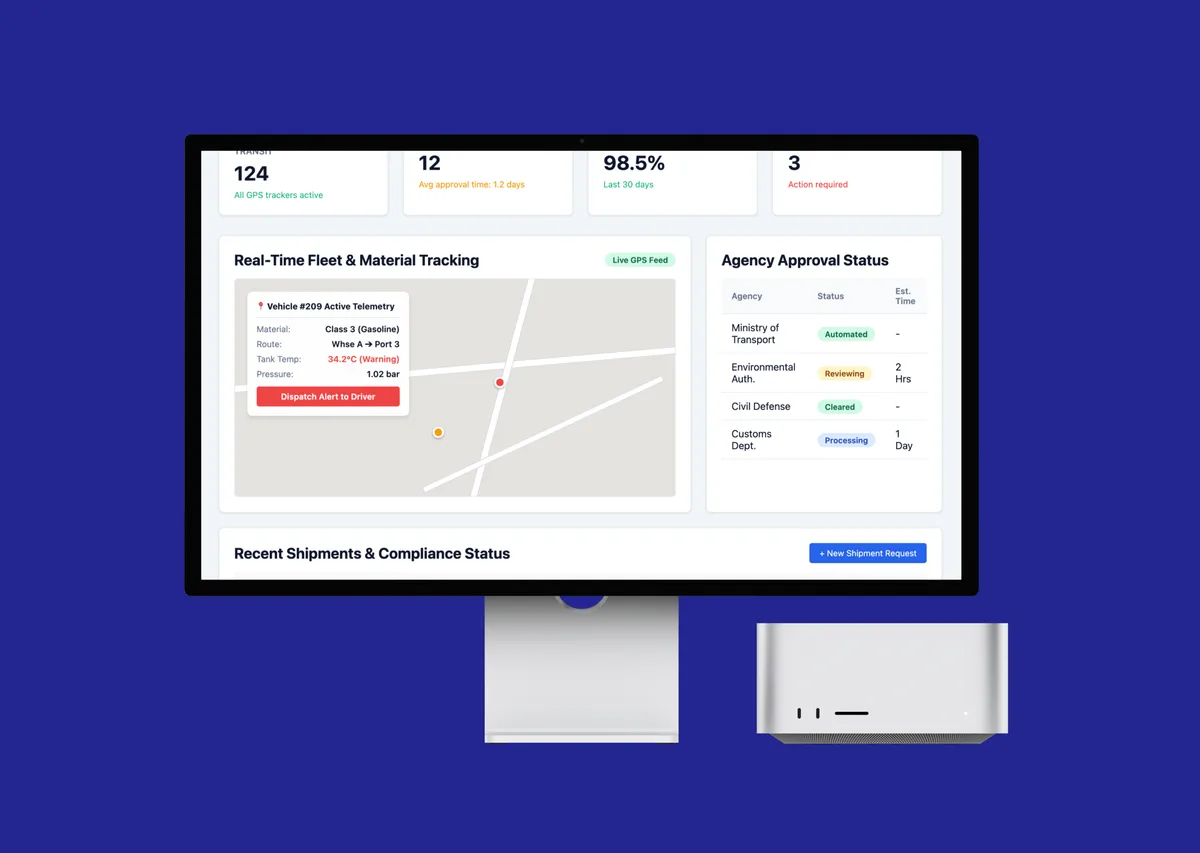
The platform includes a real-time monitoring system that tracks hazardous materials throughout their lifecycle using GPS tracking and camera integration. All stakeholders access real-time data about material locations, storage conditions, and transportation status. The platform directly integrates with government regulatory systems, eliminating manual coordination across multiple agencies. Companies submit permissions and clearance requests once, and the system automatically routes information to relevant government bodies for review and approval.
Workflow Automation and Centralized Data Management
The platform automates routine workflows for permissions, clearances, and transportation authorization, significantly reducing approval timelines and administrative burden. A comprehensive database stores all hazardous materials information, service provider credentials, licenses, and compliance documentation in one centralized location. The system automatically tracks license expiration dates and alerts users when renewal is needed. Automated compliance verification checks operations against applicable regulations in real-time.
Streamlined Operations and Analytics
The system eliminates manual data re-entry by automatically transferring information between government and company systems. Staff resources shift from administrative tasks to core operations. Detailed reports and analytics are generated for different stakeholders, enabling data-driven decision-making and supporting regulatory audits. The platform provides government regulators with compliance reports and trend analysis while giving company administrators operational insights about shipment volumes and performance metrics.
Results
Anticipated Operational Improvements
Upon full implementation, the platform will deliver significant improvements to hazardous materials management operations. The centralized system will eliminate manual coordination between government agencies and private companies, reducing approval timelines from weeks to days. Automated workflows will streamline permissions, clearances, and transportation authorization processes, reducing administrative burden on both regulatory bodies and companies.
Enhanced Safety and Compliance
Real-time monitoring and tracking capabilities will provide continuous visibility into hazardous materials throughout their lifecycle. This transparency enables immediate detection and response to safety issues, significantly reducing accident risk. Automated compliance verification ensures all operations meet regulatory requirements consistently. Comprehensive audit trails created by the system facilitate regulatory inspections and demonstrate compliance to government authorities.
Improved Operational Efficiency
The elimination of manual data re-entry and system fragmentation will free staff resources from administrative tasks. Employees can focus on core operations rather than coordinating between systems and government agencies. Automated data transfer between the platform and company systems eliminates errors caused by manual processes. Centralized information access enables faster decision-making and reduces delays caused by information gaps.
Business Growth Enablement
The scalable platform architecture supports significant business expansion without proportional increases in administrative staff. Companies can reliably handle larger volumes of hazardous materials shipments. Streamlined processes and reduced approval timelines enable faster transactions and improved customer service. Enhanced compliance capabilities and safety records improve competitiveness and support access to restricted markets and contracts.
Strategic Value
The platform transforms hazardous materials management from a costly, manual, compliance-heavy operation into an efficient, automated, transparent system. The integration of government and private sector operations creates a unified ecosystem that benefits all stakeholders. Enhanced safety, compliance, and operational efficiency position participating companies for sustainable growth and competitive advantage in the hazardous materials logistics market.
Conclusion
The hazardous materials management platform represents a critical modernization initiative that transforms government-industry coordination from a fragmented, manual process to a unified, automated system. By developing a comprehensive, integrated platform with Infinity Technologies, the company positioned itself to achieve strategic objectives in compliance, safety, and operational efficiency.
The platform delivers multiple tangible benefits including real-time monitoring that enhances safety, automated compliance verification, centralized data management that eliminates errors, and streamlined workflows that reduce administrative burden and approval timelines. These improvements translate directly into reduced safety risks, stronger compliance, and improved operational efficiency.
The scalable architecture enables business expansion without proportional increases in administrative complexity. Reduced approval timelines and improved efficiency enable faster transactions, while enhanced compliance and safety records improve competitiveness and support access to restricted markets.
This project demonstrates that comprehensive platform modernization in regulated industries delivers significant competitive advantage. Investment in modern technology infrastructure, government system integration, and automated compliance management enables organizations to achieve safety, compliance, efficiency, and growth simultaneously. For other organizations managing hazardous materials or operating in heavily regulated environments, this case study illustrates the strategic value of digital transformation as a core business strategy.


Our success stories











































Tell us about your project needs