


The table of content
Introduction
Transforming Last-Mile Logistics at Scale
In the fast-paced world of e-commerce and logistics, the last mile of delivery represents both a critical challenge and a major cost driver. For third-party logistics (3PL) operators managing thousands of orders daily across multiple clients, inefficiencies in order processing, warehousing, and delivery coordination can quickly compound into missed deadlines, customer dissatisfaction, and rising operational costs.
FM Logistic, one of Ukraine's largest international 3PL operators, faced precisely this challenge. Serving industry giants like L'Oréal, Royal Canin, and Phillips, the company was processing roughly 5,000 orders per day — yet their manual and fragmented systems were hindering growth and straining resources. The onboarding process for new clients alone was taking up to two months, warehousing operations lacked real-time visibility, and delivery coordination across multiple postal carriers remained disjointed.
Recognizing that sustainable growth required a fundamental operational transformation, FM Logistic reached out to Infinity Technologies with a clear objective: to create a comprehensive last-mile delivery management system that would organize more efficient onboarding, streamline warehousing operations, and improve logistics management for both existing and new clients. The goal was not merely to solve immediate pain points, but to build a scalable platform capable of handling the company's ambitious expansion plans.
Infinity Technologies responded by building a modern technology stack — powered by Magento, microservices, and cloud infrastructure — that unified disparate workflows, accelerated client onboarding from two months to just one day, and enabled FM Logistic to reliably scale operations while delivering superior visibility and control to its customers. This case study explores how this transformation was achieved and the measurable impact it delivered.
Challenge
Operational Bottlenecks Constraining Growth
FM Logistic stands as one of Ukraine's largest international 3PL operators, delivering a comprehensive suite of logistics services including warehousing, picking, marking, stickering, document translation, and full-cycle logistics outsourcing. Processing approximately 5,000 orders per customer per day, FM Logistic's existing operations suffered from critical inefficiencies that threatened their ability to scale.
Manual workflows, fragmented systems, and lack of automation across order receiving, warehousing, and shipment coordination were creating bottlenecks. New client onboarding required up to two months of manual configuration, while visibility into inventory, order status, and returns remained siloed across different departments and carriers. To support aggressive growth, the company needed a unified, automated platform capable of streamlining the client onboarding process, automating order receiving and processing workflows, providing customized dashboards and controls for each client, integrating seamlessly with multiple postal carriers and delivery services, tracking shipments and returns in real time, and handling the volume and complexity of large-scale, multi-client operations.
Solution
Integrated Platform Architecture
To complete the given tasks, the Infinity Technologies team implemented Magento CMS as a core technology for warehouse management, as it easily processes large scopes of information, deals with accounting, and gives control over shipment and return processes. Small microservices handle data processing and CSV file management. Integration with 3rd-party post and delivery services is performed through APIs.
The development team's work was aimed at three main directions. First, the client onboarding flow: when a new client starts cooperation with FM Logistic, their e-commerce store, warehouse, and post services are integrated into one system. The newly developed dashboard has flexible settings, allowing administrators to add new users and set up individual dashboards according to each client's needs and processes.
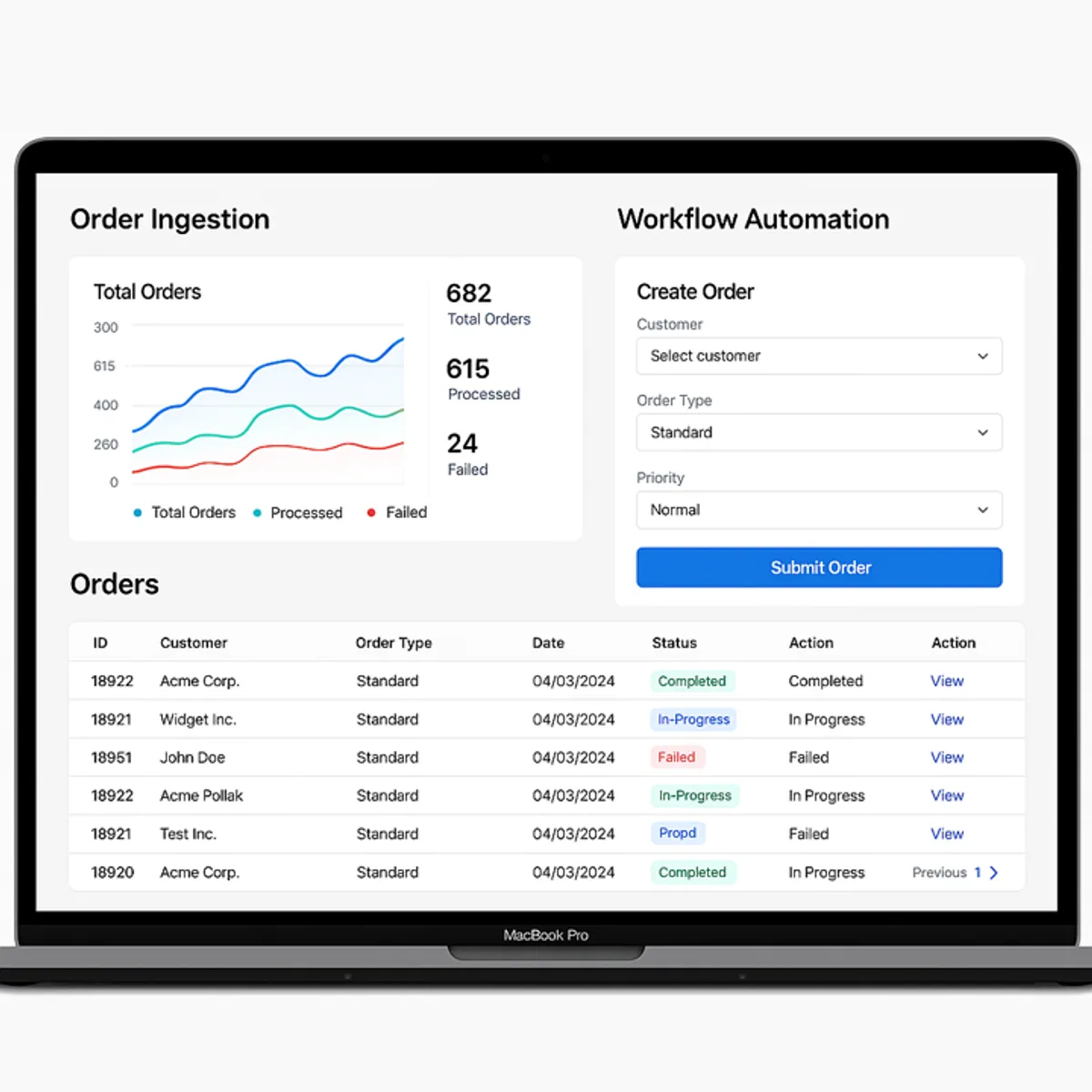
Second, warehousing and inventory management: when an order is created, it automatically moves to the system. By default, it accepts CSV files, but automatically converts other document formats as needed. The system checks goods availability and shipment possibilities, then the order moves to the warehouse where it is gathered, marked, and packed. At each stage of warehouse processing, the order status is shown to the client.
Third, integration with post services: there are three delivery options—Ukrposhta and Nova Poshta (the two largest Ukrainian post operators)—and "other service," allowing clients to choose any alternative delivery provider. When orders are packed and ready for shipment, information is automatically forwarded to the chosen carrier. The order is tracked at each shipment stage, with status transmitted to the client who can also share this information with end consumers.
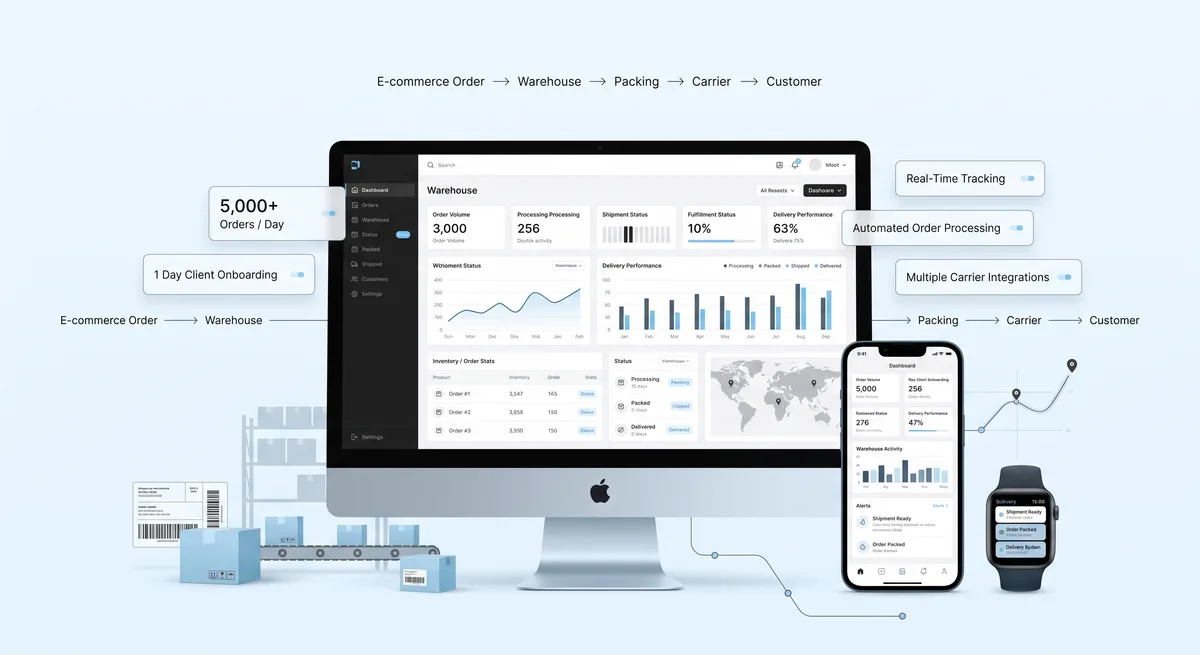
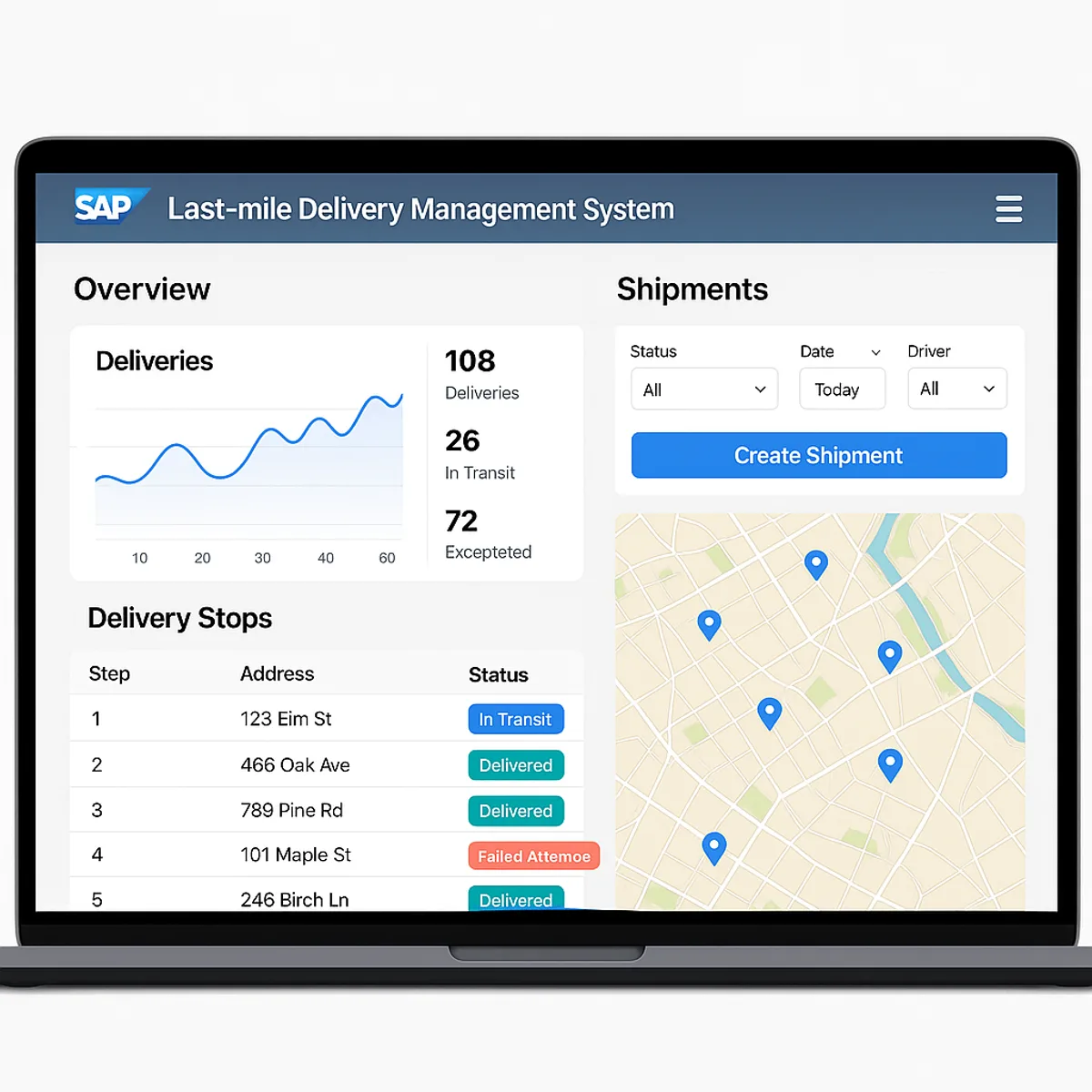
The end-to-end delivery process flows as follows: the consumer makes an order on the website; order information automatically goes to the system and is processed and forwarded to the warehouse; in the warehouse, the order is packed and forwarded to the post terminal; the post operator ships the order to the receiver's address (warehouse, physical shop, or consumer's house); throughout the journey, the client can see shipment status and share it with the end consumer.
Technology Stack & Implementation
Modern, Scalable Architecture
The solution was built on a robust technology foundation designed to handle high-volume operations and seamless integrations. Magento served as the core content management and warehousing platform, complemented by microservices architecture for flexible data processing. The technology stack included Kubernetes for container orchestration, Redis for caching and performance optimization, the Slim Framework for lightweight API development, and Google Cloud infrastructure for scalability and reliability. MySQL provided the database backbone, while APIs enabled third-party integrations with postal carriers and delivery services.
This technology choice is particularly well-suited for logistics operations, but the solution's architecture extends beyond this use case. The system is equally applicable to retail, e-commerce, or any industry requiring robust warehouse management, efficient order processing, and multi-client system integration.
Team & Timeline
Focused Development & Six-Month Delivery
The development effort was led by a focused, specialized team: two Magento developers handled the core platform and warehousing functionality, one DevOps engineer managed infrastructure and deployment, and one project manager coordinated execution. The initial minimum viable product (MVP) was delivered within six months, with the project continuing in an ongoing capacity to support new features, optimizations, and client-specific customizations.
Results
Measurable Impact & Operational Excellence
The solution has strong potential: the system is capable of processing thousands of orders from each customer per day, with capacity limited only by warehouse staff availability. When customers integrate the system with their e-commerce sites, it automatically receives orders and starts processing.
The developed solution helped stabilize the entire order receiving and processing system. Administrators can now set up dashboards individually for each customer, onboard new customers faster, and automate onboarding and order processing. All business processes run smoother and faster, resulting in better customer satisfaction. Client onboarding accelerated from two months to one day, order processing became fully automated, and visibility throughout the delivery chain became real-time and accessible to all stakeholders. These improvements translate directly into business value: faster time-to-revenue for new clients, reduced operational errors, better capacity utilization, and significantly enhanced customer satisfaction.
Conclusion
Strategic Foundation for Sustainable Growth
The transformation of FM Logistic's last-mile delivery operations demonstrates how strategic technology implementation can fundamentally reshape a business struggling to scale. By moving from fragmented, manual workflows to an integrated, automated platform, FM Logistic didn't simply solve immediate operational pain points—they built the infrastructure necessary to grow without proportional increases in operational complexity or cost.
The system's ability to process thousands of orders per day per customer, limited only by warehouse staffing capacity rather than technological constraints, positions FM Logistic to pursue aggressive growth without rebuilding infrastructure. This scalability extends to new clients as well—adding a customer who processes 5,000 orders daily no longer requires months of integration work, but rather a streamlined one-day onboarding process. The platform's flexibility and microservices architecture enable FM Logistic to adapt quickly to new client requirements and market demands without rearchitecting core systems.
For 3PL operators and other businesses facing similar challenges with order management, warehousing, and logistics coordination, this case study illustrates a proven blueprint: select technology partners with deep domain expertise, invest in modern, scalable infrastructure, and prioritize automation and integration as core design principles. The result is not just operational efficiency, but competitive advantage and a platform for sustainable growth.


Our success stories









































Tell us about your project needs